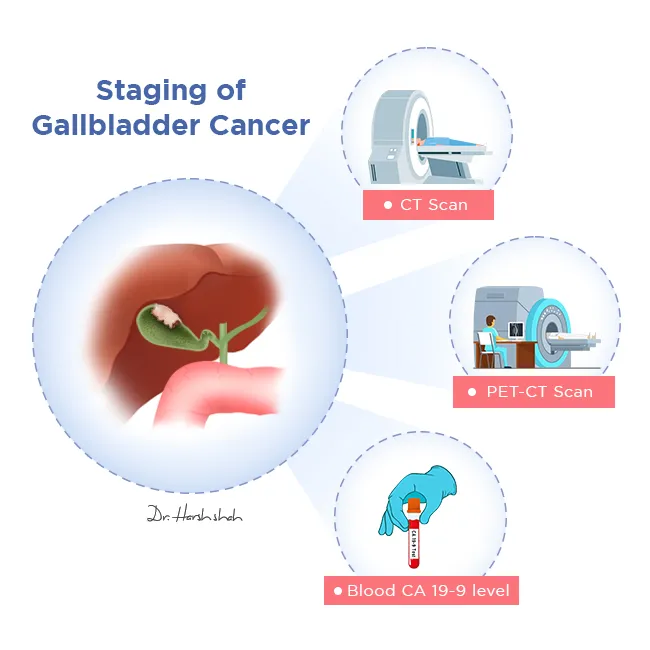
Gallbladder cancer typically progresses through several stages, which are determined based on the extent of the cancer’s spread. The staging system commonly used for gallbladder cancer is the TNM system, which considers the size and extent of the tumor (T), the involvement of lymph nodes (N), and the presence of distant metastasis (M).
The stages are usually denoted by Roman numerals from 0 to IV, with higher numbers indicating more advanced disease. Keep in mind that specific details may vary, and it’s crucial to consult with a healthcare professional for accurate information. Here’s a general overview:
Stage 0 (Tis, N0, M0):
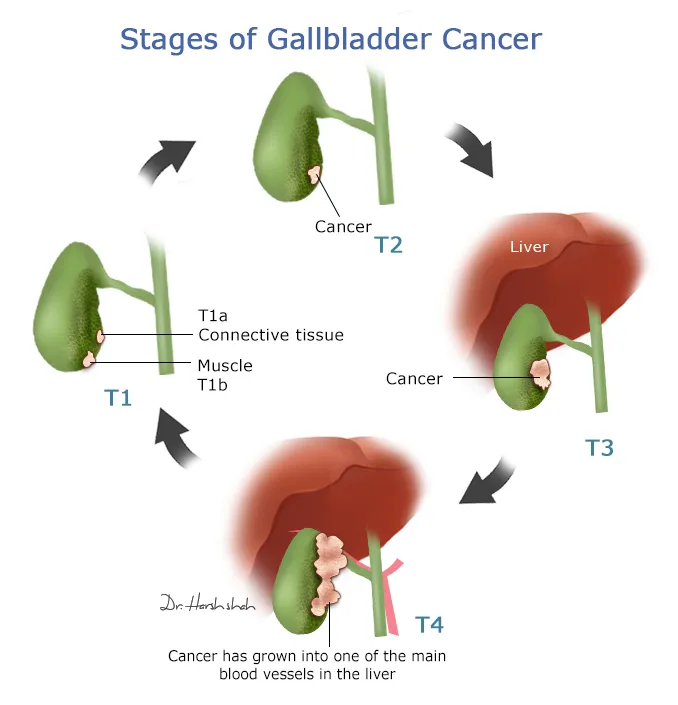
• Cancer is confined to the innermost layer of the gallbladder wall.
• No spread to nearby lymph nodes or distant organs.
Stage I (T1, N0, M0):
• Cancer has invaded the connective tissue beneath the inner layer of the gallbladder wall.
• No involvement of nearby lymph nodes or distant organs.
Stage II (T2, N0, M0):
• Cancer has spread to the muscle layer or the outer third of the gallbladder wall.
• No lymph node involvement or distant metastasis.
Stage III (T3, N0, M0):
• Cancer has invaded nearby structures, such as the liver, stomach, intestine, or main blood vessels.
• No lymph node involvement or distant metastasis.
Stage IV (Any T, N1 or N2, M0 or M1):
• Cancer has spread beyond the gallbladder to nearby lymph nodes (N1 or N2).
⦿ Stage IVA: No distant metastasis.
⦿ Stage IVB: Distant metastasis has occurred, involving organs or distant lymph nodes.