

Shah's Gastro, Cancer & Robotic Surgery Centre · Ahmedabad & Gandhinagar
A cancer in the body or tail of the pancreas has no jaundice to announce it. Apollo Hospital, Bhat, Gandhinagar · Gota OPD, Ahmedabad.
A cancer in the body or tail of the pancreas is removed by a distal pancreatectomy, with the spleen in the same specimen, because the lymph nodes along the splenic artery and vein are part of the field the operation must clear. Whether the operation is offered at all is decided on one scan — a pancreatic-protocol CT — and in many of these patients on a staging laparoscopy done first, because these tumours have a habit of having already seeded the lining of the abdomen. What decides the plan is the tumour’s relationship to the arteries behind the pancreas, not the size of the lump.
Shah’s Gastro, Cancer & Robotic Surgery Centre. The training here is in surgical gastroenterology as a super-specialty — the pancreas, liver, stomach, food pipe and bowel are the whole of the practice. In this disease the commonest serious error is not a technical one in theatre: it is operating on someone whose cancer had already declared itself elsewhere, and not operating on someone whose scan looked worse than the tumour was.
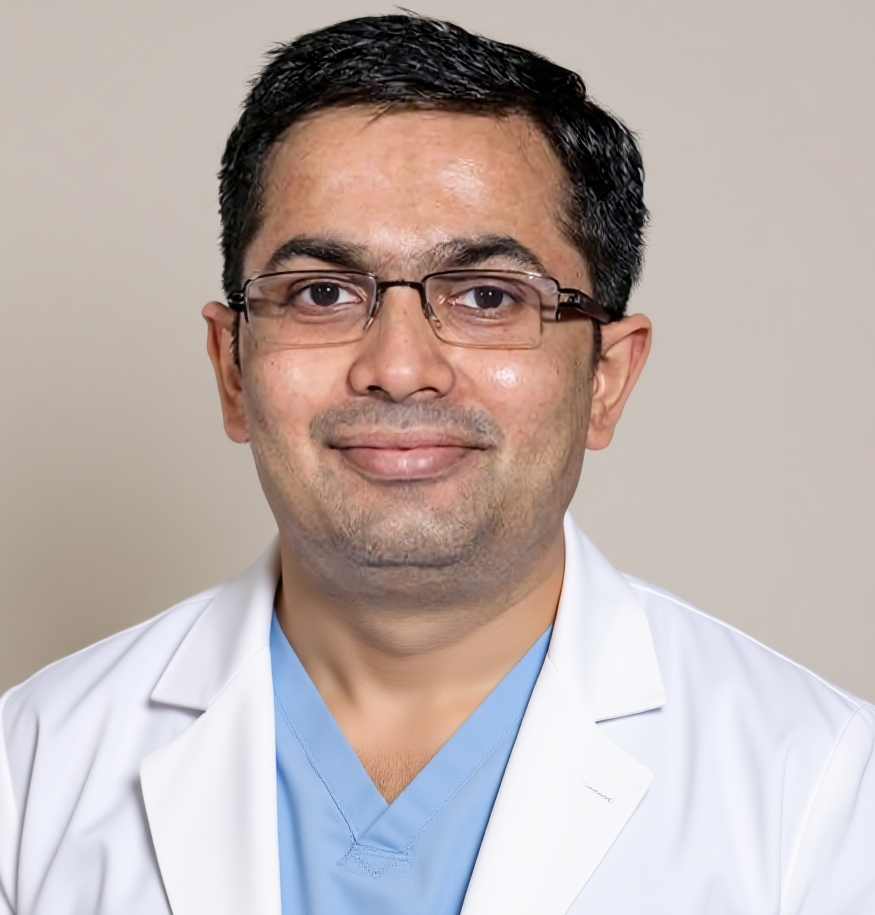
Dr Harsh Shah
MS, MCh (Surgical Gastroenterology), DrNB (Surgical Gastroenterology)
Registered with Gujarat Medical Council, Reg. No. G-38738
Pancreas Cancer Surgeon · Apollo Hospital, Bhat, Gandhinagar · Gota OPD, Ahmedabad
Google rating 4.89 from 216 reviews at the Gota clinic, and 4.94 from 17 reviews at Apollo, Bhat.
Every pancreatic cancer seen here goes to a tumour board before a plan is offered, and whether a tumour is removable is treated as a board judgement on the images rather than one reader’s opinion. The surgeon who reads the CT with the radiologist is the surgeon who operates.
Dr Harsh Shah performs the resection himself, first cut to closure, in a fixed team — the same consultant anaesthetist, the same assisting surgeon, the same theatre staff for every pancreatic case. Where the operation is robotic he is at the console and a second consultant surgeon is at the table throughout. Ask it in those words: who makes the cut, who is at the console, and is the person who consented me in theatre throughout.
The risk figure that belongs in a consent discussion is the operating unit’s own, not one copied from a published series.
A cancer in the head of the pancreas blocks the bile duct and turns the patient yellow, and that yellowness is an early alarm that brings people in. A cancer in the body or tail blocks nothing. It gives a dull upper abdominal pain boring through to the back that eases on leaning forward, weight loss with no appetite, or a diabetes appearing for the first time after middle age in someone also losing weight — each easy to attribute to something else for months.
That one fact drives the rest. These cancers are found later, more are touching the arteries behind the gland by the time anyone looks, and more have reached the lining of the abdomen. It is also why the marker is more useful here: a high CA 19-9 in a head cancer may simply reflect the jaundice, whereas here the bilirubin is usually normal, so the marker means what it says from the first blood test. An unprovoked clot in a leg vein, or pale greasy stool hard to flush, are the other presentations worth naming.
The test that decides whether a body or tail pancreatic cancer can be removed is a pancreatic-protocol CT: thin slices, timed in two phases so the arteries and then the veins are each full of contrast when photographed. A general abdominal CT does not answer the question it is being asked, and when a patient arrives with one it is repeated rather than argued over — that repeat is a different examination, not a second opinion about the radiologist.
The report must state in words the tumour’s contact with three arteries — coeliac axis, superior mesenteric, common hepatic — and with the vein behind the pancreas: whether there is contact, whether it wraps less than half way round or further, and whether the vein’s outline is deformed or blocked. Those sentences, not the size of the mass, decide the operation. Tissue is taken by endoscopic ultrasound where chemotherapy is planned, and germline genetic testing is offered to every patient — an inherited fault changes which chemotherapy works and has consequences for the family that nobody else will raise.
In a body or tail cancer a short laparoscopy is often done before committing to the resection: a camera, a look at the liver surface and the lining of the abdomen, and a sample of the fluid. It is done in this group because deposits too small for any scan are found often enough to matter, and finding one through a camera spares a patient a major operation that would not have helped.
A high marker with a normal bilirubin, a large tumour, or an uncertain shadow on the CT each make that look worth doing. If it is clean the resection proceeds in the same anaesthetic. If a deposit is found the abdomen is closed and treatment becomes systemic, with histology from that deposit in hand and no weeks lost recovering from an operation that achieved nothing. Both endings are explained beforehand.
The body and tail of the pancreas are removed together with the spleen in one piece. The spleen is not diseased; it goes because the splenic artery and vein run behind the pancreas to reach it and the nodes on those vessels are part of the territory this cancer drains into. Leaving the spleen means leaving those nodes — a smaller operation and a worse cancer operation.
The specimen is judged against a clear rim of normal tissue of at least a millimetre, measured rather than estimated, with each margin reported separately: clear at the cut edge of the gland but not at the back of it is a different situation from the reverse. The node dissection is the standard field — more than that adds complications without adding survival. Where the plane looks close, the edge is checked under the microscope while the patient is asleep.
Two variants exist and neither is a first suggestion. A tumour reaching the coeliac axis can sometimes still be cleared by taking that artery with the specimen, offered only after a board discussion. Where disease runs the length of the gland the whole pancreas must come out, meaning brittle diabetes and lifelong enzyme capsules — a conversation had before the operation, not after it.
| What the scan shows | What is planned | What the patient is told |
|---|---|---|
| No contact with the coeliac axis, superior mesenteric or hepatic artery; vein clear or barely touched, outline normal | Staging laparoscopy, then distal pancreatectomy with en-bloc splenectomy, then chemotherapy | Surgery first; chemotherapy afterwards is part of the plan |
| Contact wrapping less than half way round the coeliac axis or superior mesenteric artery, or a deformed vein that can be repaired | Chemotherapy first, then a fresh CT and a repeat marker, then reconsider the operation | Not inoperable. The order is changed so the operation is likelier to clear the tumour |
| Contact wrapping more than half way round the superior mesenteric artery or coeliac axis, or a vein blocked beyond repair | Chemotherapy, re-staged after some months; a proportion become operable | An operation now would leave tumour behind. A reassessment with a date, not a refusal |
| Deposits in the liver, on the peritoneum, or in nodes outside the field — on the scan or at laparoscopy | Systemic treatment, enzyme replacement, nutrition support and early palliative care in parallel | Surgery would shorten rather than lengthen life; what is offered instead is named |
Where the tumour touches an artery without encircling it, chemotherapy comes first and the operation is reconsidered after. Two reasons, and the second is rarely explained: treatment first raises the chance of removing the tumour completely, and it lets the disease show its own behaviour — a cancer that spreads during those months was never going to be cured by an operation.
The trap at re-staging is the CT itself: treated tumour and scar look much alike, so a mass unchanged in size may be substantially dead. A patient whose marker has fallen and who is eating and walking better is explored even when the pictures look static. Where there are deposits elsewhere the honest answer is given directly, and what is offered instead is named: chemotherapy chosen by fitness and by the genetic result, enzyme capsules with every meal, a dietitian from the start, attention to clotting risk, and for back pain that will not settle a nerve block through an endoscope.
The questions that matter are about the scan, the order of treatment and the unit’s own results. The hardest decision to reverse here is an operation agreed on an inadequate CT, so the first questions are about the images, not about the surgeon.
A second opinion is worth taking at two moments: before treatment begins, when the question is whether the tumour is removable and in what order, and after chemotherapy, when the question is whether a scan that looks unchanged is hiding a tumour that has responded. Both are hard to undo, and both turn on images rather than opinions — so bring the CT and MRI images on a disc or drive, not the report alone, with the endoscopy and biopsy reports, the marker and the bilirubin from the same sample, current medicines, and the chemotherapy record with cycles completed.
★★★★★
“(Translated by Google) In my opinion, Dr. Harsh Shah is the best pancreatic cancer specialist in Ahmedabad. He has operated on my mother who was suffering from neuroendocrine tumor of pancreas. The operation called distal pancreatectomy was done. Now my mother is fine and we are being discharged today. I would say that we have been given the best treatment for pancreatic cancer. Thanks to all the staff of the hospital. I would highly recommend Dr. Harsh Shah for any treatment for pancreatic cancer.”
— Darji Monika, Google review
★★★★★
“Met with Dr. Harsh Shah for the consultation of one of my relative. Dr. Harsh Shah is an exceptional surgical oncologist in Ahmedabad. His expertise in treating complex GI cancers like liver, pancreas, and colon cancers is truly remarkable. He explains everything clearly and gives patients full confidence in their treatment. Highly recommended for anyone looking for a skilled and compassionate cancer specialist.”
— Nagesh Patidar, Google review
★★★★★
“I’ve had personal experience with Dr. Harsh Shah. He’s a very knowledgeable and experienced Gastro Surgeon. He’ll explain you all the symptoms patiently and suggest the best route possible at a reasonable cost. He also works towards educating society on the different diseases related to Liver and Pancreas.”
— Brijesh Nandani, Google review
Reviews are reproduced exactly as written on Google, including the original spelling and spacing.
Three things change permanently and all three are manageable, provided they are set up before discharge rather than discovered at home. The gland left behind may not make enough digestive enzyme, so capsules are taken with every meal and snack — swallowed during the food, not before or after, which is the commonest reason they get blamed for not working. The body and tail hold a large share of the gland’s insulin-producing tissue, so diabetes may appear or worsen, and it goes home with a written plan and a named person to call. And the spleen has gone, so vaccination and a written rule about a fever belong in the discharge papers.
Weight matters most in the first year: falling weight in someone on enzyme capsules almost always means the dose is too low rather than that the cancer is back. Follow-up is three-monthly for two years with symptoms, weight, the marker and blood tests, scans at intervals, and a review of the enzyme dose and the diabetes at every single visit.
There is no single figure. The estimate moves with the room category, the length of stay, whether the operation is open or minimally invasive, whether intensive care is needed, and whether chemotherapy falls inside the same episode. A written estimate is given before admission, and the office states what is inside it and what is not.
Apollo Hospital, Bhat, is empanelled with the major insurers and cashless schemes, and the office handles pre-authorisation directly. Three costs are regularly forgotten: enzyme capsules, taken with every meal indefinitely; the chemotherapy that follows; and glucose monitoring. Bring imaging on a disc or drive, discharge summaries, medicines with doses, the insurance card, and one family member as the point of contact.
Because the splenic artery and vein run behind the pancreas to reach the spleen, and the lymph nodes on those vessels are part of the area this cancer drains into. It is a decision about clearing the cancer, not about the spleen being diseased.
Not always. Some tumours called inoperable are treated with chemotherapy and become removable at re-staging. Ask on what scan and by which criteria the word was used.
Within a couple of months, which is why recovery is pushed along rather than allowed to drift.
No. It means the needle did not find cancer, not that there is none. Where the scan and the story point to a cancer, a clearly removable tumour is operated on without waiting for a positive biopsy; tissue is insisted on before chemotherapy.
A distal pancreatectomy can be done open or by a minimally invasive approach — laparoscopic or robotic. Which is right depends on where the tumour sits against the arteries behind the gland and whether the plane behind it is clean, so it is decided after the CT rather than promised at the first visit, and converted to open without hesitation if that gives the better specimen.
Shah’s Gastro, Cancer & Robotic Surgery Centre — Gota, Ahmedabad
Consultations, review of CT and biopsy reports, second opinions, surveillance.
Google: Dr Harsh Shah · 4.89 from 216 reviews
Directions to the Gota clinic
Apollo Hospital — Bhat, Gandhinagar
Admission, surgery and inpatient care.
Google: Dr Harsh Shah – Robotic GI Surgeon · 4.94 from 17 reviews
Directions to Apollo, Bhat
Patients travel to Ahmedabad for pancreatic cancer surgery from across Gujarat, southern Rajasthan and western Madhya Pradesh. Send the CT images ahead so the scan is read before you travel.
More on Dr Harsh Shah’s work in GI cancer: pancreatic cancer treatment · liver cancer treatment · stomach cancer treatment.
Swasth Parivar: twice a month, practical advice on recovery, diet and warning signs. No advertising. Stop any time.
Your number is used for these updates and for the clinic to reach you. It is never sold or passed on. To stop, reply STOP on WhatsApp.