


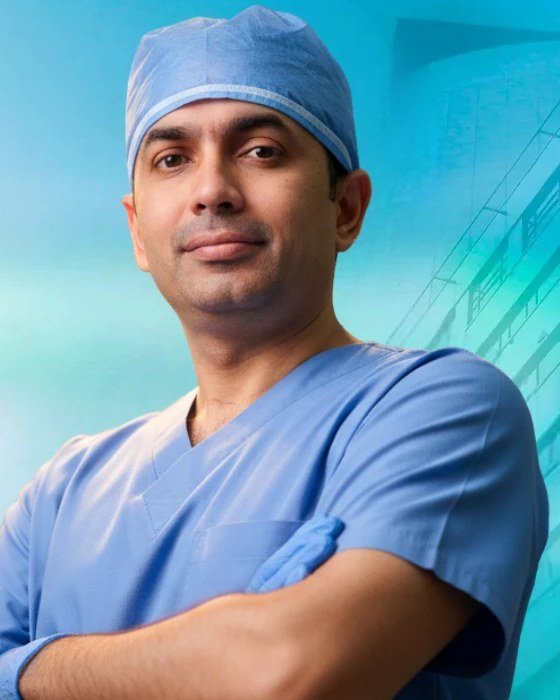
MS, MCh (Surgical Gastroenterology), DrNB (Surgical Gastroenterology)
Registered with Gujarat Medical Council, Reg. No. G-38738
Gastro & Cancer Surgeon · Apollo Hospital, Bhat, Gandhinagar · Gota OPD, Ahmedabad
18 years of experience in GI and cancer surgery
In short
A surgical oncologist is a cancer surgeon. After surgical training they train further to remove tumours, with the nearby lymph nodes, by operation.
A medical oncologist treats cancer with medicines: chemotherapy, targeted therapy and immunotherapy. They usually lead treatment when the cancer has spread.
Many patients need both, and often a radiation oncologist as well. The three specialists agree the order of treatment together, for each patient.
A surgical oncologist removes cancer by operation. That is the short answer, and it is the one most patients need first.
Their work starts before the operation. A cancer surgeon reads the scan, the endoscopy and the biopsy report, examines you, and decides whether the tumour can be removed completely and safely. If it can, they plan which operation, by which approach, and what else must be removed with it, such as the nearby lymph nodes. If it cannot be removed yet, they say so plainly, and the plan turns to treatment that may shrink it first.
After the operation, the surgeon reads the final biopsy report of what was removed. That report often decides whether more treatment is needed. The surgeon then hands over to, or works alongside, the medical oncologist.
Most cancer surgeons work on one region of the body. Dr Harsh Shah operates on cancers of the digestive system: the food pipe, stomach, colon, rectum, liver, pancreas, gallbladder and the lining of the abdomen.
A medical oncologist treats cancer with medicines. These include chemotherapy, targeted therapy and immunotherapy.
They often give treatment before an operation to shrink a tumour, or after it to lower the chance of the cancer coming back. When a cancer has spread to several organs, medicines are usually the main treatment, and the medical oncologist leads the care. They also look after side effects and the long follow-up that comes with these medicines.
A radiation oncologist treats cancer with carefully aimed radiation. For some cancers of the digestive system, radiation is combined with chemotherapy before the operation. For others it is not needed at all. Your surgeon will tell you if you need to meet one.
See a cancer surgeon first if a report shows a growth in an organ and nobody has yet told you whether it can be removed.
Because for some cancers the operation comes first, and for others it should not. The order depends on the organ, the stage of the cancer and your general health.
In food pipe, stomach and rectal cancer, chemotherapy or chemoradiation is often given before the operation, so the tumour is smaller and easier to remove completely. In many colon cancers the operation comes first. In pancreatic cancer, chemotherapy after the operation is common. These are general patterns, not rules for your case. The order for you is decided after your reports are reviewed together by the specialists, not by one doctor alone.
This is why it helps to meet a cancer surgeon early, even when the first treatment turns out to be medicines. The surgeon can then judge, at the right time, whether the tumour has become removable.
| Surgical oncologist | Medical oncologist | Radiation oncologist | |
|---|---|---|---|
| Main treatment | Operation to remove the tumour and nearby lymph nodes | Chemotherapy, targeted therapy, immunotherapy | Radiation therapy |
| Training | Surgical degree, then super-speciality surgical training | Medicine degree, then oncology training | Radiation oncology training |
| Often seen first when | A growth may be removable and nobody has yet said whether it is | Cancer has spread widely, or a blood cancer is suspected | Radiation is the main treatment, or is planned before surgery |
| Where you meet them | OPD, then the operation theatre and ward | OPD and the chemotherapy day-care unit | OPD and the radiation unit |
Dr Harsh Shah is a surgical oncologist for cancers of the digestive system. He sees patients at his Gota OPD in Ahmedabad and operates at Apollo Hospital, Bhat, Gandhinagar. When chemotherapy or radiation is needed, before or after the operation, he plans it with the medical and radiation oncologists. Read more about him on the surgical oncologist (cancer surgeon) in Ahmedabad page.
Other cancer surgeons in the same practice: Dr Swati Shah, MS, DrNB (Surgical Oncology), for kidney, bladder, prostate and testis cancers, for cancers of the uterus, ovary and cervix, and for hysterectomy; and Dr Swapnil Sharma, MS, FMAS, DrNB (Surgical Oncology), for breast cancer surgery.
Yes. A second opinion from a cancer surgeon is reasonable before any major operation, and before you decide that an operation is not possible. Bring the plan you were given, with every report and scan. Often a second opinion confirms the plan you already have, and that is a useful answer in itself.
Swasth Parivar: every week, practical advice on recovery, diet and warning signs. No advertising. Stop any time.
Your number is used for these updates and for the clinic to reach you. It is never sold or passed on. To stop, reply STOP on WhatsApp.