

Shah's Gastro, Cancer & Robotic Surgery Centre · Ahmedabad & Gandhinagar
When the cancer sits high, the question is not how much to take but how safely to rebuild. Apollo Hospital, Bhat · Gota OPD, Ahmedabad.
A cancer in the upper stomach — at the cardia, the fundus or the upper body — is usually treated by total gastrectomy: the whole stomach comes out with the fan of tissue and lymph nodes that drains it, and the food pipe is joined directly to the small bowel. The reason the whole organ goes is margin, not greed. What decides how well you live afterwards is not how much stomach was removed but the quality of the new join between oesophagus and jejunum, and the eating pattern you are taught before you leave hospital.
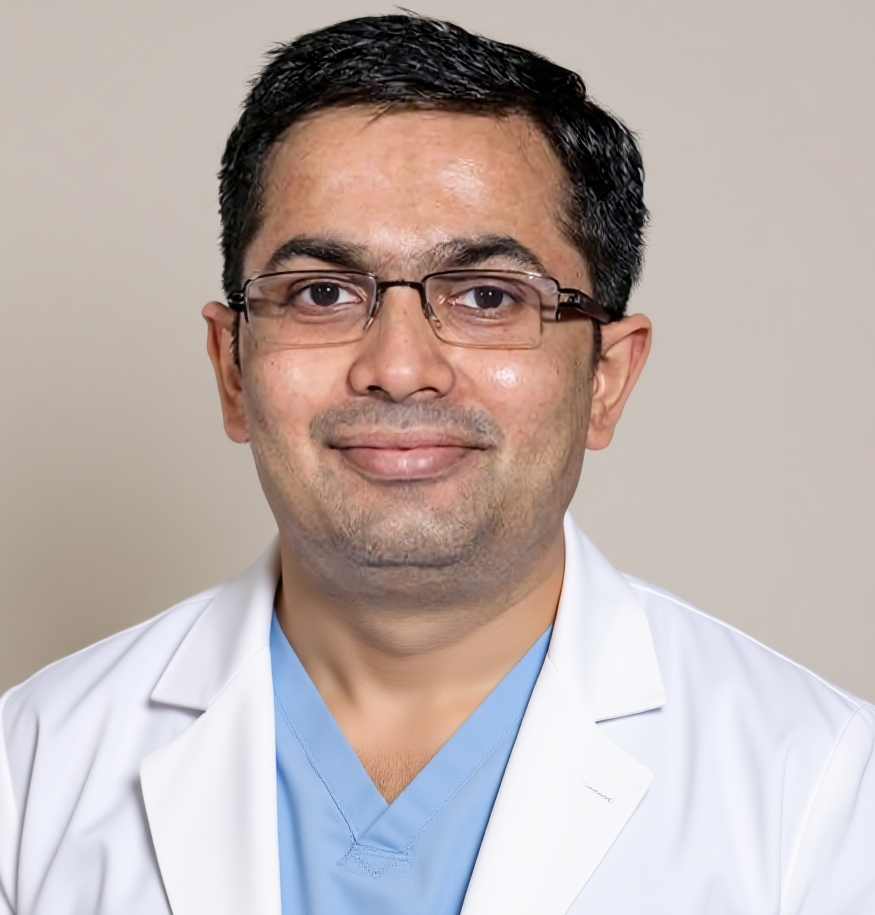
Shah’s Gastro, Cancer & Robotic Surgery Centre. The training here is in surgical gastroenterology as a super-specialty — the stomach, food pipe, bowel, liver and pancreas are the whole practice rather than a part of it. In a proximal gastric cancer the mistake that costs most is not made with the instrument: it is made when the margin is judged by feel instead of frozen section, and found weeks later on a report, when nothing can be put back.
Dr Harsh Shah
MS, MCh (Surgical Gastroenterology), DrNB (Surgical Gastroenterology)
Stomach Cancer Surgeon · Apollo Hospital, Bhat, Gandhinagar · Gota OPD, Ahmedabad
Google rating 4.89 from 216 reviews at the Gota clinic, and 4.94 from 17 reviews at Apollo, Bhat.
Every stomach cancer seen here goes to a tumour board before a plan is offered. That is where the endoscopy, the scan, the nutritional state and the biology of the tumour are argued together, and where the order of treatment is settled.
The stomach is not a uniform bag. A tumour near the outlet can be taken with the lower two-thirds and normal stomach left above it. A tumour at the cardia or upper body has almost nothing above it but the junction with the food pipe, so the clearance a distal cancer gets cannot be found without taking the organ entire.
The clearance this operation is held to is at least five centimetres of visibly normal stomach beyond the growth, and wider where the tumour is of the diffuse or signet-ring type. Where there is doubt at the upper end the margin goes for frozen section while the patient is still on the table, and the resection is extended if the report says so.
The second reason is the behaviour of the tumour rather than its position. Diffuse and linitis-type cancers infiltrate within the wall, under a lining that looks normal at endoscopy for centimetres beyond the last visible abnormality. A surgeon who saves a cuff of stomach there is accepting a risk he cannot measure.
Four things are established before an operation is offered. A plan built on fewer is built on assumption.
One: tissue. An upper GI endoscopy with biopsies confirms the cancer, records how far up the growth reaches, and gives the pathologist material to type it — intestinal or diffuse — and to test HER2 and mismatch-repair status, both of which change the drug treatment.
Two: extent. A contrast CT of the chest, abdomen and pelvis maps the tumour against the vessels, the nodes, and any disease in the liver or beyond. It decides whether an operation is the right first move at all.
Three: the peritoneum. A staging laparoscopy — a short keyhole look inside, usually as a day procedure — finds the fine peritoneal deposits a CT scan is known to miss, and finding them beforehand spares a patient an operation that would not have helped.
Four: the patient. Haemoglobin, albumin, iron and B12 are corrected, not merely noted. A patient who comes to this operation anaemic and undernourished has a harder recovery than the same patient three weeks later.
Where the scans show a bulky tumour or involved nodes, chemotherapy commonly comes first. That is decided at the tumour board and is not a sign the cancer is inoperable — it is how a modern gastric cancer is treated.
The operation has three parts. Removing the stomach is the straightforward one; clearing the nodes and rebuilding the food pathway are where it is won or lost.
The resection. The whole stomach is taken with the omentum, the line above placed on the lower food pipe beyond the growth, the duodenum divided just past the pylorus and closed. The specimen leaves the abdomen in one piece with its node fan attached, because a field pulled apart on the table cannot be mapped afterwards.
The node dissection. A D2 dissection takes the nodes along the greater and lesser curves with the specimen, then clears the second tier — along the left gastric, common hepatic and splenic arteries and around the coeliac axis — as a deliberate separate step. The standard it is held to is a specimen in which the pathologist can count at least fifteen nodes: not a score, but the only evidence afterwards that the field was actually cleared.
The reconstruction. The small bowel is brought up and joined to the lower food pipe, with a limb of jejunum arranged so bile and pancreatic juice enter well downstream instead of washing back onto the new join. That Roux-en-Y arrangement is what prevents the relentless bile reflux older reconstructions were known for.
| Where the cancer sits | What is removed | What that means for you |
|---|---|---|
| Cardia or gastro-oesophageal junction | Whole stomach and a cuff of lower food pipe, with the node field | The join sits higher; swallowing is watched closely early on |
| Fundus or upper body | Whole stomach with the node field | The standard total gastrectomy and its standard recovery |
| Diffuse or linitis type, any level | Whole stomach, wider margins, frozen section at both ends | A larger operation for a tumour that may look small — deliberately so |
| Tumour adherent to spleen or pancreatic tail | Stomach plus the adherent organ, in one piece | A bigger operation, decided in theatre, consented for in advance |
The spleen is not removed as a routine, and neither is the tail of the pancreas. Doing so to clear the splenic hilar nodes was once taught and is no longer good practice: it adds serious risk without adding benefit. The spleen comes out only where the tumour has actually grown into it or into the pancreatic tail — decided with the abdomen open, in front of the finding, not on a scan.
Patients arrive having read that keyhole and robotic surgery are better, and are surprised to hear a total gastrectomy is often done open. The honest position is narrower than the marketing on either side.
The evidence that a minimally invasive approach gives the same clearance with an easier recovery is strongest for cancers of the lower stomach, where the operation is a distal gastrectomy. For a total gastrectomy — particularly a bulky tumour, one growing through the wall, or one operated after chemotherapy — the approach is chosen on the anatomy in front of the surgeon, and open surgery is frequently correct rather than a concession.
What does not change with the approach is the operation: the same margins, the same node field, the same reconstruction. A keyhole total gastrectomy that clears less is not a lesser-invasive operation, it is a lesser operation — and converting, or starting open, is judgement rather than failure.
The oesophagojejunal anastomosis — the join between food pipe and small bowel — determines the first fortnight. It sits high in the abdomen, on a food pipe with no serosal coat to hold stitches the way bowel does — which is why it is watched so closely.
A drain is not routine after a distal gastrectomy; after a total gastrectomy it often is — not to treat a leak but to reveal one early. A drain turning turbid, or carrying enteric fluid on the third to seventh day, is the earliest honest warning a team gets.
The rules around that join are deliberately unforgiving. A sustained pulse above a hundred and twenty, new or worsening pain, a fever, or a change in what the drain carries is treated as a leak until a scan proves otherwise: nil by mouth, intravenous fluids, a CT with oral contrast, and the consultant surgeon informed at once. Nothing on that list is watched overnight to see how it looks in the morning.
The feeding jejunostomy. In selected patients a fine tube is placed into the small bowel at the end of the operation, well below the new join. It is not a sign that something went wrong — it is nutrition insurance, letting feeding begin gently on the first day while the join is protected, and it matters most after chemotherapy or in an undernourished patient. It is flushed with warm water, never forced, and comes out once eating is established.
★★★★★
“My father has carcinoma of stomach ,Harsh sir did radical gastrectomy and he is recovering very nicely under Dr.Harsh's observation ,he listen each and every complain calmly and with patience and make patient very comfortable during treatment , during procedure and during stay at hospital. we are satisfied with the treatment and very confident about the fully recovery of disease as we are under treatment of Dr.Harsh & team.Thank you Dr.Harsh & his whole team and staff.”
★★★★★
“We are very thankful to Dr. Harsh Shah for treating and operating on my father for gastric (stomach) cancer. From the first consultation to the surgery and follow-up, he guided us with great care and explained everything clearly. My father is doing well now, and we are extremely grateful for the treatment and support provided by Dr. Harsh Shah and his team. He is a highly experienced and compassionate doctor. We would definitely recommend Dr. Harsh Shah to anyone looking for an experienced doctor for stomach cancer treatment. Thank you, Doctor, for everything!”
★★★★★
“Dr. Harsh Shah operated me for stomach cancer. The surgery went very smoothly, and I am truly grateful for his expertise and care. Thank you so much, sir, for your support and excellent treatment. Highly recommended for anyone looking for the best stomach cancer surgeon.”
tina parmar · Google review
Moh. Ahsan · Google review
Maganbhai Parmar · Google review
Recovery follows a written pathway rather than the surgeon’s mood on the ward round. You sit out of bed the same evening and take sips of water; liquids and walking begin on day one, the catheter comes out, and any jejunostomy feed starts as a slow trickle. Soft diet follows over two or three days as the drip is weaned, and most patients are eating soft food and walking independently within the first week.
Discharge is by criteria, not by date: no fever for a full day, tolerating a soft diet, walking without help, comfortable on tablets, and — where a feeding tube is in place — a family confident with it.
The pathology report follows about a week later and decides the next phase: type and depth, whether both margins are clear, nodes examined and involved, HER2 and mismatch-repair. Whether chemotherapy is needed afterwards is answered from that report at the tumour board, not from the scan taken before the operation.
Surveillance afterwards is regular and dull, which is the intention: wound and histology review at about two weeks with a dietitian, three-monthly checks with weight, blood counts and tumour markers for two years, six-monthly to five years, and CT six-monthly for two years then annually.
This is the part of the consultation that deserves most time and usually gets least. Living without a stomach is entirely possible and many people do it well — but the pattern of eating changes permanently, and nobody should learn that for the first time at home.
The rule is small meals, often — six or more a day rather than three — eaten slowly, with fluids between meals rather than with them. Most people lose some weight in the first months and then settle. A dietitian is part of this pathway from the two-week visit onwards, not an extra for those who struggle.
Two problems are common enough to be planned for rather than reacted to. Dumping — light-headedness, sweating, palpitations or cramping soon after eating — happens because food reaches the small bowel without the stomach’s braking action, and responds to smaller portions, less sugar and separating drinks from solids. Bile reflux is the other, and preventing it is exactly what the Roux-en-Y limb is for.
Vitamin B12 is not negotiable. The stomach makes the factor that lets B12 be absorbed, so after a total gastrectomy it cannot be taken from food or tablets. It is injected roughly every three months for the rest of your life — not for a year, and not until you feel well. Iron is replaced from blood counts, and bone density is worth assessing later.
These are the questions that change what happens to you.
A second opinion is worth taking when the plan you have been given is a major resection, when one surgeon calls the tumour inoperable and another does not, or when nobody has told you the case went to a tumour board. Ask also who will actually operate — the named consultant or a trainee — and, if the operation is robotic, who is at the console.
Has my case been to a tumour board, and what did it recommend? · Is chemotherapy planned before the operation, and why? · Will the whole stomach come out, and what makes that necessary in my case? · Will the margins be checked by frozen section, and a D2 dissection done? · Is my spleen coming out, and if so, why? · Open or minimally invasive, and what would make you change during it? · Will a feeding tube be placed? · Who do I call at night in the first week after discharge?
The complications are named in full before consent, in the language you are most comfortable in: leak at the new join, the duodenal stump, delayed emptying, dumping, bile reflux, an internal hernia years later, long-term B12 and iron deficiency, and the risk to life itself. The figures attached to each depend on your age, fitness and nutrition — which is why they belong across a desk and not on a web page.
One. Book your consultation. Bring the endoscopy and biopsy reports, slides, and any CT on a disc.
Two. The workup is completed — staging CT, a staging laparoscopy where indicated, bloods, and nutrition corrected.
Three. Your case goes to the tumour board and a written plan comes back with the treatment order set out.
Four. Admission and surgery at Apollo Hospital, Bhat, the recovery pathway explained to your family beforehand.
Five. Histology review at about two weeks with the dietitian, the adjuvant decision, and the five-year surveillance schedule.
There is no single figure, and any page that gives you one is guessing. The cost turns on length of stay, room category, the approach used, intensive care, and what the adjuvant plan requires. The office prepares a written estimate before admission, so you compare a document rather than a conversation.
Cashless admission is arranged where your policy allows it, and the pre-authorisation paperwork is prepared by the office rather than left to you. Ask what the estimate excludes, and who your point of contact is if hospital and insurer disagree.
Yes, with a changed eating pattern: small frequent meals, fluids between meals rather than with them, and lifelong B12 injections. Most people return to work and ordinary life; what does not return is the large meal at one sitting.
Because a cancer high in the stomach leaves too little normal tissue above it for a safe margin, and a diffuse-type cancer spreads further within the wall than it appears to. Where a remnant can safely be left, it is.
Not routinely. It is removed only where the tumour has grown into the spleen or the tail of the pancreas. Removing it as a matter of course to clear nodes is no longer accepted practice.
Shah’s Gastro, Cancer & Robotic Surgery Centre — Gota, Ahmedabad
Consultation, review of endoscopy, biopsy and CT reports, second opinions, surveillance.
Google: Dr Harsh Shah · 4.89 from 216 reviews
Directions to the Gota clinic
Apollo Hospital — Bhat, Gandhinagar
Admission, surgery and inpatient care.
Google: Dr Harsh Shah – Robotic GI Surgeon · 4.94 from 17 reviews
Directions to Apollo, Bhat
Patients travel for stomach cancer surgery from across Gujarat, southern Rajasthan and western Madhya Pradesh. Send the endoscopy and CT reports ahead.
More on Dr Harsh Shah’s work in GI cancer: stomach cancer treatment · food pipe cancer treatment · recent advances in stomach cancer · stomach cancer case reports · HIPEC for peritoneal disease.
Swasth Parivar: twice a month, practical advice on recovery, diet and warning signs. No advertising. Stop any time.
Your number is used for these updates and for the clinic to reach you. It is never sold or passed on. To stop, reply STOP on WhatsApp.
