
Apollo Hospital, Bhat, Gandhinagar · Gota OPD, Ahmedabad
In hepatocellular carcinoma the operation is decided by two things at once, never one: what the tumour is doing, and what the rest of the liver can still withstand. Dr Harsh Shah assesses both before offering a liver resection, because a tumour that looks removable on a scan is not removable if the liver around it is failing.
Dr Harsh Shah is a Liver Cancer Surgeon practising at Apollo Hospital, Bhat, Gandhinagar, with consultation at Gota, Ahmedabad.
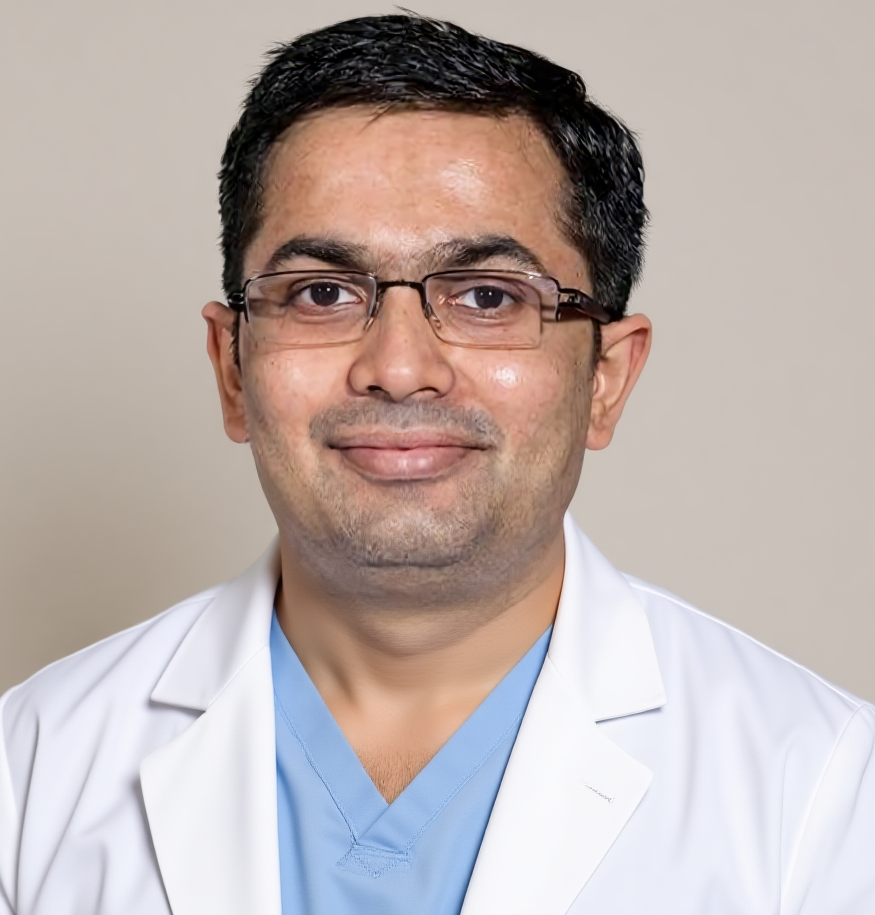
Dr Harsh Shah
MS, MCh (Surgical Gastroenterology), DrNB (Surgical Gastroenterology)
Registered with Gujarat Medical Council, Reg. No. G-38738
Liver Cancer Surgeon
Apollo Hospital, Bhat, Gandhinagar · Gota OPD, Ahmedabad
Trained in surgical gastroenterology through both a MCh and a DrNB, operating on the liver, pancreas, food pipe, stomach and intestines by open, laparoscopic and robotic approaches. Google rating 4.89 from 216 reviews at the Gota clinic.
Shah’s Gastro, Cancer & Robotic Surgery Centre exists for one kind of problem: abdominal cancers where the operation is the difficult part of the decision. Liver cancer is the clearest example in the whole of gastrointestinal surgery.
Hepatocellular carcinoma is a cancer that arises from the liver’s own cells, and in most patients it grows in a liver that is already scarred by long-standing disease.
That second half of the sentence is what makes this cancer different from every other one Dr Harsh Shah treats. A colon cancer grows in a healthy colon. A hepatocellular carcinoma usually grows in a liver damaged by hepatitis B, hepatitis C, alcohol, or the fatty liver disease that has become so common in Ahmedabad and across India. So there are two diseases in the abdomen, not one, and both of them decide what can be done.
It also means the diagnosis is often made without a biopsy. In a liver that is already cirrhotic, a nodule above a centimetre that lights up in the arterial phase of a multiphase CT or MRI and then washes out on the later phases is diagnostic on the imaging alone. A biopsy is reserved for the cases where the pattern is atypical, where the liver is not cirrhotic, or where the diagnosis genuinely remains in doubt — because a needle through a liver tumour carries a small risk of seeding the track.
Most hepatocellular carcinoma should be found on surveillance rather than on symptoms. Anyone with cirrhosis of any cause, and some people with hepatitis B who have not yet developed cirrhosis, should be having an ultrasound every six months. A tumour found that way is far more often operable than one found because it began to hurt.
A liver resection removes the part of the liver containing the tumour together with the territory of blood vessels that feeds it, leaving behind enough working liver for the patient to recover.
Where it can be done, Dr Harsh Shah prefers an anatomical resection — taking the segment or segments the tumour’s own portal vein branch supplies, rather than simply cutting around the lump. The reason is that hepatocellular carcinoma spreads along those small vessels, so removing the territory removes disease that is not yet visible. Where liver function is marginal, that principle gives way to a parenchyma-sparing resection, because preserving working liver becomes more important than the extra margin.
The judgement that matters most is how much liver will be left. A normal liver tolerates having a large proportion removed; a cirrhotic liver needs considerably more left behind, and volumetry on the CT is measured before any major hepatectomy rather than estimated in theatre. When the remnant would be too small, the operation is not simply abandoned: the portal vein branch to the side being removed can be blocked off some weeks earlier, which makes the side that will remain grow.
Minimally invasive liver surgery — laparoscopic or robotic — is now endorsed in the international guidelines rather than merely tolerated, and it suits peripheral and left-sided tumours particularly well. In a cirrhotic patient the advantage is real and not cosmetic: less disturbance of the abdominal wall means less ascites afterwards. Which approach is used on a given liver is decided by where the tumour sits, not by preference.
Intra-operative ultrasound is used in every case. It changes the operation more often than surgeons expect, finding a second nodule or clarifying the relationship to a vein that the pre-operative scan had not settled.
Three things are weighed together — how much tumour there is, how well the liver is working, and how fit the patient is — and the answer is sometimes that a transplant, not a resection, is the better cancer operation.
The framework used internationally links each stage to a treatment rather than only to a prognosis, and it is the one Dr Harsh Shah works within. What it looks like in practice:
| What the imaging and the liver show | What is usually considered first |
|---|---|
| A single small tumour, liver working well, no significant portal hypertension | Resection, or ablation for the smallest lesions |
| A single tumour or a small number of small ones, liver function preserved or mildly impaired | Resection, ablation, or assessment for transplant |
| Several tumours, still confined to the liver, patient well | Treatment delivered through the artery feeding the tumours; transplant for some after the disease is brought back within criteria |
| Tumour growing into the main veins, or disease outside the liver | Drug treatment given by a medical oncologist |
| Liver function severely impaired | Supportive care, and transplant assessment where the patient is otherwise a candidate |
Two measurements do most of the work in that table. The first is a score combining bilirubin, albumin, clotting and the presence of ascites or confusion, which grades how well the liver is functioning. The second is portal hypertension — the back-pressure in the veins draining the gut, judged from the platelet count, the spleen, and the varices seen at endoscopy. Significant portal hypertension is the practical reason a major resection is turned down in a patient whose tumour would otherwise be straightforward to remove.
The conversation about transplant happens early or it does not happen. A transplant is the only treatment that deals with the tumour and the diseased liver at the same time, and for a patient whose tumour is within the accepted size and number criteria it can be the better cancer operation even when a resection is technically possible. In Indian practice the route is usually a living donor, because waiting for a deceased donor is long and unpredictable. The commonest reason a patient in this country misses a transplant is that they were referred too late, not that they were ineligible. That is why Dr Harsh Shah raises it at the first consultation rather than after a resection has recurred.
Every case is discussed at a multidisciplinary meeting before treatment starts. Hepatocellular carcinoma is the gastrointestinal cancer where a decision taken by one specialty alone does the most harm, because the liver physician, the radiologist, the interventional radiologist, the medical oncologist and the surgeon each hold part of the answer.
A second opinion is worth taking whenever the plan offered is either an operation you were not expecting or no operation at all, and it usually confirms rather than overturns the first plan.
Specific situations where Dr Harsh Shah thinks another look is reasonable: when you have been told the tumour is inoperable without volumetry having been done or portal vein embolisation having been discussed; when a transplant has not been mentioned at all and your tumour is small; when repeated rounds of treatment through the artery are being offered after the first two produced no response; and when an adjuvant immunotherapy is being proposed after a resection, because the trial that first suggested a benefit did not sustain it on longer follow-up and that is no longer standard practice outside a study.
Bring the actual images rather than only the reports. A multiphase CT or MRI can be reread; a report cannot.
Ask how much liver will be left, who will be operating, and what the plan is if the liver does not cope afterwards.
The last two matter more in this disease than in most. Treating the underlying liver disease is not an afterthought to the cancer operation — suppressing hepatitis B, curing hepatitis C, stopping alcohol with real support, managing the metabolic causes: each changes what happens years later, independently of the tumour. And because the whole liver remains at risk rather than just the part that was removed, surveillance imaging continues for life. A new tumour found early is often still treatable, which is the entire reason follow-up is not optional.
★★★★★
“Dr. Harsh Shah is the best robotic surgeon I have come across. He performed my surgery with great skill and care. Thanks to him, I am now back to my routine life. He is undoubtedly the best liver cancer surgeon in Ahmedabad. Highly recommended.. SATISH RANINGA Ex.Director Human rights Co.New Delhi.”
★★★★★
“Met with Dr. Harsh Shah for the consultation of one of my relative. Dr. Harsh Shah is an exceptional surgical oncologist in Ahmedabad. His expertise in treating complex GI cancers like liver, pancreas, and colon cancers is truly remarkable. He explains everything clearly and gives patients full confidence in their treatment. Highly recommended for anyone looking for a skilled and compassionate cancer specialist.”
★★★★★
“Dr harsh sir is a good doctor for Liver, Gastro & Cancer Surgeon in Ahmedabad thanks sir.”
These are Google reviews from Dr Harsh Shah’s own listings, reproduced as their authors wrote them.
A written estimate is given before admission, not after, and liver cancer surgery is covered by most Indian health insurance policies and by CGHS.
What moves an estimate for a liver resection: how much liver is being removed and therefore how long the operation takes; whether the approach is open, laparoscopic or robotic; whether a portal vein embolisation is needed beforehand as a separate procedure; the room category chosen; and how long the stay turns out to be, which in a cirrhotic patient is less predictable than in a healthy liver.
The coordinator at Apollo Hospital handles pre-authorisation and cashless approval with the insurer or the TPA before admission. Robotic consumables are treated differently by different insurers, and the position on yours is explained before you are admitted rather than discovered at discharge. Bring your policy documents, the insurance card, photo identification, all previous scans on a disc or drive, the list of medicines you currently take, and the reports of any hepatitis treatment you have had.
Often yes, but it depends on how well the cirrhotic liver is functioning and whether there is significant back-pressure in the portal vein. A small tumour in a well-compensated cirrhotic liver is frequently resectable. The same tumour in a liver that is already producing ascites or jaundice is not, and in that situation a transplant assessment or a non-surgical treatment is the better path.
For some patients, yes, because a transplant treats the cirrhosis as well as the cancer, and the remaining liver is where a new tumour would otherwise appear. It depends on the size and number of tumours, on your liver function, and in India on whether a suitable living donor is available. It is worth raising at the first consultation rather than later.
No treatment given routinely after a successful resection has been shown to keep the cancer away. An immunotherapy combination looked promising in a trial, but the benefit was not sustained when the same patients were followed for longer, and international guidance was revised accordingly. Careful surveillance, not drug treatment, is the standard after surgery — outside a clinical trial.
Recurrence is common in this disease and you should be told so plainly, because the cause is that the whole liver is at risk, not merely the part that was removed. That is exactly why surveillance scanning continues for life and why treating the underlying hepatitis, alcohol or fatty liver disease matters as much as the operation did. A new tumour picked up early on a surveillance scan is often still treatable.
Yes, and for tumours in the peripheral and left-sided parts of the liver it is often the better choice, with less ascites and fewer wound problems afterwards, which matters particularly in cirrhosis. Large tumours, those sitting against the major veins, and those needing a major hepatectomy may still be safer open. The approach is chosen for the tumour, not the other way round.
A few days after an uncomplicated keyhole resection, and longer after a major hepatectomy or where the liver is cirrhotic. Discharge is not decided by the calendar but by whether you are eating and walking and, above all, whether your bilirubin and clotting are improving rather than worsening.
Consultation at Gota. Surgery at Apollo, Bhat, Gandhinagar.
Send your scans and reports on WhatsApp and Dr Harsh Shah will tell you whether an operation is the right conversation to be having. WhatsApp the reports Call +91 63555 64601
Swasth Parivar: twice a month, practical advice on recovery, diet and warning signs. No advertising. Stop any time.
Your number is used for these updates and for the clinic to reach you. It is never sold or passed on. To stop, reply STOP on WhatsApp.