
Shah's Gastro, Cancer & Robotic Surgery Centre · Ahmedabad & Gandhinagar
Hereditary GI cancer surgeon in Ahmedabad · Gota OPD, Ahmedabad · Apollo Hospital, Bhat, Gandhinagar
Last updated: 12-Oct-2026
When a cancer is inherited, the operation changes. It is often larger than the cancer alone needs, or it is done before any cancer appears.
This page is for people told they carry Lynch syndrome, a polyposis syndrome or a CDH1 change, and for their families. It explains how Dr Harsh Shah and the tumour board decide how much to remove and when. It covers what changes that decision, when a second opinion helps, and what to ask before you sign. It does not try to explain each syndrome in full.
The extent of surgery is decided at a tumour board that includes genetics. Dr Harsh Shah explains the choice to you, and then performs the operation himself.
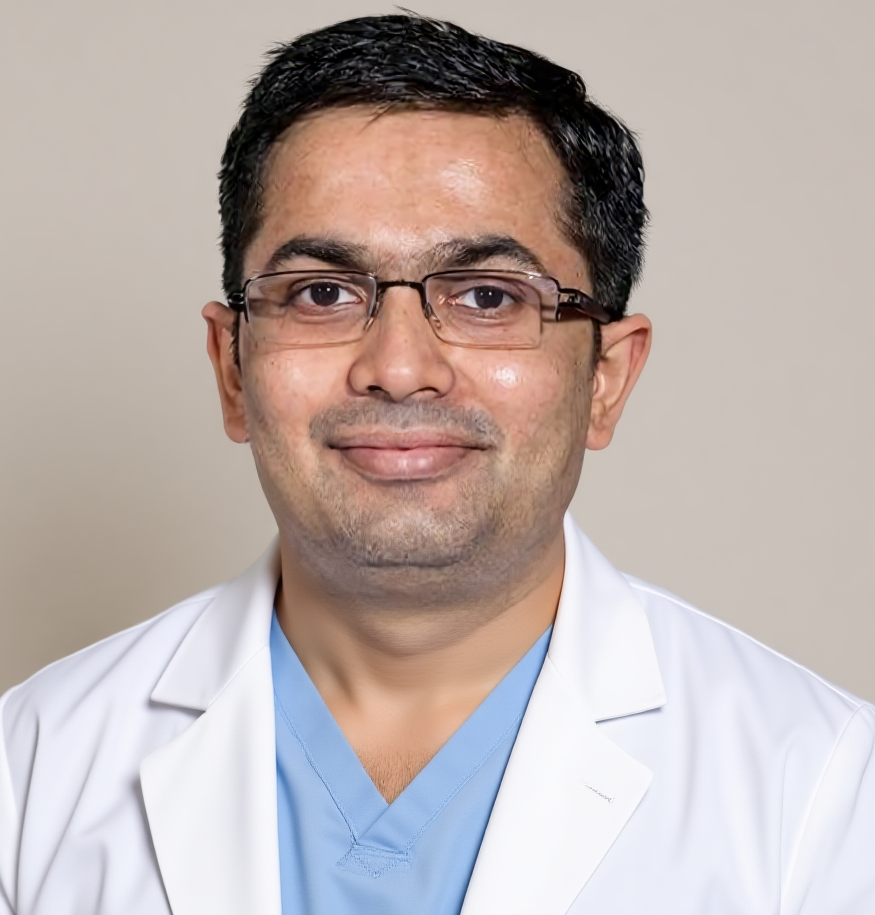
Shah’s Gastro, Cancer & Robotic Surgery Centre. He trained in super-specialty surgical gastroenterology and is qualified twice over in that field. He has 18 years of experience in GI and cancer surgery. Colon, rectal and stomach operations are part of his daily work. The same surgeon sees you from the first visit to the last follow-up.
Dr Harsh Shah
MS, MCh (Surgical Gastroenterology), DrNB (Surgical Gastroenterology)
Registered with Gujarat Medical Council, Reg. No. G-38738
Gastro & Cancer Surgeon · Apollo Hospital, Bhat, Gandhinagar · Gota OPD, Ahmedabad
Google rating 4.89 from 216 reviews at the Gota clinic, and 4.94 from 18 reviews at Apollo, Bhat.
Every patient with a confirmed or suspected syndrome is discussed before cancer surgery. So is every plan for risk-reducing surgery. The surgeon, the cancer physician, the radiologist, the pathologist and the genetics counsellor read the same reports. A gene result that is not clearly harmful, called a variant of uncertain significance, is never a reason to operate. Dr Shah then sits with you and your family. He names the operation, explains why it was chosen, and tells you what the other choices were.
Every colon and rectal cancer is tested for MMR or MSI. A three-generation family history is taken. Either can point to an inherited cause before the plan is fixed.
| Finding | What it may point to |
|---|---|
| Bowel or womb cancer at a young age, or a MMR-deficient tumour. | Lynch syndrome. |
| Many adenoma polyps in the colon over time. | FAP, attenuated FAP or MUTYH polyposis. |
| Dark freckles on the lips, and small bowel polyps or intussusception in a young person. | Peutz-Jeghers syndrome. |
| Diffuse or signet-ring stomach cancer at a young age, or in more than one relative. | Hereditary diffuse gastric cancer (CDH1). |
| Several juvenile polyps, with a family history. | Juvenile polyposis. |
The syndrome, the exact gene, your age and your wishes decide the extent. The table shows the choices the protocol gives for each syndrome.
| Syndrome | The choices discussed |
|---|---|
| Lynch, with a colon cancer. | Removal of most or all of the colon, joining the small bowel to the rectum. Or removal of the affected segment, with colonoscopy for life. |
| Lynch, with a rectal cancer. | Removal of the colon and rectum. Or removal of the rectum, with checks of the remaining colon. |
| FAP or attenuated FAP. | Removal of the colon with the rectum kept. Or removal of colon and rectum with an internal pouch. |
| MUTYH polyposis. | As for attenuated FAP, guided by the number of polyps. |
| Peutz-Jeghers. | Polyps removed with a scope, during surgery if needed. Bowel is saved at every operation. |
| CDH1 change (hereditary diffuse gastric cancer). | Removal of the whole stomach as a preventive step. Close scope checks are a weaker alternative. |
| Juvenile polyposis. | Removal of the colon or stomach when polyps, bleeding or pre-cancer cannot be controlled. |
With Lynch syndrome, the colon left behind can grow a new cancer. So a larger operation is discussed. The final choice is shared between you and the surgeon.
The choice weighs two things. A larger operation lowers the chance of a new cancer in the colon. A smaller one keeps more bowel and better function, but needs colonoscopy for life. The gene matters. A younger person with a MLH1 or MSH2 change leans towards the larger operation. An older person with a MSH6 or PMS2 change may reasonably choose the smaller one with regular checks. Your ability to keep up lifelong colonoscopy also counts.
For women with Lynch syndrome, the womb and ovaries carry a risk as high as the bowel, or higher. Removing them is discussed once the family is complete. It can be offered at the same operation as the bowel surgery, which avoids a second operation.
In FAP, the timing of the operation is set for each person. It depends on the number of polyps, any pre-cancer change and your life plans.
In classic FAP, the colon is usually removed in late teens or early adult life. In attenuated FAP, it can often wait. There are two operations. Removing the colon and keeping the rectum gives better bowel function. But the rectum needs checks for life and can still develop cancer. Removing the colon and rectum, with an internal pouch, removes that risk. Function is poorer, and in women it can reduce the chance of pregnancy. So that is discussed before surgery. The choice depends on polyps in the rectum, the site of the gene change, the risk of desmoid tumours, and your own wishes.
MUTYH polyposis is handled like attenuated FAP. It is inherited from both parents. Brothers and sisters may carry it, while children are usually only carriers. That changes the family conversation.
For CDH1 carriers, removing the whole stomach is recommended in early adult life. Scope checks can miss this cancer, because it spreads under the lining.
This is a major, life-changing operation in a young, well person. It is never rushed. It needs repeated talks, a dietitian before and after, and psychological support. If you decide to wait, close endoscopy with many biopsies at a specialist centre is the other choice. It is explained honestly as a weaker choice, not an equal one. Women carriers also need yearly breast MRI scans.
In Peutz-Jeghers syndrome, polyps can make the small bowel fold into itself. The aim at every operation is to remove polyps and keep as much bowel as possible.
Small bowel checks with a capsule camera or MRI find larger polyps early. These are removed with a long scope, before they cause a blockage. If an operation is needed, a scope is passed through the whole small bowel during surgery. All polyps are cleared at one sitting. This avoids cutting out bowel piece by piece over the years, which can leave too little bowel to live on.
The specific gene, your age, the polyps in the rectum, desmoid risk, plans for children and your ability to keep up lifelong checks can each change the operation.
| Factor | What it changes |
|---|---|
| The exact gene. | Higher-risk genes lean towards a larger operation and earlier checks. |
| Your age. | A younger person has more years of risk ahead. |
| Polyps in the rectum. | Many rectal polyps favour removing the rectum too. |
| Desmoid risk in FAP. | Surgery can trigger desmoid tumours. This affects timing and choice. |
| Plans for children. | A pouch can reduce fertility in women. It is discussed first. |
| A gene result of uncertain meaning. | No operation is based on it. |
| Lifelong checks. | If regular scopes are hard for you, a larger operation may suit you better. |
Preparation follows the operation’s own plan, with four additions: stoma siting, fertility counselling, nutrition before stomach removal, and support for operating on a well person.
The risks are those of the operation itself, plus some that come from the syndrome. The figures that fit you are given at the consent meeting, in person.
| Operation | Consequences named at consent |
|---|---|
| Removal of most of the colon. | Looser and more frequent stools. These usually settle over months. |
| Internal pouch. | Inflammation of the pouch, frequent stools, and lower fertility in women. |
| Colon removed, rectum kept. | Lifelong rectal checks. The rectum can still develop cancer. |
| Whole stomach removed. | Small, frequent meals for life. Vitamin B12 injections for life. Weight loss that may not fully return. Dumping. A lasting change in how you eat. |
| Any operation in FAP. | Upper GI scope checks for life. Desmoid tumours can develop after surgery. |
The general risks of a bowel or stomach operation are also named. They include bleeding, infection, a leak from the join, clots and the risk of dying.
★★★★★
“(Translated by Google) Dr. Harsh Shah's personality is very nice. He always talks in a good way. He has undergone surgery for colon cancer. Without any problem. Yours faithfully.🙏 (Original) ડૉ હર્ષ શાહ નો સ્વાભાવ ખૂબ જ સરસ છે.તેઓ હમેશા સારી રીત વાત કરે છે .મોટા આંતરડા ના કેન્સર ની સર્જરી એમને કરેલ લી છે. કોઈ પ્રકાર ની તકલીફ નાથી .આપનો અભર.🙏”
— Ismailbhai Shaikh, Google review
★★★★★
“Met with Dr. Harsh Shah for the consultation of one of my relative. Dr. Harsh Shah is an exceptional surgical oncologist in Ahmedabad. His expertise in treating complex GI cancers like liver, pancreas, and colon cancers is truly remarkable. He explains everything clearly and gives patients full confidence in their treatment. Highly recommended for anyone looking for a skilled and compassionate cancer specialist.”
— Nagesh Patidar, Google review
★★★★★
“My father has carcinoma of stomach ,Harsh sir did radical gastrectomy and he is recovering very nicely under Dr.Harsh's observation ,he listen each and every complain calmly and with patience and make patient very comfortable during treatment , during procedure and during stay at hospital. we are satisfied with the treatment and very confident about the fully recovery of disease as we are under treatment of Dr.Harsh & team.Thank you Dr.Harsh & his whole team and staff.”
— tina parmar, Google review
Reviews are reproduced exactly as written on Google. The first describes colon cancer surgery by Dr Harsh Shah, and the third a stomach cancer operation. None names an inherited syndrome.
A patient’s own account after a colon cancer operation by Dr Harsh Shah, recorded and shared with consent.
Finding a syndrome in one person can prevent cancer in many relatives. Much of the benefit lies in testing them, and it is the step most often missed.
Once your gene change is known, your children, brothers, sisters and parents can be offered a simple test for that one change. This costs far less than a full panel. The clinic gives you a written note to hand to relatives. A named person keeps track until each relative has been offered testing. Counselling also covers the chance of passing the change on, and options for planning a pregnancy.
A second opinion helps if the plan does not reflect the syndrome, or if a step that decides the operation was missed. It is worth taking before an operation that cannot be undone.
Bring the gene report, every scope report and photo, the biopsy and pathology reports, scans on a disc, and your family tree.
Surgery reduces risk but does not end checks. Each syndrome has its own lifelong plan, and the family testing plan runs alongside it.
| Syndrome | Checks that continue |
|---|---|
| Lynch. | Regular colonoscopy, timed by the gene. Women’s health review. Upper GI scope where advised. A talk about daily aspirin. |
| FAP. | Upper GI scope for life with a side-viewing scope. Checks of the rectum or pouch. Thyroid scan. |
| Attenuated FAP or MUTYH. | Regular colonoscopy and upper GI checks. |
| Peutz-Jeghers. | Small bowel, colon and stomach checks. Breast and pancreas checks. |
| CDH1, if the stomach is kept. | Close endoscopy with many biopsies. Yearly breast MRI in women. |
The cost depends on the operation, the approach, the days in hospital and the genetic tests. A written estimate is given before admission, and test costs are discussed early.
Testing the affected person first, then testing relatives for that single change, costs much less than testing everyone with a full panel. Apollo Hospital, Bhat, works with the major insurers and cashless schemes, and the office handles pre-authorisation. Bring your reports, your medicines with doses, the insurance card and identification.
Because the inherited change gives a high chance of new cancers in the bowel or stomach that remain. The aim is to prevent a future cancer, not only to treat the present one.
Sometimes, yes. It depends on the gene, your age and your ability to keep up lifelong scopes. The choice is shared, and it is written down.
An internal pouch can lower fertility in women. Keeping the rectum avoids that, but needs lifelong checks. This is discussed before any pouch operation.
That is the result the operation aims for. It means the cancer was prevented, not that the operation was wasted.
They should be offered testing for your specific gene change. The age to start depends on the syndrome, and a counsellor explains it.
No. Each syndrome has its own lifelong checks. In FAP, for example, upper GI scopes continue after the colon is removed.
Shah’s Gastro, Cancer & Robotic Surgery Centre — Gota, Ahmedabad
Consultations, review of gene and scope reports, follow-up and lifelong checks.
Google: Dr Harsh Shah · 4.89 from 216 reviews
Directions to the Gota clinic · +91-63555-64601
Apollo Hospital — Bhat, Gandhinagar
Apollo Hospital International Limited, Plot No. 1 A, GIDC Bhat Industrial Estate, Bhat, Gandhinagar.
Google: Dr Harsh Shah – Robotic GI Surgeon · 4.94 from 18 reviews
Directions to Apollo, Bhat · WhatsApp +91-63555-64601
Families come to Ahmedabad from across Gujarat — Gandhinagar, Mehsana, Banaskantha, Nadiad, Anand, Bhavnagar, Rajkot, Jamnagar and Kutch — and from southern Rajasthan and western Madhya Pradesh.
A gene report, a MMR result or a polyp count has changed the plan? The genetic test report, the colonoscopy and endoscopy reports with photos, the biopsy reports and a written family tree can be sent ahead of your appointment. That way the consultation starts with them already read. The decision is made at the consultation, after examination and the tumour board. Call +91-63555-64601 · Send the reports ahead on WhatsApp
Swasth Parivar: twice a month, practical advice on recovery, diet and warning signs. No advertising. Stop any time.
Your number is used for these updates and for the clinic to reach you. It is never sold or passed on. To stop, reply STOP on WhatsApp.