

Shah's Gastro, Cancer & Robotic Surgery Centre · Ahmedabad & Gandhinagar
The measurement that decides how much stomach stays, what changes it in theatre, and what to ask before you consent. Apollo Hospital, Bhat, Gandhinagar · Gota OPD, Ahmedabad.
For a cancer in the body of the stomach, the operation is decided by one measurement above all others — the distance from the upper edge of the tumour to the junction with the food pipe. Enough distance and a subtotal gastrectomy leaves you with a working stomach; too little and the correct operation is a total gastrectomy. Both carry a D2 lymph node dissection. This page is about how Dr Harsh Shah arrives at that decision, what would change it while you are still asleep, and what a patient choosing a surgeon should ask. For what stomach cancer is and how it behaves, read the condition page on stomach cancer treatment.
Shah’s Gastro, Cancer & Robotic Surgery Centre. Trained at the institutions that set the standard for gastrointestinal cancer surgery in India. Qualified in surgical gastroenterology specifically — a super-specialty training in the gastrointestinal tract, not general surgery with an interest in it. A practice built on the stomach, food pipe, pancreas and bowel, week after week.
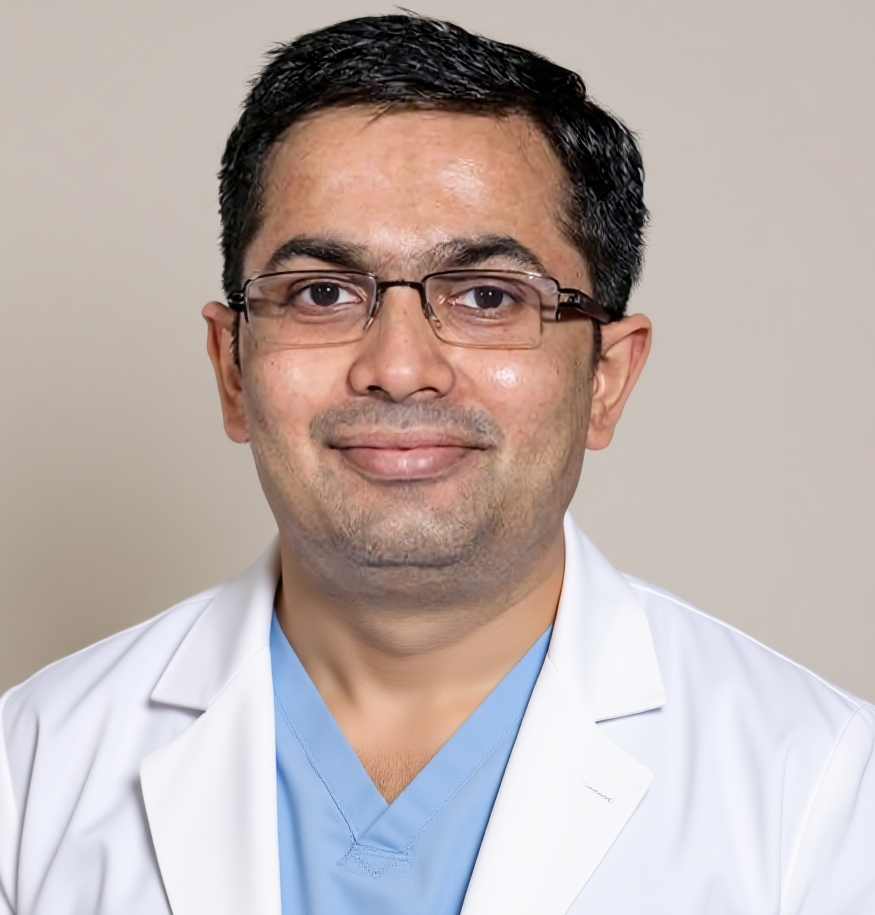
Dr Harsh Shah
MS, MCh (Surgical Gastroenterology), DrNB (Surgical Gastroenterology)
Stomach Cancer Surgeon · Apollo Hospital, Bhat, Gandhinagar · Gota OPD, Ahmedabad
Google rating 4.89 from 216 reviews at the Gota clinic, and 4.94 from 17 reviews at Apollo, Bhat.
The consultant who measures the margin is the consultant who makes the incision and the consultant who reads your histology report afterwards. For a body tumour that matters more than for most operations, because the extent of the resection can be revised during surgery — and the person revising it should be the person who explained to your family beforehand what would make him revise it.
The planned clearance above the tumour is at least five centimetres of grossly normal stomach for the intestinal type, and wider for the diffuse type, which spreads further through the wall than the eye can see. Whether that clearance is achievable while leaving a useful stomach behind is what separates a subtotal from a total gastrectomy.
A tumour low in the stomach almost always allows a subtotal gastrectomy and one at the top almost always requires a total; a tumour in the body sits between those answers, which is why two surgeons can read the same scan and propose different operations in good faith. The disagreement is almost never about judgement. It is about a measurement that was never made, or never written down.
An endoscopy report that says “ulceroproliferative growth in the body of the stomach” has not given the operating surgeon what he needs. An endoscopy report that records the distance in centimetres from the incisors to the upper edge of the tumour, and from the tumour to the gastro-oesophageal junction, has. Dr Harsh Shah will often ask for a repeat endoscopy for exactly this reason, and it is not duplication for its own sake — it is the difference between planning an operation and guessing at one.
| What is measured | What it decides |
|---|---|
| Distance from the upper edge of the tumour to the gastro-oesophageal junction | Whether a five-centimetre clearance still leaves enough upper stomach to be worth keeping. Comfortable distance means a subtotal gastrectomy; a short distance means a total |
| Histological type on the biopsy — intestinal or diffuse | The diffuse type travels submucosally beyond what is visible, so the planned margin is wider and the threshold for a total gastrectomy is lower. Linitis plastica is a total gastrectomy from the outset |
| Involvement of the greater curvature and the splenic hilum on CT | Whether the nodes along the splenic artery are in the field. It affects the extent of the node dissection, not by itself the extent of the stomach resection |
| Staging laparoscopy with peritoneal washings | Looks directly at the lining of the abdomen for deposits a CT cannot resolve. A positive washing moves the plan away from immediate surgery altogether, whatever the margin allows |
What that means in practice: you should leave the consultation able to say which operation is planned, what the measured distance was, and the one finding that would change the plan. If nobody has told you those three things, the conversation has not happened yet.
Where the margin is borderline, the cut edge is sent to the pathologist and examined under the microscope while the operation is still in progress. If it comes back involved, the resection is extended in the same sitting rather than discovered to be inadequate a week later on the final report.
This is the single most useful thing to understand about mid-stomach surgery, and it is rarely explained. A margin that looks and feels clear to the hand can still contain tumour cells at the edge under the microscope. A final histology report showing an involved margin — what surgeons call an R1 resection — changes everything that follows: it is one of the few situations in which radiotherapy is added after surgery, and it raises the chance of the cancer returning where it started.
So the plan for a body tumour is stated as a plan with a named branch. A subtotal gastrectomy is performed with the intention of a clear margin; the margin is checked; and the surgeon proceeds to a total gastrectomy in the same operation if the check demands it. Families should be told this before the consent form is signed, not afterwards, because it changes what recovery will look like and it must not arrive as a surprise in the recovery room.
A D2 lymph node dissection clears the nodes beside the stomach and the deeper stations along the left gastric, common hepatic and splenic arteries. The spleen and the tail of the pancreas are not removed as part of it. At least fifteen nodes must reach the pathologist, and more than twenty-five is the standard to aim for.
This matters specifically for a body or greater-curvature tumour, because the nodes at the splenic hilum lie in that drainage territory and removing the spleen with them was once accepted practice. It was abandoned for a good reason: it added infective and pancreatic complications without improving survival. The nodes in that territory are cleared with the spleen and the pancreatic tail left in place unless the tumour is directly invading them.
The node count on your histology report is the one number that describes the operation rather than the disease. A low yield means either a limited dissection or an incomplete specimen, and it makes the stage unreliable — which makes the decision about chemotherapy afterwards unreliable too. It is worth reading on your own report, and worth asking about.
A minimally invasive approach — laparoscopic or robotic — is established for a subtotal gastrectomy and gives the same node clearance and the same margins as open surgery, with less pain and an earlier discharge. For a bulky tumour, one growing through the stomach wall into a neighbouring structure, and for most total gastrectomies, the open approach remains the right operative judgement.
Dr Harsh Shah operates open, laparoscopically and robotically for stomach cancer. The position stated plainly: for a body tumour the approach follows the operation, and the operation follows the margin. Where the margin allows a subtotal gastrectomy, a minimally invasive approach is usually appropriate. Where the tumour is bulky or the correct operation is a total gastrectomy, open surgery is chosen on judgement — and a surgeon who tells you in advance what would make him open is telling you something useful about how he works.
The clearance of the cancer is what determines your outcome, and that clearance is the same across all three approaches when the operation is done properly. The difference between them is in recovery, not in cure.
For how the robotic platform is used across the rest of the gastrointestinal tract, and where it genuinely changes an operation, see robotic surgery.
For most body tumours that have grown into the muscle layer or involve lymph nodes, chemotherapy runs before surgery as well as after it. Surgery is performed four to six weeks after the last pre-operative cycle.
Chemotherapy first is not a delay and it is not a sign that the cancer is inoperable. It treats disease the scan cannot see, it shrinks the tumour so the margin is easier to achieve, and it tells the team something useful — how the cancer behaves under treatment. The sequence is decided at the tumour board before treatment begins, not adjusted case by case afterwards.
| Stage of the pathway | What happens, and why |
|---|---|
| Before chemotherapy | Endoscopy with measured distances and biopsy, CT of chest, abdomen and pelvis, PET where indicated, staging laparoscopy with washings where the CT is equivocal. Nutrition is assessed and corrected — a feeding jejunostomy is placed where the patient cannot eat, so that nutrition never becomes the reason chemotherapy is abandoned |
| Chemotherapy before surgery | A course of combination chemotherapy under the medical oncologist, with a scan afterwards to reassess. Weight, blood counts and fitness are tracked through it |
| Surgery | Four to six weeks after the last cycle. Subtotal or total gastrectomy with a D2 dissection, reconstruction, and frozen section where the margin is borderline |
| After surgery | Histology discussed at two weeks, including the margin and the node count. Chemotherapy resumes. Radiotherapy is added only where the dissection was limited or the margin involved — never routinely after a clean D2 |
A consent conversation for a gastrectomy should name every complication, state what would change the plan in theatre, and describe what daily life looks like afterwards — in writing, with your family in the room.
The complications that must be named to you, by name, are: bleeding needing a transfusion; infection at the operation site; a clot in the leg or in the lung; a cardiac event; a leak from the join between the stomach or food pipe and the bowel; a blowout of the duodenal stump; delayed emptying of the remaining stomach; dumping — weakness, sweating or palpitations after a sweet or milky meal; bile reflux; an internal hernia years later; and long-term vitamin B12 and iron deficiency. Conversion from a minimally invasive approach to open surgery is part of the same conversation. A risk of death is part of every consent for a major gastrectomy, and it is discussed with you personally rather than left on a form.
The individual figures against each of those are given to you in writing at the consent discussion, worked out for your age, your fitness, your body mass index, whether you have had abdominal surgery before, and whether you have had chemotherapy first. They are not published on a website, because a pooled average from a published series is not a prediction about you, and presenting one as though it were would be dishonest.
Six questions worth asking any surgeon before a gastrectomy for a body tumour:
A second opinion is most worth taking on a mid-stomach tumour when you have been told the whole stomach must come out, when you have been told the cancer cannot be operated on, or when two doctors have proposed different operations.
Bring the endoscopy report and, if you have them, the endoscopy images; the biopsy report naming the histological type; the CT films on a disc or a drive rather than only the typed report; any PET report; recent blood counts; a list of the medicines being taken; and a note of the weight at diagnosis and the weight today. That last one is not a formality — weight loss over time tells a surgeon something no single scan does.
★★★★★
“We are very thankful to Dr. Harsh Shah for treating and operating on my father for gastric (stomach) cancer. From the first consultation to the surgery and follow-up, he guided us with great care and explained everything clearly. My father is doing well now, and we are extremely grateful for the treatment and support provided by Dr. Harsh Shah and his team. He is a highly experienced and compassionate doctor. We would definitely recommend Dr. Harsh Shah to anyone looking for an experienced doctor for stomach cancer treatment. Thank you, Doctor, for everything!”
Moh. Ahsan — Google review, Dr Harsh Shah – Robotic GI Surgeon, Apollo Hospital, Bhat
★★★★★
“My father has carcinoma of stomach ,Harsh sir did radical gastrectomy and he is recovering very nicely under Dr.Harsh's observation ,he listen each and every complain calmly and with patience and make patient very comfortable during treatment , during procedure and during stay at hospital. we are satisfied with the treatment and very confident about the fully recovery of disease as we are under treatment of Dr.Harsh & team.Thank you Dr.Harsh & his whole team and staff.”
tina parmar — Google review, Dr Harsh Shah, Gota, Ahmedabad
★★★★★
“Dr Harsh shah's dedication and commitment to his patients health are commendable. He always provides comprehensive explanations and ensures that we understood our treatment plans.Dr harsh shah is best stomach cancer surgeon in Ahmedabad Gujarat. Thank u so much sir for all support and help.🙏”
Haresh Chavda — Google review, Dr Harsh Shah, Gota, Ahmedabad
These are unedited Google reviews from Dr Harsh Shah’s own listings, reproduced word for word, including the original spelling.
The cost of a gastrectomy is not one number. It moves with the operation performed, the approach used, the length of stay, the intensive care needed, and whether a feeding jejunostomy or a stent was required beforehand. A written estimate is given before admission.
What moves the estimate: subtotal against total gastrectomy; open, laparoscopic or robotic; the room category chosen; how many nights are needed; and whether a complication extends the stay. Chemotherapy before and after surgery is costed separately by the medical oncology team.
Apollo Hospital, Bhat is empanelled with the major insurers and with government schemes, and admissions are handled cashless wherever the policy allows. Pre-authorisation is applied for before admission and the office prepares that paperwork. Bring the policy document and card, photo identification, all previous reports and films, the current medicine list, and the name of a family member who will stay through the admission.
Not necessarily. For a tumour in the body of the stomach it depends on the distance from the tumour to the junction with the food pipe and on the histological type. Where a clearance of about five centimetres can be achieved and useful stomach remains above it, a subtotal gastrectomy is performed and part of the stomach stays.
You will eat, but the pattern changes permanently: smaller meals, more often, chewed well, with fluids kept a little apart from food. Most people settle into it within a few months with a dietitian's help. After a total gastrectomy the change is greater, and lifelong vitamin B12 is required.
Because for most tumours that have reached the muscle layer or the lymph nodes, treating before and after surgery does better than operating first. It also makes the margin easier to achieve and shows how the cancer responds to treatment.
Take a second opinion from a surgeon who operates on the stomach regularly, and take the CT films rather than only the report. Disagreement about a mid-stomach tumour usually turns on a measurement, and a measurement can be re-checked.
Shah’s Gastro, Cancer & Robotic Surgery Centre — Gota, Ahmedabad
Consultations, review of reports, follow-up and surveillance.
Google: Dr Harsh Shah · 4.89 from 216 reviews
Directions to the Gota clinic
Apollo Hospital — Bhat, Gandhinagar
Admission, surgery and inpatient care.
Google: Dr Harsh Shah – Robotic GI Surgeon · 4.94 from 17 reviews
Directions to Apollo, Bhat
Patients travel to Ahmedabad for stomach cancer surgery from across Gujarat — Gandhinagar, Mehsana, Nadiad, Anand, Bhavnagar, Rajkot, Jamnagar and Kutch — and from southern Rajasthan and western Madhya Pradesh. Send reports ahead on WhatsApp and the first visit can be a decision rather than a triage.
More on Dr Harsh Shah’s work in gastrointestinal cancer: stomach cancer treatment · food pipe cancer treatment.
Swasth Parivar: twice a month, practical advice on recovery, diet and warning signs. No advertising. Stop any time.
Your number is used for these updates and for the clinic to reach you. It is never sold or passed on. To stop, reply STOP on WhatsApp.
