

Shah's Gastro, Cancer & Robotic Surgery Centre · Ahmedabad & Gandhinagar
Primary GI lymphoma surgeon in Ahmedabad · Gota OPD, Ahmedabad · Apollo Hospital, Bhat, Gandhinagar
Lymphoma that starts in the stomach or the intestine is treated with medicines — antibiotics against H. pylori for many early stomach lymphomas, and chemotherapy, sometimes with radiotherapy, for the rest. An operation does not treat it. A surgeon is needed for four reasons only: to get tissue when endoscopy cannot, and to deal with a perforation, a bleed that will not stop, or a blockage that does not settle. When one of these happens, Dr Harsh Shah does the smallest operation that controls it, and hands you on to the haemato-oncologist without delay, because the chemotherapy is the treatment.
In lymphoma of the gut, the haemato-oncologist owns the disease. Dr Harsh Shah’s part is to say plainly when an operation is not needed, to get the tissue that makes the diagnosis when no other route can, and to operate himself, at Apollo Hospital, Bhat, when a perforation, a bleed or a blockage forces it.
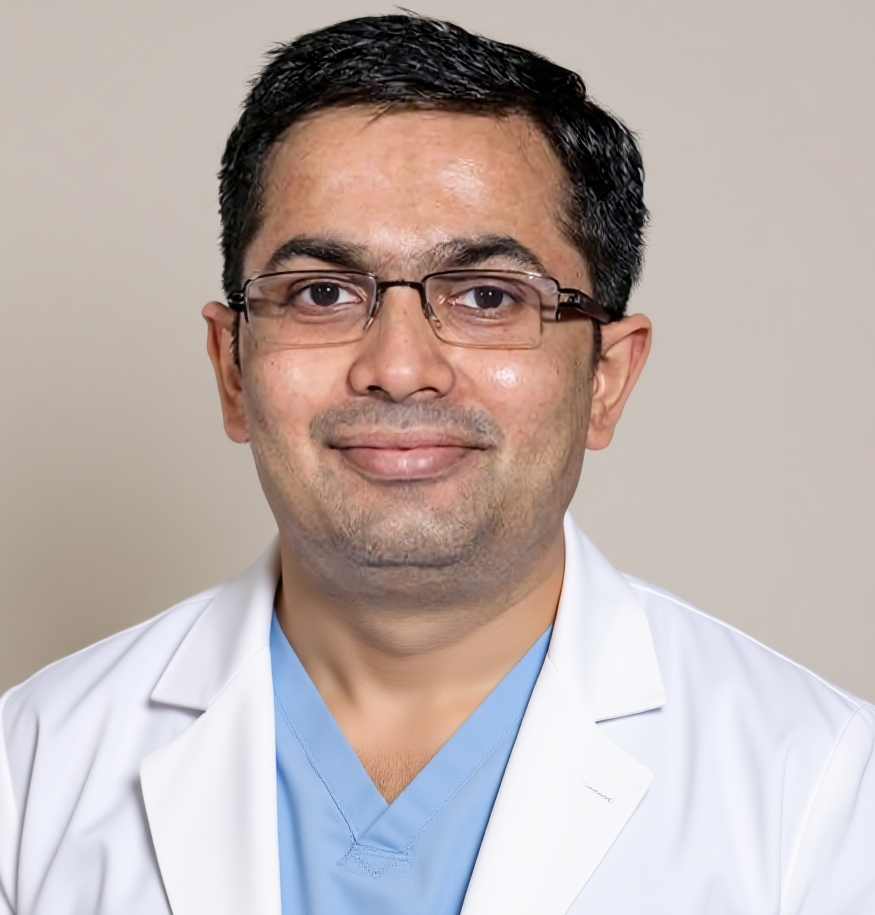
Shah’s Gastro, Cancer & Robotic Surgery Centre. Trained in super-specialty surgical gastroenterology programmes, qualified twice over in the specialty, with 18 years of experience in GI and cancer surgery. The practice treats emergencies of the stomach and intestine at Apollo Hospital, Bhat, and works with the haemato-oncology team from the first visit, so that an operation, when one is needed, is the start of treatment and not the whole of it.
Dr Harsh Shah
MS, MCh (Surgical Gastroenterology), DrNB (Surgical Gastroenterology)
Gastro & Cancer Surgeon · Apollo Hospital, Bhat, Gandhinagar · Gota OPD, Ahmedabad
Google rating 4.89 from 216 reviews at the Gota clinic, and 4.94 from 18 reviews at Apollo, Bhat.
This page is for the patient and family who have been told the word lymphoma, or who have been told a mass in the stomach or bowel “may be lymphoma”. It does not explain the types of lymphoma. It explains one decision: whether an operation has any part in your treatment, and how to tell whether an operation you have been offered is the right one.
Lymphoma is a cancer of the body’s immune cells. Even when it shows itself as one lump in the stomach or intestine, it behaves as a disease of the whole body, and it melts with chemotherapy. Removing the organ with a wide margin does not change how well it is controlled, so a radical cancer operation and a full lymph node clearance are never done for it.
This is the opposite of what happens with an ordinary stomach or bowel cancer, where the operation is the main treatment and the margin matters a great deal. That difference is why the diagnosis has to be certain before anyone plans a resection. A mass in the small intestine is still often removed straight away in Indian practice, on the assumption that it is a cancer that needs surgery; this practice does not do that. It operates on a suspected lymphoma only for tissue, or for a complication.
It also explains why lymphoma is staged with its own system, the Lugano staging, and not the TNM system used for stomach and bowel cancers. A report that labels a lymphoma with a TNM stage has quietly put the patient on a resection path that does not suit the disease.
Four situations bring a surgeon into the care of a gut lymphoma: no tissue diagnosis despite endoscopy, a perforation, bleeding that endoscopy and the radiology team cannot stop, and a complete blockage that does not open up. Each has its own smallest operation.
| Reason | What is done first | The operation, if one is needed |
|---|---|---|
| No diagnosis: endoscopy cannot reach the mass or its biopsies do not settle the type | Repeat endoscopy with deep, multiple, large biopsies; a snare biopsy of an abnormal fold if needed | A keyhole or open biopsy, with the tissue sent fresh to the haematopathologist |
| A perforation — a hole in the stomach or bowel — at diagnosis or during chemotherapy | Resuscitation, antibiotics and an urgent scan | Stomach: the hole is closed with stitches or a patch of omentum, or a small wedge is removed. Small bowel: the affected segment is removed and the ends are joined |
| Bleeding from the tumour | Resuscitation, then control through the endoscope, then blocking the bleeding vessel from inside by angioembolisation | Only if both fail: the narrowest operation — stitching the vessel, a small wedge, or a segment of bowel |
| Blockage of the bowel | If the diagnosis is known and the blockage is partial: a tube through the nose, a drip, and chemotherapy started — the tumour usually shrinks | Only for a complete blockage that does not settle: removal of the blocked segment, not a radical resection |
A larger operation, such as removing most or all of the stomach, is done only when a hole or a bleed cannot be controlled in any smaller way. If the patient is too unwell for a long operation, the surgeon controls the leak or the bleed, closes temporarily and moves the patient to intensive care, and the definitive step comes later. That is called damage control, and in a lymphoma it is often the safest choice.
For most people with a gut lymphoma, the treatment never involves a surgeon’s knife. Early lymphoma of the stomach linked to H. pylori is treated first with antibiotics; the faster-growing types are treated with chemotherapy; and a partial blockage with the diagnosis already known is treated with a tube, a drip and chemotherapy, not with an operation.
Early stomach lymphoma of the MALT type. The first treatment, at almost every stage, is a course of four medicines to clear H. pylori, chosen because resistance to the usual antibiotic is common in India. The lymphoma goes away slowly. Repeat endoscopies with biopsies are graded each time, and the team waits many months before calling the treatment a failure. If it does not respond, radiotherapy to the stomach is used, and the stomach is kept. Removing the stomach is not a treatment for this lymphoma.
Faster-growing lymphomas. Diffuse large B-cell lymphoma is treated with chemotherapy combined with rituximab. Burkitt lymphoma needs intensive chemotherapy started within days; an attempt to cut it out only delays that. Lymphoma that covers the bowel lining with many polyps is a whole-body disease, and no removal of the colon treats it.
Lymphoma grows beneath the lining of the gut, so small surface biopsies often miss it. Deep, multiple, large biopsies, and tissue sent fresh to the laboratory rather than in formalin alone, are what allow the diagnosis to be made through the endoscope instead of in theatre.
A surgeon cares about this because a well-taken biopsy is the operation that never has to happen. Fresh tissue allows flow cytometry, immunohistochemistry and molecular tests, which decide the exact type, and the type decides everything after it. For a stomach lymphoma, H. pylori is tested on every patient. Blood tests, a CT scan of the neck, chest, abdomen and pelvis, and a bone marrow test complete the picture; a PET-CT before treatment is strongly preferred for the faster-growing types wherever its result will change the plan or the family can meet the cost, and if it is not done, that fact is written down.
Only when every route through the endoscope has failed is a keyhole or open biopsy offered, planned with the haematopathologist so that no tissue is wasted.
A bulky lymphoma that has grown through the wall of the stomach or bowel can leave a hole behind as it melts on chemotherapy. Such tumours are flagged at the tumour board before the first cycle, and new belly pain during the early cycles is treated as a possible perforation the same day.
A scan that shows the tumour shrinking fast is good news for the lymphoma, but it is not reassurance about the bowel wall. The family is told before treatment begins which symptoms mean coming to hospital at once: new or worsening belly pain, a hard and tender abdomen, fever with a fast pulse, vomiting, or black stools. A perforation found early, while the patient is still well, is a smaller and safer operation than one found late.
Bulky lymphoma also releases a load of chemicals into the blood as it breaks down, which can strain the kidneys; the oncology team checks the blood for this in the first days of treatment.
The aim of every operation for a gut lymphoma is to control the crisis with the least removed, to send the whole specimen fresh to the laboratory with a note that lymphoma is suspected, and to get the patient fit for chemotherapy as early as possible.
When a surgeon opens the abdomen in an emergency for what was thought to be an ordinary tumour, and finds a bulky, soft mass with a widened rather than narrowed bowel, or lymph nodes far larger than expected, lymphoma has to be thought of at once. The right response is to deal with the complication, take generous tissue for diagnosis, and stop. A radical resection done at that moment adds risk and adds nothing to the outcome.
Every confirmed gut lymphoma is discussed with the haemato-oncology team before treatment starts, and any planned operation outside an emergency is discussed there first. Seven facts carry the most weight in deciding whether a surgeon has any part to play.
★★★★★
“We are very thankful to Dr. Harsh Shah for treating and operating on my father for gastric (stomach) cancer. From the first consultation to the surgery and follow-up, he guided us with great care and explained everything clearly. My father is doing well now, and we are extremely grateful for the treatment and support provided by Dr. Harsh Shah and his team. He is a highly experienced and compassionate doctor. We would definitely recommend Dr. Harsh Shah to anyone looking for an experienced doctor for stomach cancer treatment. Thank you, Doctor, for everything!”
— Moh. Ahsan, Google review
★★★★★
“Met with Dr. Harsh Shah for the consultation of one of my relative. Dr. Harsh Shah is an exceptional surgical oncologist in Ahmedabad. His expertise in treating complex GI cancers like liver, pancreas, and colon cancers is truly remarkable. He explains everything clearly and gives patients full confidence in their treatment. Highly recommended for anyone looking for a skilled and compassionate cancer specialist.”
— Nagesh Patidar, Google review
★★★★★
“We consulted Dr. Harsh Shah for rectal cancer treatment and had a very good experience. He is a very experienced and knowledgeable doctor who explained the treatment process clearly and guided us at every step. His supportive nature and professional approach gave us confidence throughout the treatment. We are grateful for his dedication and the care provided by him and his team. Highly recommended for rectal cancer treatment in Ahmedabad.”
— Mamta Somar, Google review
Reviews are reproduced exactly as written on Google. None of them describes lymphoma — no Google review yet names it — so these three describe Dr Harsh Shah’s cancer care more generally.
An operation for a lymphoma complication treats the complication, not the lymphoma. So the haemato-oncologist is told of the operative findings the next day, the pathology is chased until the special tests are confirmed done, and the date for starting chemotherapy is fixed before discharge.
Recovery follows the usual steps: sitting out of bed on the day of surgery if stable, sips and then liquids, walking several times a day, the urinary catheter out early, and soft food as the bowel recovers. Going home needs no fever for a day, soft food tolerated, independent walking, pain controlled with tablets, and the oncology appointment confirmed in writing. A tumour left in place keeps the risk of bleeding until it is treated, which is why that appointment matters as much as the wound.
Emergency surgery in a patient with lymphoma carries real risks, higher when there is peritonitis, when the patient is on chemotherapy, older or poorly nourished. Dr Harsh Shah names these risks at the consent discussion, with figures adjusted to your own situation, and says plainly that the operation treats the complication while chemotherapy treats the disease.
General risks: bleeding needing transfusion, wound infection, clots in the legs or lungs, a heart event, and complications of anaesthesia. Risks of the operation itself: a leak from the join or the repair; a collection of pus inside the abdomen; the bowel taking longer than usual to start working; a temporary stoma; the wound coming apart; a perforation at another place during later chemotherapy; and the release of chemicals from a bulky tumour into the blood. The risk of dying is real, and is much higher in an emergency operation for a perforation with peritonitis than in a planned diagnostic one; it is discussed openly.
After the operation, fever with a fast pulse, new pain, a change in the drain fluid or falling urine output is investigated the same day, never watched overnight.
A second opinion is worth taking if you have been advised removal of the stomach or a length of bowel for a lymphoma that is not perforated, bleeding uncontrollably or completely blocked, or if a resection is planned for a suspected lymphoma before the tissue diagnosis is confirmed.
It is also worth taking if a stomach lymphoma is to be operated on before H. pylori treatment has been tried, if the report gives the lymphoma a TNM stage, if the biopsies were small surface pinches sent only in formalin, if a partial blockage is to be operated on even though the diagnosis is known and chemotherapy could start, or if anyone has proposed cutting out a Burkitt lymphoma to “reduce the load”. A second opinion that agrees with your plan is not wasted; it lets treatment begin without a question left open.
Dr Harsh Shah performs these operations himself at Apollo Hospital, Bhat — the keyhole or open biopsy, the repair of a perforation, the removal of a bleeding or blocked segment — and the decision to stop at the smallest operation is his. He stays in touch with the haemato-oncologist until chemotherapy has begun.
The cost depends on what is needed: a consultation and review of reports only, a planned keyhole biopsy, or an emergency operation with its length of stay and any intensive care. A written estimate is given before any planned operation and explained line by line; in an emergency it is given as soon as the patient is stable.
Apollo Hospital, Bhat, works with the major insurers and cashless schemes, and the office handles pre-authorisation directly; in an emergency, the request is raised on the day of admission. Chemotherapy is billed separately by the oncology team.
Usually not. Early stomach lymphoma of the MALT type is treated first with antibiotics against H. pylori, and radiotherapy if it does not respond, keeping the stomach. Faster-growing types are treated with chemotherapy. The stomach is operated on only for a hole, or a bleed that cannot be stopped any other way.
Not as a routine. The mass may be lymphoma, which is treated with chemotherapy, so a biopsy comes first wherever it can be obtained. Removal first is right only when the bowel is perforated or completely blocked.
Because lymphoma behaves as a disease of the whole body even when it appears as one lump. Removing it with a wide margin does not improve how well it is controlled; chemotherapy does that.
It can, in a bulky lymphoma that has grown through the bowel wall, mostly in the first cycles. These tumours are flagged before treatment, and new belly pain during chemotherapy is checked the same day.
The operation dealt with the emergency. Chemotherapy is the treatment for the lymphoma, so he needs to see the haemato-oncologist within days of recovering, not weeks.
Operations for gut lymphoma are small and are mostly done in an emergency. They are done keyhole or open, whichever controls the problem most safely on that day.
Shah’s Gastro, Cancer & Robotic Surgery Centre — Gota, Ahmedabad
Consultations, review of reports and scans, and follow-up.
Google: Dr Harsh Shah · 4.89 from 216 reviews
Directions to the Gota clinic · +91-63555-64601
Apollo Hospital — Bhat, Gandhinagar
Apollo Hospital International Limited, Plot No. 1 A, GIDC Bhat Industrial Estate, Bhat, Gandhinagar.
Google: Dr Harsh Shah – Robotic GI Surgeon · 4.94 from 18 reviews
Directions to Apollo, Bhat · WhatsApp +91-63555-64601
Families come to Ahmedabad for stomach and intestinal cancer care from across Gujarat — Gandhinagar, Mehsana, Banaskantha, Nadiad, Anand, Bhavnagar, Rajkot, Jamnagar and Kutch — and from southern Rajasthan and western Madhya Pradesh.
Told you have a lymphoma in the stomach or bowel, and that an operation has been advised? The endoscopy and biopsy reports, any immunohistochemistry or flow cytometry report, the CT or PET-CT report and images, and the haemato-oncologist's notes can be sent ahead of your appointment, so the consultation starts with them already read. Treatment is decided at the consultation, after examination. Call +91-63555-64601 · Send the reports ahead on WhatsApp
Swasth Parivar: twice a month, practical advice on recovery, diet and warning signs. No advertising. Stop any time.
Your number is used for these updates and for the clinic to reach you. It is never sold or passed on. To stop, reply STOP on WhatsApp.
