Shah's Gastro, Cancer & Robotic Surgery Centre · Ahmedabad & Gandhinagar
The gallbladder is already out, and the laboratory report has changed the diagnosis. Apollo Hospital, Bhat · Gota OPD, Ahmedabad.
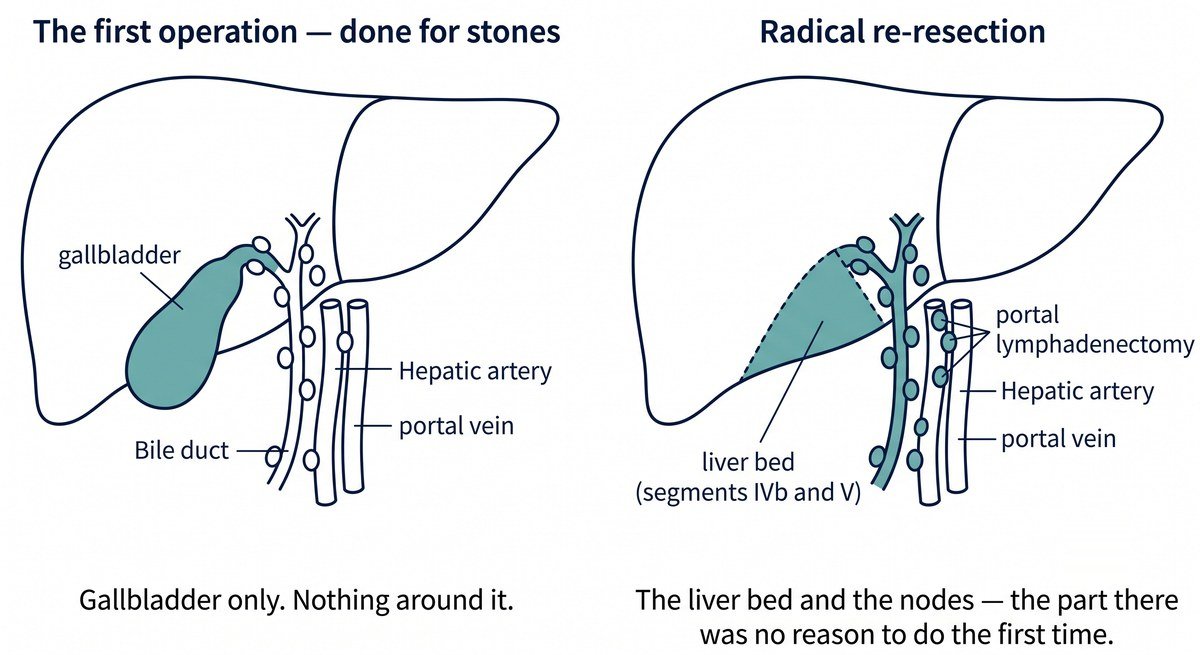
A gallbladder removed for what everyone believed was stone disease sometimes returns from the laboratory reported as cancer. That does not mean the first operation was wrong. It means the first operation was not an oncological one — it took the gallbladder and nothing around it. For most of these patients a second, larger operation is advised: a radical re-resection that removes the bed of liver the gallbladder was sitting on, together with the lymph nodes running along the bile duct, the hepatic artery and the portal vein. Dr Harsh Shah’s position is that this decision belongs to the histology report and a fresh scan, is taken at a tumour board, and is explained to a family rather than announced to them.
Shah’s Gastro, Cancer & Robotic Surgery Centre. Gallbladder cancer is far commoner in India than the European and American figures behind most textbooks would suggest, and it is commoner in women. A great many of these cancers are therefore found the way yours was found — not on a scan beforehand, but by a pathologist looking down a microscope at a gallbladder that was taken out for stones.
Dr Harsh Shah
MS, MCh (Surgical Gastroenterology), DrNB (Surgical Gastroenterology)
Registered with Gujarat Medical Council, Reg. No. G-38738
Gallbladder Cancer Surgeon · Apollo Hospital, Bhat, Gandhinagar · Gota OPD, Ahmedabad
Google rating 4.89 from 216 reviews at the Gota clinic, and 4.94 from 17 reviews at Apollo, Bhat.
An operation for gallstones is designed to relieve symptoms. It separates the gallbladder from the liver and lifts it out, and it deliberately stays out of the liver and away from the lymph nodes, because in stone disease there is no reason to go there. A cancer operation on the same organ is a different operation with a different purpose: it removes the gallbladder, a margin of the liver beneath it, and the nodes that drain it, so that the pathologist can say whether the disease had already left the gallbladder wall.
That is the whole of the argument for a second operation. Nothing has gone wrong, and nothing has been left behind that can be seen. What is missing is the part of the operation nobody had a reason to do — the liver bed and the lymph nodes — and those are precisely the two places gallbladder cancer goes first.
Patients find this difficult, and understandably so. They have recovered from an operation, they feel well, and they are now being told that a bigger one is needed for a disease they had no symptoms of. Dr Harsh Shah counsels this personally rather than delegating it, because a family that understands why the second operation is being advised makes the decision once, and a family that has only been told makes it three times.
One line in the report decides almost everything: how deeply the cancer had grown into the gallbladder wall. A cancer that never left the innermost lining is treated as already removed. A cancer that had reached the muscle layer or gone beyond it is treated as a cancer that needs the liver bed and the lymph nodes taken as well.
The gallbladder wall has layers, and the pathologist reports which of them the tumour reached. In the staging language on your report that appears as a T followed by a number. It is worth asking for the report itself rather than a summary of it, because the difference between two adjacent lines on the same page is the difference between no further surgery and a major one.
| What the histology report says | What it usually means for a second operation |
|---|---|
| Tumour confined to the innermost lining — T1a — and the gallbladder was removed intact | The first operation is accepted as sufficient. No re-resection; surveillance instead |
| Tumour into the muscle layer — T1b — or deeper, T2 or T3 | Radical re-resection advised: liver bed and portal lymphadenectomy |
| The cystic duct margin is reported as involved | The bile duct is excised and reconstructed as part of the re-resection |
| The gallbladder was perforated, or bile spilled, at the first operation | Re-staging carries more weight; the peritoneum is inspected carefully before anything is resected |
| The re-staging scan shows disease beyond the gallbladder bed and its nodes | The second operation is not done. Systemic treatment is the better path |
Two things on that table are commonly got wrong elsewhere. Excision of the bile duct is not routine — it is done when the cystic duct margin is involved, and adding it otherwise buys a reconstruction, and a lifelong risk of biliary infection, for nothing. And excising the old laparoscopy port sites, once standard practice, is no longer advised: it was studied, it did not change how patients did, and it is now left alone.
Before a second operation is planned, a fresh contrast scan of the chest, abdomen and pelvis is done. It is not a formality. A proportion of patients declare disease elsewhere in the weeks after the first operation, and finding that on a scan spares them an operation that could not have helped.
The scan is read for three things: whether the liver next to the gallbladder bed is involved, which nodes are enlarged and where they sit, and whether there is disease in the peritoneum, the liver away from the bed, or the chest. Nodes close to the bile duct and hepatic artery can be taken with the specimen. Nodes behind the pancreas or beside the aorta cannot, and their involvement changes the plan from surgery to systemic treatment.
A CA 19-9 blood test is usually added. It is not a diagnosis on its own and it is unreliable while a patient is jaundiced or has biliary infection, which is why it is repeated once those are settled rather than acted on in the middle of them.
For gallbladder cancer specifically, Dr Harsh Shah often begins the second operation with a staging laparoscopy — a short look inside with a camera before committing to the full procedure. Unsuspected peritoneal deposits are common enough in this disease that looking first is worth the few minutes it adds, and a family is told beforehand that this is part of the plan and what it would mean if something were found.
A radical re-resection removes the bed of liver that the gallbladder sat against — usually segments IVb and V, occasionally a formal liver resection where the tumour demands it — together with a clearance of the lymph nodes along the cystic duct, the bile duct, the hepatic artery and the portal vein. The bile duct itself is removed only if its margin was involved.
In practical terms the operation has three parts. The liver part takes a margin of liver tissue where the gallbladder was attached, because the gallbladder has almost no barrier between itself and the liver at that point. The nodal part is a clearance rather than a sampling: the pathologist needs a proper number of nodes to be able to say the disease had not spread, and a handful of nodes cannot answer that question. The third part is an inspection — the peritoneum, the other surfaces of the liver, and the area behind the pancreas are all examined before the resection begins.
Where the cystic duct margin was involved, the bile duct is removed with the specimen and the bile is rerouted by joining the ducts to a loop of small bowel. This adds to the operation and to the recovery, and it carries a risk of biliary infection that stays with the patient. It is done because leaving cancer in the duct is worse, not because it is tidier.
The approach — open or laparoscopic — is decided by the anatomy, the extent of liver required, and what the first operation left behind. Dr Harsh Shah performs a radical cholecystectomy as an open operation in most cases, and says so plainly at consent rather than promising a keyhole procedure that the findings may not allow.
The second operation is usually planned four to eight weeks after the first. That interval is not a delay. It allows the tissues to settle so that the anatomy can be seen, and it allows the re-staging scan to reveal disease that would make the operation futile.
Operating too early means working through inflammation that makes the liver bed and the nodes hard to define. Leaving it too long is worse: the disease has time to progress, and the window in which a complete resection is possible closes. Where a referral arrives late, the case is still re-staged and assessed rather than dismissed — a patient referred several months after the index operation should be scanned and discussed, not written off on the date alone.
What happens inside that interval matters. The slides and blocks from the first operation are obtained rather than just the typed report, because they are sometimes reviewed and re-reported. The scan is done. The case is discussed at the tumour board. Blood counts, liver function, clotting and nutrition are corrected. Smoking and alcohol are stopped. None of this is filler; each of these has been shown to change how the second operation goes.
★★★★★
“Dr. Harsh Shah operated my mother for gallbladder. The surgery went very well, and she has recovered nicely. We are truly grateful for his expertise and care throughout the treatment. Dr. Harsh Shah is one of the best gallbladder cancer surgeons in Ahmedabad. His approach is very professional, and he ensures that patients and their families feel confident and supported. Highly recommend him as one of the best cancer surgeons.”
★★★★★
“Dr. Harsh Shah operated for a gall bladder tumour and the outcome was excellent. Very skilled surgeon, compassionate approach, and clear communication. Truly grateful. Highly recommended.”
★★★★★
“Dr. Harsh Shah performed gallbladder surgery for my father, and our experience was excellent. He is very humble and highly knowledgeable. He patiently answered all our queries and took great care in explaining every detail. He was always supportive and addressed each of my father’s concerns with patience and clarity, which gave us a lot of confidence and comfort throughout the treatment. We are truly grateful for his care and would highly recommend him.”
sohani rana · Google review
Sagar Parmar sagar123 · Google review
Sunny Shah · Google review
An incidental gallbladder cancer is one of the situations in which a second opinion earns its keep, because the decision is made on paper and paper can be re-read.
Four situations make it worth the trouble. When you have been told the cancer was fully removed and no further operation is needed, but nobody has shown you the depth of invasion on the report. When a second operation is advised and nobody has re-staged you with a fresh scan first. When the bile duct is being removed and the cystic duct margin was reported as clear. And when you have been offered surveillance alone for a tumour that had reached the muscle layer or deeper.
The reverse is also true, and Dr Harsh Shah says it as often as the other. A patient whose report reads T1a with the gallbladder removed intact does not need a second operation, and being advised one is as much a reason to seek another view as being denied one.
These are the questions Dr Harsh Shah would want a member of his own family to ask before agreeing to a radical re-resection.
How deeply had the cancer grown, in the pathologist’s words? Ask for the line in the report, not the reassurance.
Has my case been discussed at a tumour board, and what did that meeting decide? Every incidental gallbladder cancer should go to that meeting, particularly on the re-resection question.
Has a fresh scan been done since the first operation, and what did it show? A plan built on the pre-operative ultrasound alone is a plan built on old information.
Is my bile duct going to be removed, and why? The answer should name the cystic duct margin.
What would make you stop the operation? Finding disease in the peritoneum or beyond the reach of the resection is the honest answer, and it is better heard beforehand.
What treatment comes after, and when? A course of tablet chemotherapy is usually advised after a resection for this disease, and it is started within a defined window rather than whenever the appointment happens.
One. Book your consultation. Bring the histology report in full, the first operation’s notes, the slides and blocks if you have them, and any imaging on a disc.
Two. Re-staging — a contrast scan of chest, abdomen and pelvis, bloods including CA 19-9, and a pathology review of the original slides where there is any doubt about the depth.
Three. Your case goes to the tumour board, and a written plan comes back stating whether a re-resection is advised, what it will include, and whether the bile duct is involved.
Four. Surgery at Apollo Hospital, Bhat — a staging laparoscopy first where it is indicated, then the radical re-resection, with the recovery pathway explained to your family beforehand.
Five. Histology review at about two weeks, the decision on chemotherapy after surgery, and a surveillance schedule given to you in writing.
There is no single figure for a radical re-resection, and any page offering one is guessing. What moves it is the extent of liver required, whether the bile duct has to be removed and reconstructed, the length of stay, the room category, whether intensive care is needed, and whether chemotherapy follows. A re-resection without bile duct excision is a shorter pathway than one with it.
The office prepares a written estimate before admission, so that you are comparing a document rather than a conversation. Cashless admission is arranged where your policy allows it, and the pre-authorisation paperwork is prepared for you. Ask what the estimate excludes, and who your point of contact is if the hospital and the insurer disagree.
Two practical points specific to this situation. Your insurer has already paid for one gallbladder operation, and the second claim is a different claim for a different diagnosis — bring the histology report to the pre-authorisation, because it is the document that explains why. And ask for the discharge summary and histology of the first operation from the hospital that did it before you travel, since obtaining them afterwards is slower than it should be.
Feeling well is expected and is not evidence either way. Gallbladder cancer causes no symptoms at the stage at which it is usually found incidentally. The question is answered by the depth of invasion on the report and by a fresh scan, not by how you feel.
Usually not. Most of these cancers are not visible on pre-operative ultrasound and are not apparent at the operation itself. What matters is that the specimen was sent for histology, which is why every gallbladder removed should be sent and every gallbladder should be opened and inspected in theatre.
A tumour confined to the innermost lining, in a gallbladder removed intact, is accepted as adequately treated by the first operation. If a re-resection is being advised on a T1a report, ask for the reasoning, and a second opinion is reasonable.
In most cases a radical re-resection is performed as an open operation, because the liver bed and the nodal clearance are easier to do completely that way, and because the first operation leaves adhesions. The approach is stated at consent rather than promised in advance.
Shah’s Gastro, Cancer & Robotic Surgery Centre — Gota, Ahmedabad
Consultation, review of the histology report and the first operation’s notes, second opinions, surveillance.
Google: Dr Harsh Shah · 4.89 from 216 reviews
Directions to the Gota clinic
Apollo Hospital — Bhat, Gandhinagar
Admission, surgery and inpatient care.
Google: Dr Harsh Shah – Robotic GI Surgeon · 4.94 from 17 reviews
Directions to Apollo, Bhat
Patients are referred for gallbladder cancer from across Gujarat, southern Rajasthan and western Madhya Pradesh, very often after a cholecystectomy done elsewhere. Send the histology report and the operation notes ahead of the appointment.
More on Dr Harsh Shah’s work in gallbladder and liver cancer: gallbladder cancer treatment · liver resection for cancer · HIPEC for peritoneal spread.
Swasth Parivar: twice a month, practical advice on recovery, diet and warning signs. No advertising. Stop any time.
Your number is used for these updates and for the clinic to reach you. It is never sold or passed on. To stop, reply STOP on WhatsApp.