

Dr. Jivraj Mehta Hospital · Vasna, Ahmedabad
Retrorectal and presacral tumour surgeon in Ahmedabad · Dr. Jivraj Mehta Hospital, Vasna, Ahmedabad
Last updated: 27-Oct-2026
A retrorectal tumour is a rare growth in the narrow space between the rectum and the tailbone. Most can be removed, and the surgeon who plans the approach shapes the result.
Few doctors see more than a handful of these tumours in a career. A scan may call it a cyst, a mass or a “presacral lesion”, and the words can feel vague. This page explains how the decision to operate is made and what changes it. It also covers when a second opinion is worth taking and what to ask before you consent. Our page on rectal cancer covers the more common growth of the rectum itself.
Dr Harsh Shah is a surgeon for the gut and for cancers of the gut. He operates in the deep pelvis, where a retrorectal tumour sits.
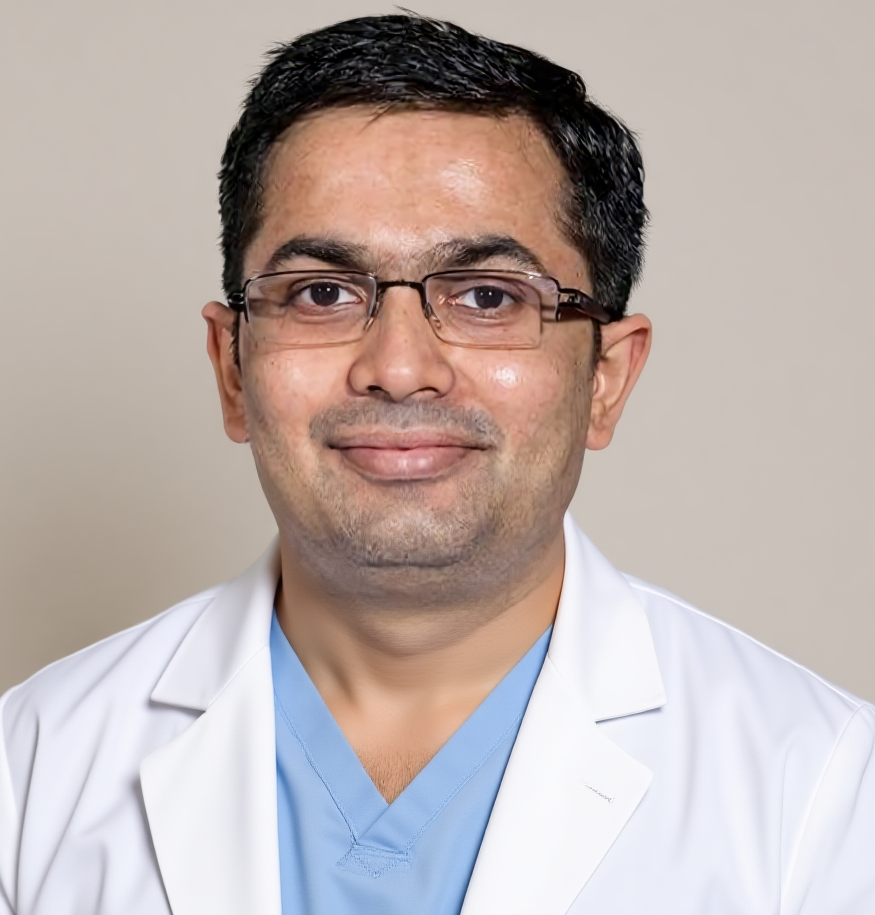
Dr Harsh Shah. He trained at Maulana Azad Medical College and GB Pant Hospital in Delhi. His work is cancer and major surgery of the food pipe, stomach, liver, pancreas, gallbladder and bowel. He operates by the open and 3D HD laparoscopic routes. You see the same surgeon from the first visit to the last follow-up.
Dr Harsh Shah
MS, MCh (Surgical Gastroenterology), DrNB (Surgical Gastroenterology)
Registered with Gujarat Medical Council, Reg. No. G-38738
Gastro, Cancer & Laparoscopic Surgeon · Dr. Jivraj Mehta Hospital, Vasna, Ahmedabad
Google rating 4.94 from 18 reviews at Dr. Jivraj Mehta Hospital, Vasna, Ahmedabad.
Patients are first seen at Dr. Jivraj Mehta Hospital, Vasna in Ahmedabad, and operations are done at Dr. Jivraj Mehta Hospital, Vasna, Ahmedabad. A retrorectal case needs a radiologist, a pathologist and often a spine or bone surgeon beside the gut surgeon. A medical oncologist joins when a cancer is suspected.
The retrorectal space lies behind the rectum and in front of the sacrum. Because it is small, a growth there is easily missed.
| Kind | Usual features | What shapes the plan |
|---|---|---|
| Developmental cyst. | Present from birth, often found in young women. | Complete removal, since it can get infected or turn malignant. |
| Solid growth of nerve or fat tissue. | Slow growing. | Closeness to the nerves of the pelvis. |
| Bone or notochord tumour such as chordoma. | Arises from the sacrum. | Needs removal in one piece, with a bone surgeon’s help. |
| Spread from another cancer. | Seen with a known cancer elsewhere. | Treated as part of that cancer’s plan. |
The same space can hold a harmless cyst or a slow cancer. Only careful tests can tell them apart.
Many retrorectal tumours cause no symptoms for years. They are found during a rectal examination or a scan done for another reason.
A swelling near the tailbone that comes back after each drainage should never be treated as a simple boil.
A good work-up answers three questions. What is the lump? How far does it reach? Which nerves and bones does it touch?
A cyst that can be taken out completely is usually removed. A suspected cancer is planned with the whole team, sometimes with drug or radiation treatment first.
| What the scan suggests | Usual next step |
|---|---|
| A thin-walled cyst, no worrying features. | Planned complete removal. |
| A cyst that has been infected before. | Infection settled first, then removal. |
| A solid mass with bone involved. | Team review, then planned one-piece removal or other treatment. |
| A mass with a known cancer elsewhere. | Treated within that cancer’s plan. |
Taking only a piece of a suspected cancer can make it harder to remove the tumour for good later. That is why the first plan must be made with care.
The route is chosen from the level of the lump. A low lump is reached from behind, a high lump from the belly, and some need both.
| Position of the tumour | Usual route |
|---|---|
| Below the level of the third sacral bone. | From behind, through the buttock crease. |
| Above that level. | From the belly, by keyhole or open surgery. |
| Large, and reaching both levels. | Combined front and back approach. |
If a planned keyhole operation proves unsafe, the surgeon changes to an open one. That is a safe decision and not a failure.
The aim is to remove the whole tumour without breaking it. A broken cyst can infect the area, and a broken cancer can come back.
The nerves for the bladder, bowel and legs run close to this space. The higher the lump, the more careful the surgeon must be.
Most patients with a low lump keep normal control. A large lump pressing on nerves may leave some weakness at first. The surgeon explains this risk in plain words before surgery, with what is likely for your tumour.
A patient who is strong, well fed and free of infection recovers better. Where time allows, a few weeks of preparation are worthwhile.
Every operation carries risks. Yours depend on the position of the tumour and the route, and will be discussed in person before you consent.
Most patients walk the next day and eat within a few days. Sitting comfort improves over some weeks, and follow-up scans continue for years.
| When | What happens |
|---|---|
| First days. | Monitoring, walking, light fluids and then food, and drains if placed. |
| Going home. | Wound care, a sitting cushion, medicines and a review visit. |
| Some weeks later. | The slide report is reviewed, and further treatment is planned if advised. |
| First two years. | Examination and MRI at set gaps. |
| Following years. | Scans at longer gaps. |
Keep every report and the final slide result. They tell any future doctor what was found and what was done.
A second opinion is most useful before any cut is made, and when the advice seems rushed. It matters most when the lump has been called a simple boil.
| What you notice | Why it matters |
|---|---|
| Told it is an abscess, but it keeps returning. | It may be an infected cyst that needs full removal. |
| A needle biopsy was passed through the rectum. | The surgeon needs to know before planning. |
| Advised to remove only part of the lump. | Incomplete removal can make later surgery harder. |
| No team review before surgery on a solid mass. | A bone surgeon and an oncologist may be needed. |
| Told that nothing can be done. | Options may still exist. |
A second opinion that agrees with your plan is not wasted. Bring the scan images on a disc and all reports.
★★★★★
“Dr. Harsh performed my wife’s gallbladder surgery and has been a thorough professional. He truly assuaged our concerns and treated us with great care. I have never met a surgeon who is consistently upbeat, and that makes a real difference to families whose loved ones are undergoing a surgical procedure.”
— Gaurav Roy, Google review
★★★★★
“Precise and excellent surgical operation done by Dr.Harsh Shah, I really appreciate their consultation and guidance.”
— bikash tarafdar, Google review
★★★★★
“Dr harsh operated my sister for liver cancer .we came for follow up .Now she is good. Thank u so much sir”
— Natu Vadalia, Google review
Reviews are reproduced exactly as written on Google. They speak about Dr Harsh Shah’s care in GI surgery, and do not name retrorectal tumours.
The cost depends on the operation, the hospital room and the number of days in hospital. A written estimate is given before admission.
Dr. Jivraj Mehta Hospital, Vasna, Ahmedabad, works with the major insurers and offers cashless admission. The insurance desk handles pre-authorisation. On admission, bring the scan reports and images, the slide report, your medicines with doses, the insurance card and an identity proof. For questions before booking, call +91-63555-64601.
It is a rare growth in the space behind the rectum and in front of the sacrum. It may be a cyst, a solid growth or, rarely, a cancer.
No. Many are developmental cysts. Some are cancers such as chordoma, so the type must be confirmed before treatment.
A needle through the rectum can carry cells along its track and infect the space. A safer route is chosen when a biopsy is needed.
Yes. An infected cyst looks like an abscess near the anus. It returns after drainage until the cyst wall is removed.
Most cysts and solid growths that can be removed are usually taken out completely. Cancers are planned with the whole team.
Most patients with a low lump keep normal control. The risk is higher with a large or high lump, and it is explained before surgery.
Many patients go home within about a week if recovery is smooth. A combined front and back operation may need longer.
Dr. Jivraj Mehta Hospital, Vasna, Ahmedabad
Dr. Jivraj Mehta Hospital, Dr Jivraj Mehta Marg, Vasna, Ahmedabad 380007.
Operations, endoscopic procedures and hospital stay.
Google: Dr Harsh Shah · 4.94 · 18 reviews
Directions to Dr. Jivraj Mehta Hospital, Vasna · WhatsApp +91-63555-64601
Families come to Ahmedabad from across Gujarat, including Gandhinagar, Mehsana, Banaskantha, Nadiad, Anand, Bhavnagar, Rajkot, Jamnagar and Kutch, and from southern Rajasthan and western Madhya Pradesh.
Has a scan shown a lump behind the rectum or in front of the tailbone? Send the MRI, the CT report and any biopsy report. Dr Shah reads them before you arrive, so the visit goes to the plan and not to repeat tests. Call +91-63555-64601 · Send reports on WhatsApp
Swasth Parivar: every week, practical advice on recovery, diet and warning signs. No advertising. Stop any time.
Your number is used for these updates and for the clinic to reach you. It is never sold or passed on. To stop, reply STOP on WhatsApp.