

Shah's Gastro, Cancer & Robotic Surgery Centre · Ahmedabad & Gandhinagar
A cancer on the right side of the colon rarely bleeds where anyone can see it. Apollo Hospital, Bhat, Gandhinagar · Gota OPD, Ahmedabad.
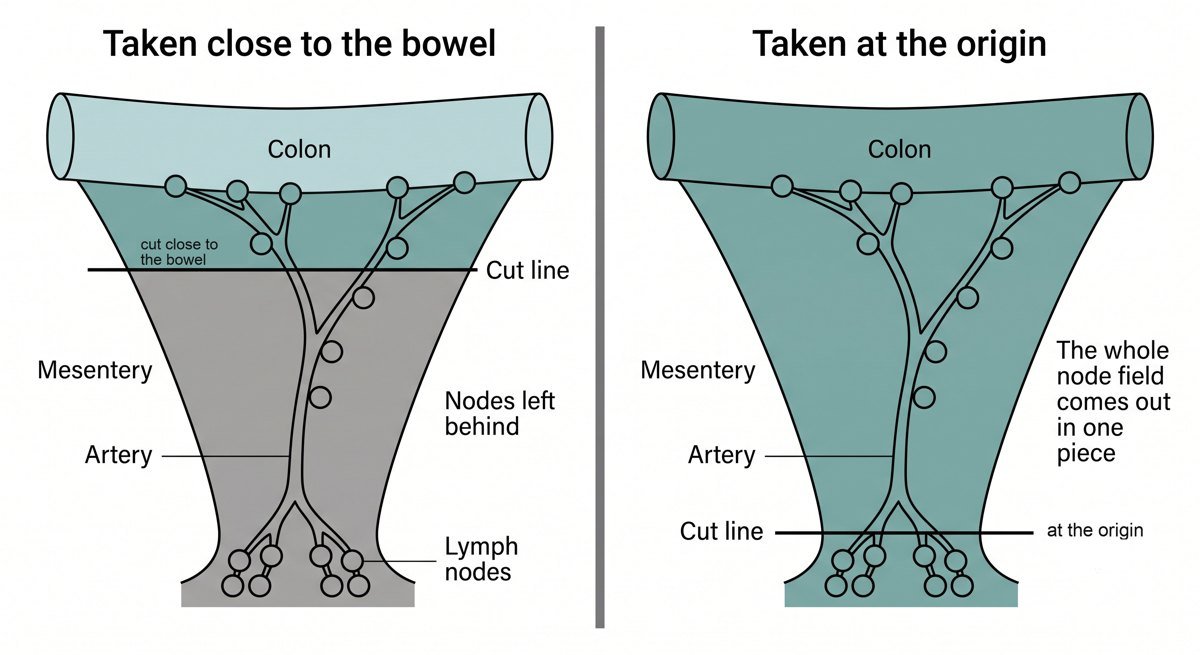
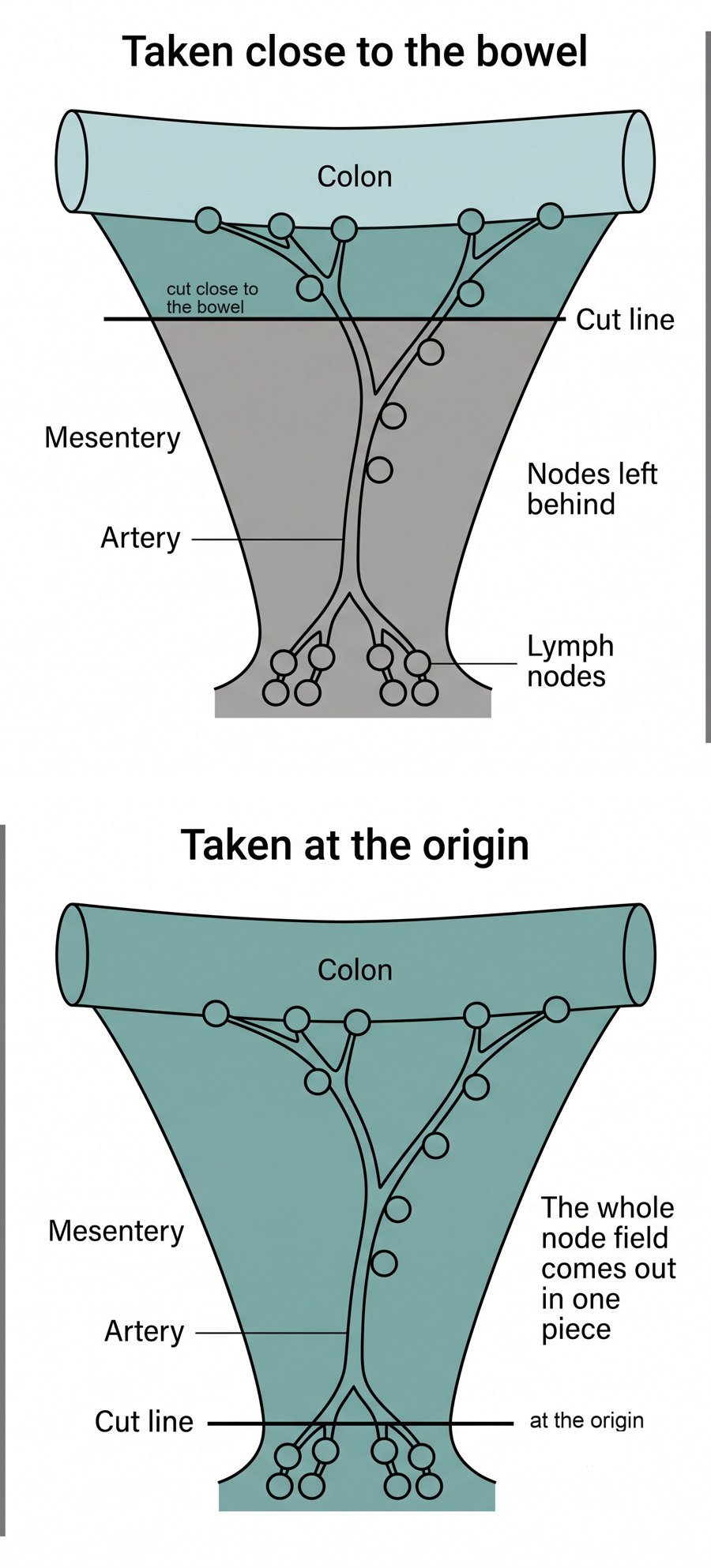
A cancer of the caecum or ascending colon is removed by a right hemicolectomy: the segment of bowel, and with it the whole fan of mesentery that drains it, taken as one piece with the feeding vessels divided at their origin. The two ends — small bowel to transverse colon — are then joined, and in a planned operation that join almost always means no bag. What decides the extent of the operation is not the size of the lump but which vessels the tumour’s lymph drainage follows, which is why the same cancer a few centimetres further along becomes a bigger resection.
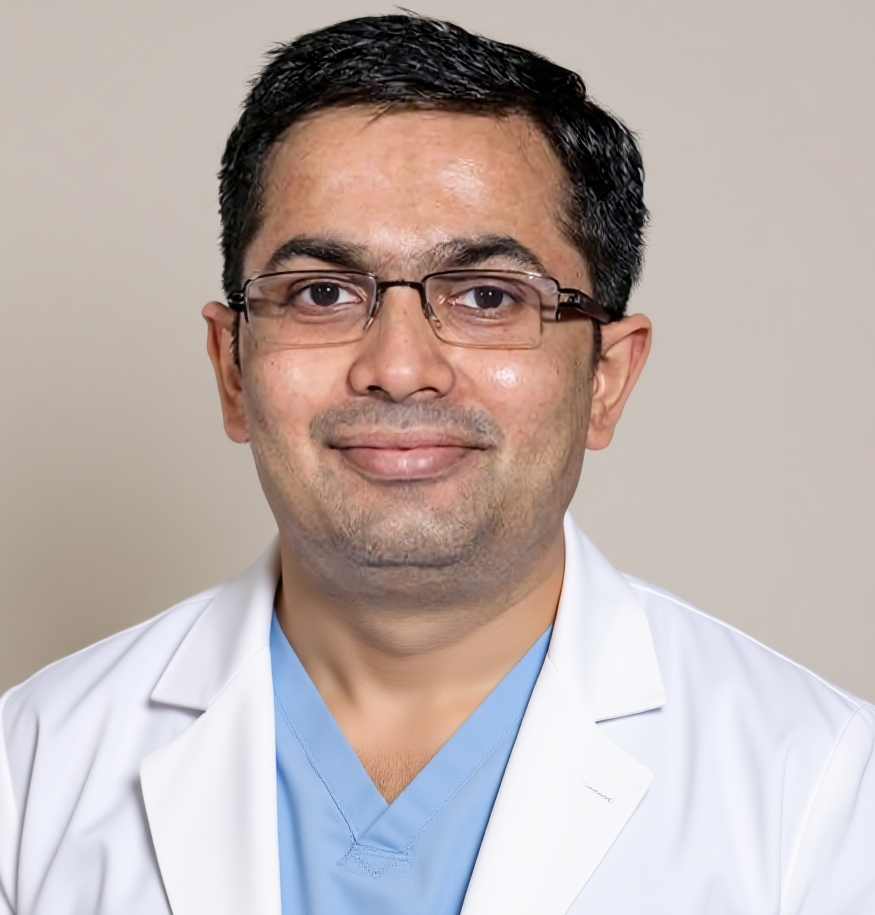
Shah’s Gastro, Cancer & Robotic Surgery Centre. The training here is in surgical gastroenterology as a super-specialty — the bowel, stomach, food pipe, liver and pancreas are the whole of the practice rather than a part of it. In a right colon cancer the error that costs most is almost never a slip of the instrument. It is a mesentery divided short of the origin of the vessel, which leaves behind the very nodes the operation existed to take, and which nothing later can put right.
Dr Harsh Shah
MS, MCh (Surgical Gastroenterology), DrNB (Surgical Gastroenterology)
Registered with Gujarat Medical Council, Reg. No. G-38738
Colon Cancer Surgeon · Apollo Hospital, Bhat, Gandhinagar · Gota OPD, Ahmedabad
Google rating 4.89 from 216 reviews at the Gota clinic, and 4.94 from 17 reviews at Apollo, Bhat.
Every colon cancer seen here goes to a tumour board before a plan is offered. The board is where the liver shadow on the scan, the anaemia, the fitness of the patient and the pathology of the biopsy are argued in one room rather than in three corridors, and where a decision to operate now, to treat first, or not to operate at all is recorded with its reasons.
Dr Harsh Shah performs the resection himself, first cut to closure, with a fixed team — the same consultant anaesthetist, the same assisting surgeon, the same theatre staff for every colorectal case. Where the operation is robotic he is at the console and a second consultant surgeon is scrubbed at the table throughout. Ask it in those words: who makes the cut, who is at the console, and will the person who consented me be in theatre from start to finish.
The complication figures that belong in a consent discussion are the operating unit’s own, given to you in person and adjusted for your age, your fitness and whether the operation is planned or urgent — not a number copied from a published series.
The right colon is wide and its contents are liquid, so a tumour there can grow to a considerable size without ever blocking anything. It bleeds, but slowly and invisibly, into a stream that is still fluid — so instead of bleeding that is seen, it shows up as iron-deficiency anaemia: tiredness, breathlessness on the stairs, a pallor the family notices before the patient does.
That single fact is why the standing rule exists that iron-deficiency anaemia in any man, or in any woman past the menopause, without an obvious cause, is a colonoscopy until proven otherwise. Treating such a patient with iron tablets alone, and reviewing in three months because the haemoglobin came up, is the commonest way a right colon cancer is missed for a year. The other presentations worth naming are a mass felt low on the right side of the abdomen, unexplained weight loss, and a change in bowel habit that has lasted more than a month.
Right-sided tumours also differ under the microscope and in the laboratory. They are more often mismatch-repair deficient, which is why testing every colon cancer for it is mandatory and not optional here: that one result screens the family for Lynch syndrome, tells us whether chemotherapy after surgery would help or harm, and in advanced disease decides whether immunotherapy rather than chemotherapy is the right first treatment.
Four things are settled before a date is offered: that the whole colon has been seen, that the lesion has been marked, that the disease has been staged on a contrast CT of the chest, abdomen and pelvis, and that the patient is fit enough for the operation that the scan implies. A plan built on a partial colonoscopy is a plan that may have to be undone.
The colonoscopy must reach the caecum, because a second, separate cancer elsewhere in the colon is found often enough to change the operation entirely — and finding it after the first resection means a second operation. Where the scope cannot pass an obstructing tumour, a CT colonography stands in, or the rest of the colon is cleared by colonoscopy within a few months of the resection; it is never simply forgotten. Any lesion small enough that a surgeon may not be able to feel it is tattooed with India ink at the time of the scope, so the segment to be removed is identified by a mark rather than by guesswork.
Alongside that: a baseline CEA blood level to compare against later, full blood counts, kidney and liver function, albumin, and a nutrition screen. Weight loss of more than a tenth of body weight over six months, a low albumin, or eating less than half of what is needed for a week each trigger a dietitian referral and preoperative build-up before theatre rather than after it, and the anaemia is corrected before the operation rather than afterwards.
The last part of the small bowel, the caecum, the ascending colon and the right side of the transverse colon are removed as one piece, together with the whole sheet of mesentery that carries their blood supply and their lymph nodes. The ileocolic and right colic vessels are divided at their origin, not part way along, because the nodes that matter sit at the root of those vessels. The small bowel is then joined to the transverse colon.
Three standards are non-negotiable, and a patient is entitled to ask about each. The mesentery is taken intact, in its own membrane, with the vessels tied at the origin — the technique called complete mesocolic excision. At least twelve lymph nodes must be found in the specimen by the pathologist; a lower yield is itself treated as a high-risk finding and changes the advice about chemotherapy. And the bowel is divided with a clear length of normal tissue on either side of the tumour.
Where the tumour sits against another organ — the abdominal wall, a loop of small bowel, the duodenum — that structure is taken in one piece with the specimen. It is never peeled off. Peeling an adherent tumour away is the single manoeuvre that converts a cancer that could have been removed completely into one where tumour has been left behind, and it can look like the more conservative choice in the moment.
A keyhole operation is the validated standard for colon cancer and is what is offered in the great majority of these resections; the cancer results are the same as open surgery and the recovery is faster. Robotic surgery is a reasonable alternative in experienced hands. Open surgery is the right answer for a very bulky tumour, for a resection taking several organs together, or for an abdomen scarred by previous surgery — and choosing it, or converting to it during the operation, is a surgical judgement made in your interest, not a failure of technique.
| Site of the tumour | Operation | Vessels divided at their origin | What the patient is told |
|---|---|---|---|
| Caecum or ascending colon | Right hemicolectomy | Ileocolic and right colic | The standard right-sided resection; the two ends are joined and a bag is not usually needed |
| Hepatic flexure or proximal transverse colon | Extended right hemicolectomy | Ileocolic, right colic and middle colic | A longer segment of bowel, for the same reason — the lymph drainage follows the middle colic vessel |
| Tumour stuck to a neighbouring structure | Right hemicolectomy with that structure removed in one piece | As above | A bigger operation, taken deliberately, because separating the two would leave cancer behind |
| Obstructed right colon presenting as an emergency | Resection, usually with the join made at the same operation | As above | Urgent surgery carries more risk than planned surgery; the aim is still one operation, not a bag |
In a planned right hemicolectomy the two ends are joined during the same operation and a stoma — a bag on the abdomen — is not usually needed. That is a genuine difference between the right side and the left: on the right the join is between small bowel and colon, which heals more reliably than a join low down in the pelvis.
It is still consented for every single time, and that is deliberate rather than defensive. If the bowel above an obstruction is grossly swollen, if there has been a perforation and the abdomen is contaminated, or if the patient is unstable on the table, then making a join would be the dangerous choice and a temporary stoma is the safe one. A patient who has been told this beforehand, and who has met the stoma nurse and had the site marked before theatre, is in a completely different position from one who wakes up to a bag nobody mentioned. Where a stoma is made in these circumstances it is usually temporary, and the plan to reverse it is discussed before you go home.
The questions that matter most are about completeness — of the colonoscopy, of the mesentery, and of the pathology report. An operation agreed before the whole colon has been seen is the hardest decision here to undo, so the first question is about the scope, not about the surgeon.
A second opinion is worth taking at two moments, and both are before anything is irreversible. The first is before surgery, when the question is whether the extent of the planned resection matches where the tumour actually sits. The second is after the pathology report, when the question is whether chemotherapy is genuinely indicated — because a mismatch-repair-deficient stage II cancer is a case where chemotherapy is not advised, and that is easy to get wrong. Bring the colonoscopy report and images, the biopsy report, the CT on a disc rather than as a printed summary, the CEA result, and a list of current medicines.
★★★★★
“I underwent surgery under the care of Dr. Harsh Shah. The surgery was done very smoothly and successfully. After the surgery, I am able to perform my daily routine work without any problem. He is very caring, skilled, and supportive throughout the treatment. In my opinion, he is the best colon cancer surgeon in Ahmedabad. Highly recommended.”
— Kalabhai Solanki, Google review
★★★★★
“Dr. Harsh Shah did a great job with my dads colon cancer treatment and surgery. I really think he is the best doctor in Gujarat. He is quite caring, humble and very detail oriented. He made sure my dad was ready for surgery before operating. His attention to detail is exceptional. My family and I owe him greatly. I highly recommended him for colon cancer treatment and surgery.”
— Chirag Mirani, Google review
★★★★★
“Dr harsh shah had done laproscopic cancer surgery. After surgery now she is fine. Dr harsh shah is very humble and down to earth human being. I once again thanks from the bottom of my heart to him . And highly recommend him as best colon cancer surgeon in Ahmedabad.”
— Gajendra Sharma, Google review
Reviews are reproduced exactly as written on Google, including the original spelling and spacing.
Recovery after a keyhole right hemicolectomy is deliberately brisk: out of bed the same evening, drinking freely from the start, eating normally the next day, the catheter out within a day, walking several times a day, and home in about four or five days when the pathway runs as it should. Nothing about that is rushing the patient; a bowel that is used early works sooner.
The pathology report then decides everything that follows, and four items in it are the whole of the conversation: how many lymph nodes were examined and how many contained cancer, whether the margins were clear, the mismatch-repair result, and whether there are high-risk features such as a tumour through the bowel wall, invasion of nerves or small vessels, or a perforation at presentation. The report is explained to you in person, with those four lines pointed to.
Where chemotherapy is advised it starts within six to eight weeks of the operation, because the benefit falls away measurably after that — which is one more reason recovery is pushed along. For a node-positive cancer with otherwise favourable features, three months of treatment is now the default rather than six, and it spares a great deal of nerve damage in the hands and feet. For a stage II cancer that is mismatch-repair deficient, the correct answer is usually no chemotherapy at all. Afterwards: review every three months for the first years with examination, weight and a CEA level, a CT at intervals, a colonoscopy at one year and then at widening intervals, and a genetics referral where the tumour or the family history points to an inherited syndrome.
There is no single figure, and any quoted without seeing you is a guess. The estimate moves with the room category, the length of stay, whether the operation is keyhole, robotic or open, whether intensive care is needed afterwards, and whether the admission is planned or an emergency. A written estimate is given before admission, and the office tells you plainly what is inside it and what is not.
Apollo Hospital, Bhat, is empanelled with the major insurers and cashless schemes, and the office handles pre-authorisation directly. Three costs are regularly forgotten at the planning stage: the chemotherapy that may follow, the surveillance colonoscopy and scans over the years afterwards, and — where a stoma has been made — appliances until it is reversed. Bring imaging on a disc or drive, previous discharge summaries, your medicines with doses, the insurance card, and one family member as the single point of contact.
In a planned operation, almost certainly not — the small bowel is joined to the colon at the same sitting. It is still consented for every time, because an obstructed, contaminated or unstable situation can make a temporary stoma the safer choice.
Because the operation is defined by the lymph drainage, not by the lump. The nodes sit along the feeding vessels, and taking them properly means taking the segment of bowel those vessels supply.
Usually the anaemia is corrected first rather than the operation delayed indefinitely — intravenous iron where tablets have failed or where time is short. Operating anaemic and transfusing afterwards is the worse of the two options.
Yes, and it is the standard approach for colon cancer in most of these patients, with the same cancer results as open surgery. Robotic surgery is a reasonable alternative. A very bulky tumour, a resection involving several organs, or a heavily scarred abdomen is a proper reason to start open or to convert.
That is decided after the operation, from the pathology report, not before it. Many patients with an early cancer need no chemotherapy at all, and a mismatch-repair-deficient stage II cancer is a case where it is specifically not advised.
Sometimes. The mismatch-repair test done on every specimen here is the first step in finding an inherited syndrome, and where it points that way, genetic counselling is offered to you and to your relatives.
Shah’s Gastro, Cancer & Robotic Surgery Centre — Gota, Ahmedabad
Consultations, review of colonoscopy, biopsy and CT reports, second opinions, surveillance.
Google: Dr Harsh Shah · 4.89 from 216 reviews
Directions to the Gota clinic
Apollo Hospital — Bhat, Gandhinagar
Admission, surgery and inpatient care.
Google: Dr Harsh Shah – Robotic GI Surgeon · 4.94 from 17 reviews
Directions to Apollo, Bhat
Patients travel to Ahmedabad for colon cancer surgery from across Gujarat, southern Rajasthan and western Madhya Pradesh. Send the colonoscopy and CT reports ahead so they are read before you travel.
More on Dr Harsh Shah’s work in GI cancer: cancer surgery services · recent advances in colon cancer · colon cancer case reports · rectal cancer treatment · HIPEC for peritoneal disease.
Swasth Parivar: every week, practical advice on recovery, diet and warning signs. No advertising. Stop any time.
Your number is used for these updates and for the clinic to reach you. It is never sold or passed on. To stop, reply STOP on WhatsApp.