
Shah's Gastro, Cancer & Robotic Surgery Centre · Ahmedabad & Gandhinagar
How the operation is decided, who performs it, and what to ask before you consent. Apollo Hospital, Bhat, Gandhinagar · Gota OPD, Ahmedabad.
A cancer in the head of the pancreas is removed by an operation called a Whipple’s pancreaticoduodenectomy. Whether it can be removed is not decided by the diagnosis — it is decided by where the tumour sits in relation to two blood vessels behind the pancreas, and that question is answered by one specific scan, a pancreatic-protocol CT. Dr Harsh Shah reads that scan with the tumour board before anything is offered. This page is about how that decision is reached, what would change it, who is in the operating room, and the questions a patient should ask before signing a consent form.
Shah’s Gastro, Cancer & Robotic Surgery Centre. Qualified in surgical gastroenterology specifically — a super-specialty training in the gastrointestinal tract rather than general surgery with an interest in it. The pancreas, bile duct, stomach, food pipe and bowel are the whole of the practice, week after week. A Whipple’s is not an operation to be done occasionally.
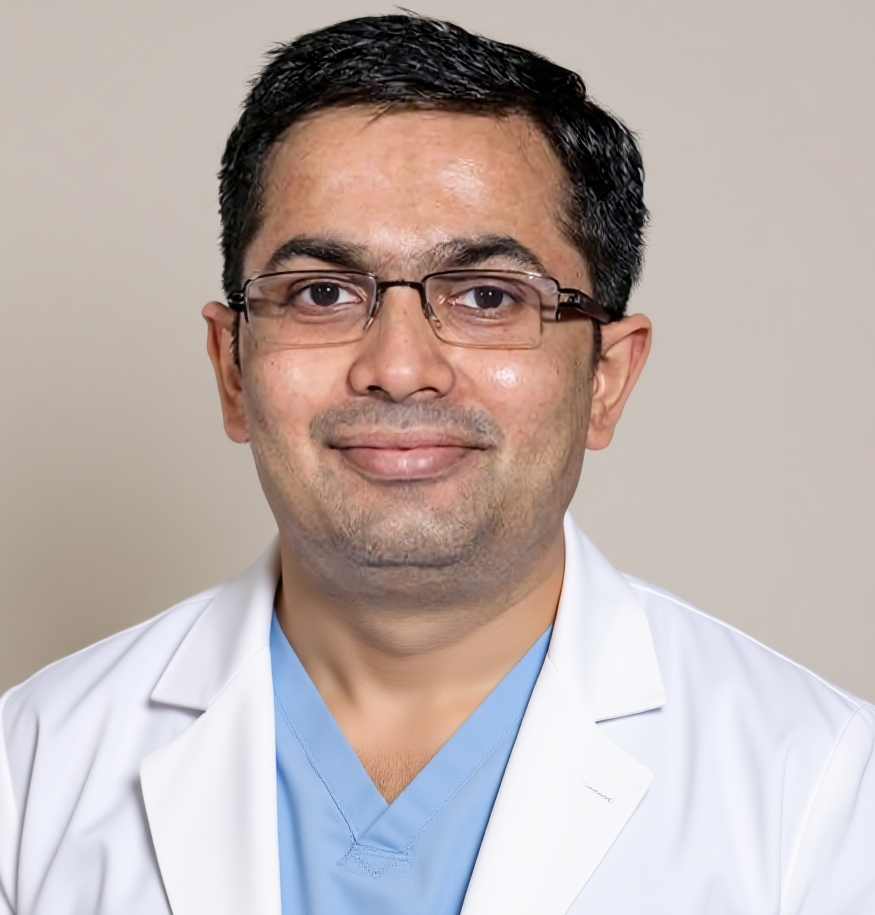
Dr Harsh Shah
MS, MCh (Surgical Gastroenterology), DrNB (Surgical Gastroenterology)
Registered with Gujarat Medical Council, Reg. No. G-38738
Pancreas Cancer Surgeon · Apollo Hospital, Bhat, Gandhinagar · Gota OPD, Ahmedabad
Google rating 4.89 from 216 reviews at the Gota clinic, and 4.94 from 17 reviews at Apollo, Bhat.
The surgeon who sees you in the Gota OPD is the surgeon who performs the operation at Apollo, Bhat. There is no separate operating list run by someone you have not met.
No pancreatic cancer is offered an operation on one person’s reading of a scan. Every case goes to a tumour board — surgeon, medical oncologist, radiologist and pathologist in one room — before a date is given, not after.
The head of the pancreas sits in the curve of the duodenum, wrapped around the bile duct. A tumour there blocks the bile duct early, which is why it announces itself as painless yellowing of the eyes rather than as pain — and why head tumours are sometimes found earlier than tumours of the body or tail.
Three presentations bring most patients to Dr Harsh Shah: yellow eyes and dark urine with no fever and no pain; weight loss with a dull ache through to the back that eases on leaning forward; and diabetes appearing for the first time after fifty in someone who is losing weight. The last is the one most often missed, because new diabetes is treated as new diabetes.
What the location settles is the operation: a tumour of the head, the uncinate process or the periampullary region is removed by a Whipple’s. A tumour of the body or tail is a different operation entirely. What it does not settle is whether an operation is possible at all — a separate question, and the one that matters most.
A pancreatic operation is only worth doing if the whole tumour can be removed with a clear rim of normal tissue around it. Leaving cancer behind carries all of the risk of a major operation and almost none of the benefit. Whether a clear removal is achievable is decided on a pancreatic-protocol CT — a thin-slice scan timed to two separate contrast phases. A routine abdominal CT cannot answer this, and where one has been done elsewhere it has to be repeated.
What the scan is read for is not the size of the tumour but its relationship to the artery and vein running immediately behind the pancreas. A tumour that merely touches the vein behaves very differently from one that has grown around the artery, and that difference decides the whole plan.
| What the scan shows | What it is called | What happens next |
|---|---|---|
| Tumour clear of the artery, and clear of the vein or touching it only slightly | Resectable | Surgery first, in a patient fit for it, with chemotherapy afterwards |
| Tumour in limited contact with the artery, or wrapped around the vein but with healthy vein above and below | Borderline resectable | Chemotherapy first, then re-scan and re-decide. The operation is not cancelled — it is sequenced differently |
| Tumour encasing the artery, or blocking the vein in a way that cannot be rebuilt | Locally advanced | Chemotherapy, then reassess. A proportion of patients become operable who were not at the start |
| Deposits in the liver, the abdominal lining or distant nodes | Metastatic | Treatment is systemic. An operation to remove the pancreas would shorten life rather than lengthen it |
Two points patients are rarely told. Borderline is not a softer word for inoperable — it is an instruction about the order of treatment. And after chemotherapy the scan tends to understate the response: a tumour that looks unchanged, in a patient who is well and whose tumour marker has fallen, is still explored rather than abandoned.
A Whipple’s removes the head of the pancreas, the whole duodenum, the gallbladder and the lower bile duct, and usually a small cuff of stomach — then rebuilds three separate joins: pancreas to bowel, bile duct to bowel, and stomach to bowel. The duodenum is removed with the pancreatic head because the two share a single blood supply and cannot be separated.
Patients are often shocked by how much is taken for what looked like a small tumour. The answer is anatomy rather than aggression: the pancreatic head and the duodenum share one blood supply, and taking one without the other is not surgically possible. The lymph nodes of the standard field come out with the specimen so the pathologist can stage the disease accurately.
What is not done matters equally. A more extensive lymph node clearance than the standard field adds complications without adding benefit, and Dr Harsh Shah does not perform one. Whether the pylorus — the valve at the stomach outlet — is preserved or removed makes no difference to the cancer outcome, so it is decided by what the tumour allows on the day. Where the tumour is stuck to the vein behind the pancreas, that segment of vein is removed and reconstructed to achieve a complete clearance; that is an established part of the operation in experienced hands. Removing and rebuilding the artery is a different matter and is not standard practice.
The join between the cut pancreas and the bowel is the part of a Whipple’s that determines recovery. Pancreatic juice is corrosive, and where a little leaks from that join it causes a complication called a pancreatic fistula. A drain is left at the join and the fluid in it is tested the morning after surgery — that single test shapes the rest of the stay.
A soft pancreas with a fine duct leaks more readily than a firm one with a wide duct, and the surgeon knows which they are dealing with only once the gland is divided. If the first morning’s test is reassuring the drain comes out within days. If it is not, the drain stays, feeding is managed differently, and the stay lengthens. That is not a surgical failure; it is the known behaviour of the operation.
The other pattern worth knowing in advance: the stomach can be slow to restart after a Whipple’s. Eating may be delayed by days, and a tube may go back down for a while. It resolves, and it is distressing mainly to people who were not warned.
The full list of risks, and the figures that apply to your own gland, age and fitness, is gone through in person before consent. Dr Harsh Shah states those numbers rather than implying them — they belong in a conversation where questions can be asked, not on a web page.
A Whipple’s for pancreatic head cancer is usually performed as an open operation, and that is a deliberate choice rather than a limitation. The reconstruction involves three delicate joins deep in the abdomen, and the priority is a complete cancer clearance and a secure pancreatic join, not a smaller scar.
Dr Harsh Shah performs robotic and laparoscopic surgery routinely for other gastrointestinal cancers, so “will it be keyhole?” is a fair question. For the pancreatic head the honest answer is that the approach is chosen per patient and per tumour, and that no approach is offered because it sounds more advanced. Anyone who promises a specific technology before reading your scan is selling the technology rather than planning your operation.
The team is fixed and small. Ask who will be operating, and whether that person will still be operating if the date moves.
A patient with painless jaundice from a pancreatic head tumour does not automatically need a stent before surgery. Where the operation can happen within about two weeks and the patient is otherwise well, going straight to surgery avoids a procedure. A stent is genuinely needed for infection in the bile, severe itching, very high bilirubin with a delay expected, kidney impairment, or where chemotherapy is planned first.
This matters because the reflex in many places is to stent first and refer later, and each stent carries its own risk and delay. A stent already placed elsewhere rules nothing out — it becomes part of the plan, and the bile is cultured at operation so antibiotics can be matched to it.
That last question is the one most often skipped. After a Whipple’s the pancreas makes fewer digestive enzymes, and capsules taken with every meal — not before, not after — are what restore normal eating and weight. Diabetes may appear or worsen and needs its own plan. Neither is a complication; both are predictable and managed.
A second opinion on pancreatic cancer is worth taking before treatment starts, not after it. The two decisions that are hardest to undo are being told an operable tumour is inoperable, and being operated on when the tumour was never removable in full. Both are judgements made on a scan, and both are worth having read twice.
Bring the CT on a disc or drive rather than the report alone — the images are what matter, and the report is one person’s reading of them. Bring biopsy slides or blocks if a biopsy was done, tumour marker results, and current medicines. Send reports ahead on WhatsApp so the first consultation is a decision, not a document-collecting exercise.
A word on biopsies, because it causes confusion. Tissue is essential before chemotherapy. It is not essential before removing a clearly resectable mass, and a negative biopsy never proves a mass is harmless — repeat biopsies often delay treatment without changing it.
★★★★★
“We are very thankful to Dr. Harsh Shah for successfully performing the Whipple’s procedure. From the beginning, he explained everything clearly and gave us great confidence throughout the treatment. Today, we are happy to share that we received the discharge and are going home with a positive feeling. Thank you, Dr. Harsh Shah, for your expertise, care, and support. Highly recommended for GI surgery.”
— Desai Sonal, Google review
★★★★★
“My father underwent surgery for pancreas cancer under the care of Dr. Harsh Shah, and we are very satisfied with the treatment. Dr. Harsh Shah is highly skilled, caring, and explained everything clearly before and after the surgery. His confidence and expertise gave us great reassurance throughout the entire journey. The surgery was successful, and my father is recovering well. We are truly grateful for the excellent care and support provided by Dr. Harsh Shah and his team. I highly recommend Dr. Harsh Shah to anyone looking for the best pancreas cancer surgeon in Ahmedabad.”
— Gudia Khan, Google review
★★★★★
“We came from Banaskantha for my father's treatment. Dr. Harsh Shah performed his pancreas cancer surgery with great care and professionalism. He explained everything clearly and supported us throughout the treatment. We are grateful for the excellent care and highly recommend him to anyone looking for the best pancreas cancer surgeon in Ahmedabad. Thank you, Dr. Harsh Shah and the entire team.”
— Jay Chauhan, Google review
Reviews are reproduced exactly as written on Google, including the original spelling and spacing.
Dr Harsh Shah explains why a tumour in the head behaves differently from one in the body or the tail, and why the two lead to different operations.
The cost of a Whipple’s is not a single figure. It moves with the room category chosen, the length of stay, whether the pancreatic join behaves, whether intensive care is needed, and whether a vein reconstruction is required. A written estimate is given before admission, and the office tells you what is inside it and what is not.
Apollo Hospital, Bhat, is empanelled with the major insurers and cashless schemes, and the office handles pre-authorisation directly. Send policy details with the reports so the paperwork runs alongside the medical planning. Where a stay runs longer than estimated, an enhancement request is raised at the time rather than at discharge.
Bring on admission: imaging on a disc or drive, previous discharge summaries, medicines with doses, insurance card and identification, and one family member as the point of contact.
For a tumour that can be removed completely in a patient fit for the operation, removing it is the only treatment that offers a chance of cure, and it is worth doing. For a tumour that cannot be removed completely, it is not, and Dr Harsh Shah will say so.
About a week to ten days after an uncomplicated Whipple's. A pancreatic leak or a slow stomach lengthens it, and both are managed in hospital rather than at home.
Chemotherapy is the treatment where the tumour cannot be removed, and it is also given first where the tumour is borderline. But for a removable tumour, chemotherapy alone does not replace the operation.
Some patients do, and some who already have diabetes find it changes. It is checked before discharge, you leave with a written plan, and it is followed up rather than left to the family doctor to discover.
Because the part of the pancreas that makes digestive enzymes has been reduced. Without them food is not absorbed properly, weight falls and chemotherapy is tolerated badly. They are taken with every meal and with snacks, and they are not optional.
No. It means chemotherapy comes first and the decision about surgery is taken again afterwards, on a fresh scan. Many borderline tumours are operated on successfully after that treatment.
Shah’s Gastro, Cancer & Robotic Surgery Centre — Gota, Ahmedabad
Consultations, review of reports, follow-up and surveillance.
Google: Dr Harsh Shah · 4.89 from 216 reviews
Directions to the Gota clinic
Apollo Hospital — Bhat, Gandhinagar
Admission, surgery and inpatient care.
Google: Dr Harsh Shah – Robotic GI Surgeon · 4.94 from 17 reviews
Directions to Apollo, Bhat
Patients travel to Ahmedabad for pancreatic cancer surgery from across Gujarat — Gandhinagar, Mehsana, Nadiad, Anand, Banaskantha, Bhavnagar, Rajkot, Jamnagar and Kutch — and from southern Rajasthan and western Madhya Pradesh. Send the CT ahead on WhatsApp.
More on Dr Harsh Shah’s work in gastrointestinal cancer: pancreatic cancer treatment · stomach cancer treatment · rectal cancer treatment.
Swasth Parivar: twice a month, practical advice on recovery, diet and warning signs. No advertising. Stop any time.
Your number is used for these updates and for the clinic to reach you. It is never sold or passed on. To stop, reply STOP on WhatsApp.
