
Shah's Gastro, Cancer & Robotic Surgery Centre · Ahmedabad & Gandhinagar
Borderline resectable pancreatic cancer surgeon in Ahmedabad · Gota OPD, Ahmedabad · Apollo Hospital, Bhat, Gandhinagar
In borderline resectable pancreatic cancer the operation is not refused — it is postponed on purpose. Chemotherapy comes first, and the decision that really matters is taken afterwards, when Dr Harsh Shah and the tumour board read a fresh pancreatic-protocol CT together with the tumour marker and with how well you are. That second decision has three honest answers: operate now, give more treatment and look again, or stop pursuing an operation. This page explains how the choice is made, what moves it, who operates, and what to ask before you consent.
The surgeon who sees you at the Gota OPD when the diagnosis is made is the surgeon who re-reads your scan after chemotherapy and who performs the operation at Apollo, Bhat. In borderline disease that continuity matters more than usual, because the surgical question is asked twice, months apart, and it should be answered the second time by the person who answered it the first time.
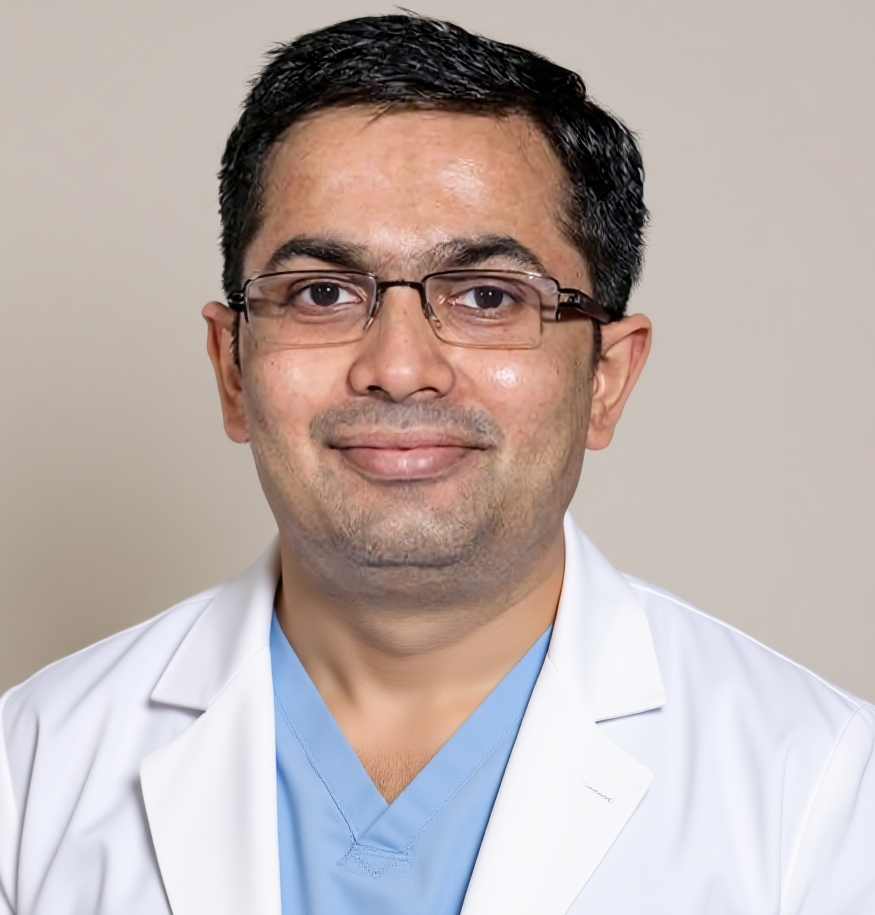
Shah’s Gastro, Cancer & Robotic Surgery Centre. Trained in super-specialty surgical gastroenterology programmes, qualified twice over in the specialty, and operating on the pancreas, bile duct, stomach, food pipe and bowel as the whole of his practice rather than one line on a general surgical list.
Dr Harsh Shah
MS, MCh (Surgical Gastroenterology), DrNB (Surgical Gastroenterology)
Registered with Gujarat Medical Council, Reg. No. G-38738
Pancreas Cancer Surgeon · Apollo Hospital, Bhat, Gandhinagar · Gota OPD, Ahmedabad
Google rating 4.89 from 216 reviews at the Gota clinic, and 4.94 from 17 reviews at Apollo, Bhat.
The chemotherapy itself is given by a medical oncologist. What Dr Harsh Shah does during those months is less visible and just as important: he keeps the surgical file open. Weight is checked, enzyme capsules are adjusted, a blocked stent is dealt with before it stops the treatment, and fitness is watched — a patient who has quietly lost strength over those months needs a different plan.
No borderline tumour is operated on one person’s reading. Every case goes to a tumour board — surgeon, medical oncologist, radiologist and pathologist reading the same images in one room — at diagnosis and again at re-staging.
Borderline resectable is an instruction about the order of treatment, not a verdict on the cancer. It means the tumour is in contact with the main vein behind the pancreas — over a long stretch, or enough to distort it — but there is healthy vein above and below that can be rebuilt, and any contact with the main artery is limited.
That anatomy is what makes an operation possible at all: a segment of vein can be removed with the tumour and rejoined, whereas an encased artery cannot. It is also what makes going straight to theatre unwise. A tumour sitting that close to the vessels is the kind most likely to leave cancer at the edge of the specimen if it is removed first, and the kind most likely to have spread in ways no scan can yet see.
So chemotherapy comes first, for three practical reasons. It improves the chance that the tumour can be removed with a clear rim of normal tissue. It gives the disease time to show how it behaves before a major operation is spent on it. And it means the chemotherapy is actually received — when surgery is done first, a large share of patients never recover quickly enough to start it afterwards.
After a course of chemotherapy, usually a few months, the pancreatic-protocol CT and the CA 19-9 blood marker are repeated and the tumour board meets again. Dr Harsh Shah then gives one of three recommendations — proceed to surgery, continue treatment and reassess, or stop pursuing an operation — and tells you which findings led to it.
| What re-staging shows | What it usually means | What is recommended |
|---|---|---|
| Tumour the same size or smaller on CT, marker falling, patient well and active | The cancer is responding, even if the scan does not show it shrinking | Proceed to surgery — the operation is planned and a date is given |
| Clear removal still uncertain on the scan, marker only partly down, fitness preserved | Response is incomplete but the disease has not spread | More treatment — further chemotherapy, sometimes radiotherapy for local control — then a further re-staging |
| New deposits in the liver or the lining of the abdomen, or a rising marker with new disease | The cancer has shown it is not confined to the pancreas | No operation; treatment continues as systemic and supportive care |
| Disease controlled, but strength and weight have fallen badly during chemotherapy | The tumour may be removable while the patient is not yet fit for removal | Strength and nutrition rebuilt first; surgery reconsidered when fit |
One finding misleads families more than any other. CT under-estimates the response to chemotherapy in pancreatic cancer. A tumour often looks unchanged in size after treatment because much of what remains is scar rather than cancer. A patient who is well, whose marker has fallen and whose scan “shows no change” has not failed chemotherapy, and is still offered exploration. Reading “no change” as “no benefit” ends the chance of an operation for people who had one.
No single result decides whether to operate after chemotherapy. Dr Harsh Shah reads four things side by side — the new scan against the old one, the marker, your fitness, and, where something remains uncertain, a short camera look inside the abdomen — and the recommendation follows from all four together.
Two other results shape the plan without deciding it. A germline test for inherited BRCA or PALB2 changes, offered to every patient with this diagnosis, can change which chemotherapy is used and matters to brothers, sisters and children. And a stent in the bile duct, if one was needed, should be a short covered metal stent — plastic stents block over months of treatment, and the infection that follows can interrupt chemotherapy at exactly the wrong time.
When the decision is to operate, the aim is a complete removal with a clear rim of normal tissue at every cut surface. If the tumour is still stuck to the vein, that segment of vein is removed with it and rebuilt, either joined directly or bridged. Removing and rebuilding the main artery is not standard practice, and Dr Harsh Shah does not offer it as a routine.
Which operation depends on where the tumour sits. A tumour of the head of the pancreas is removed by a Whipple’s pancreaticoduodenectomy; a tumour of the body or tail by a distal pancreatectomy with the spleen. The standard field of lymph nodes comes out with the specimen and no more — a wider clearance adds complications without adding benefit.
Three things can still change the plan in theatre, and you are told about each of them beforehand. Where the cut edge of the pancreas or the bile duct is close to the tumour, a frozen section is sent to the pathologist during the operation and more tissue is taken if needed. Where the vein has been removed, the reconstruction is checked before the abdomen is closed. And where deposits are found on the liver or the lining of the abdomen, the resection is not performed.
The quality of the operation is judged later, on the pathology report, which is gone through with you in person at the first follow-up visit.
Dr Harsh Shah performs the operation himself, from the first incision to the last stitch of the reconstruction. The approach is chosen for the tumour after the re-staging scan is read, not promised in advance, and no technology is offered because it sounds more advanced.
Dr Harsh Shah operates robotically and laparoscopically for other gastrointestinal cancers, so “will it be keyhole?” is a fair question to ask. After chemotherapy, with a tumour close to the vein and a reconstruction that may be needed, the priority is a complete removal and a secure join between the pancreas and the bowel, not a smaller scar. Anyone who names a machine before reading your scan is planning the technology rather than your operation.
In borderline disease a second opinion is most useful at three moments: when you have been told the tumour is inoperable only because it touches the vein, when you have been offered surgery straight away on a borderline scan without chemotherapy first, and when an operation has been called off after chemotherapy because the scan “has not changed”.
Each of those is a judgement made on images, and each is hard to undo. Vein contact on its own is what borderline means, not what inoperable means. Surgery first on a borderline tumour gives up the advantages chemotherapy was meant to buy. And a scan that looks unchanged after chemotherapy, in a patient who is well with a falling marker, is not a reason to abandon the operation. If a routine CT rather than a pancreatic-protocol CT was used at any of these points, the question has not yet been properly asked.
What to bring: both CTs, before and after chemotherapy, on a disc or drive — the images, not just the reports; the chemotherapy record, including any doses that were reduced or delayed; every CA 19-9 result with the bilirubin from the same date; the biopsy report; and details of any stent and when it was placed.
The risks are gone through in person, by Dr Harsh Shah, before you sign: a leak from the join between the pancreas and the bowel, a stomach that is slow to start emptying, bleeding after the operation — including the small warning bleed that must never be watched overnight — bile leak, a collection that needs draining, and the possibility of a second operation. The figures that apply to your own gland, age and fitness are given at that discussion, where questions can be asked, rather than on a web page. Afterwards, enzyme capsules with every meal and a plan for blood sugar are part of normal life, not complications.
★★★★★
“We are very thankful to Dr. Harsh Shah for successfully performing the Whipple’s procedure. From the beginning, he explained everything clearly and gave us great confidence throughout the treatment. Today, we are happy to share that we received the discharge and are going home with a positive feeling. Thank you, Dr. Harsh Shah, for your expertise, care, and support. Highly recommended for GI surgery.”
— Desai Sonal, Google review, Apollo Hospital, Bhat listing
★★★★★
“My patient was having tumour in abdomen. Dr Harsh Shah did an operation called whipple’s operation. Today after 7 days of operation, we are being discharged from the hospital. We are happy with the services provided by Dr Harsh Shah & Apollo Hospital.”
— piyush aanjna, Google review, Gota clinic listing
★★★★★
“Met with Dr. Harsh Shah for the consultation of one of my relative. Dr. Harsh Shah is an exceptional surgical oncologist in Ahmedabad. His expertise in treating complex GI cancers like liver, pancreas, and colon cancers is truly remarkable. He explains everything clearly and gives patients full confidence in their treatment. Highly recommended for anyone looking for a skilled and compassionate cancer specialist.”
— Nagesh Patidar, Google review
Reviews are reproduced exactly as written on Google, including the original spelling and spacing.
A patient’s own account after a Whipple’s operation by Dr Harsh Shah, for a neuroendocrine tumour of the pancreas — a different tumour from the one on this page, recorded and shared with written consent.
The cost of borderline pancreatic cancer treatment comes in two parts — the chemotherapy months and the operation — and neither is a single figure. The operation’s cost moves with the room category, the length of stay, whether intensive care is needed, whether the vein is rebuilt, and how the pancreatic join behaves in the first week. A written estimate is given before admission.
Apollo Hospital, Bhat, works with the major insurers and cashless schemes, and the office handles pre-authorisation for the operation directly. Because borderline treatment runs over months, keep the policy papers, chemotherapy bills and discharge summaries together from the start; send the policy details with the reports so the paperwork runs alongside the medical planning. If a stay runs longer than estimated, an enhancement request is raised at the time, not at discharge.
Bring on admission: both CTs, the chemotherapy summary, medicines with doses, the insurance card and identification, and one family member as the point of contact.
Not necessarily. CT under-estimates the response to chemotherapy in pancreatic cancer, because much of what remains after treatment is often scar rather than cancer. If you are well and your CA 19-9 has fallen, Dr Harsh Shah still recommends exploration rather than abandoning the operation.
Because a borderline tumour is the kind most likely to leave cancer at the cut edge if removed first, and the kind most likely to have spread in ways a scan cannot yet see. Chemotherapy first improves the chance of a clear removal and makes sure the chemotherapy is actually received.
Sometimes. If the tumour is still attached to the vein at the operation, that segment is removed with it and rebuilt, joined directly or bridged. You are told before consent whether this is likely, and what it changes about recovery.
The tumour board — surgeon, medical oncologist, radiologist and pathologist — reads the new scan together, and Dr Harsh Shah, who will operate, gives the recommendation to you in person with the reasons for it.
Yes. If deposits are found on the liver or the lining of the abdomen, the pancreas is not removed, because doing so would add risk without lengthening life. This possibility is discussed with you and your family before the operation.
Once re-staging is complete and you have recovered from the last cycle, the operation is planned without unnecessary delay. If strength or weight has fallen, a short period of rebuilding comes first, because fitness for the operation matters as much as the scan.
Shah’s Gastro, Cancer & Robotic Surgery Centre — Gota, Ahmedabad
Consultations, review of scans, follow-up and surveillance.
Google: Dr Harsh Shah · 4.89 from 216 reviews
Directions to the Gota clinic · +91-63555-64601
Apollo Hospital — Bhat, Gandhinagar
Apollo Hospital International Limited, Plot No. 1 A, GIDC Bhat Industrial Estate, Bhat, Gandhinagar.
Google: Dr Harsh Shah – Robotic GI Surgeon · 4.94 from 17 reviews
Directions to Apollo, Bhat · WhatsApp +91-63555-64601
Families come to Ahmedabad for pancreatic cancer surgery from across Gujarat — Gandhinagar, Mehsana, Banaskantha, Nadiad, Anand, Bhavnagar, Rajkot, Jamnagar and Kutch — and from southern Rajasthan and western Madhya Pradesh.
Bring the scans themselves, not only the reports. The CT images from before and after chemotherapy, the chemotherapy record and the marker results can be sent ahead of your appointment, so the consultation starts with them already read. Treatment is decided at the consultation, after examination. Call +91-63555-64601 · WhatsApp the clinic
Swasth Parivar: twice a month, practical advice on recovery, diet and warning signs. No advertising. Stop any time.
Your number is used for these updates and for the clinic to reach you. It is never sold or passed on. To stop, reply STOP on WhatsApp.
