

WhatsApp

Stents, Bypass, Pain Control and Re-staging — Dr Harsh Shah's Role in Locally Advanced Pancreatic Cancer

Shah's Gastro, Cancer & Robotic Surgery Centre · Ahmedabad & Gandhinagar

Locally advanced pancreatic cancer surgeon in Ahmedabad · Gota OPD, Ahmedabad · Apollo Hospital, Bhat, Gandhinagar

A locally advanced pancreatic cancer cannot be removed at diagnosis, but a surgeon still has work to do from the first day. Dr Harsh Shah checks that the label is right, deals with the jaundice, the blocked stomach and the pain that can stop chemotherapy, and asks the operation question again at re-staging — then gives you a straight answer, including when that answer is still no. This page is about those decisions, what changes them, when a second opinion helps, and what to ask.

Who operates — and why the surgeon stays involved before there is an operation

In locally advanced pancreatic cancer the operating surgeon is involved long before any operation, because the problems that interrupt chemotherapy — a bile duct that blocks, a stomach outlet that closes, pain that stops a patient eating — are surgical problems. Dr Harsh Shah sees you at the Gota OPD, follows you through treatment, and is the surgeon who operates at Apollo, Bhat, if the time comes.
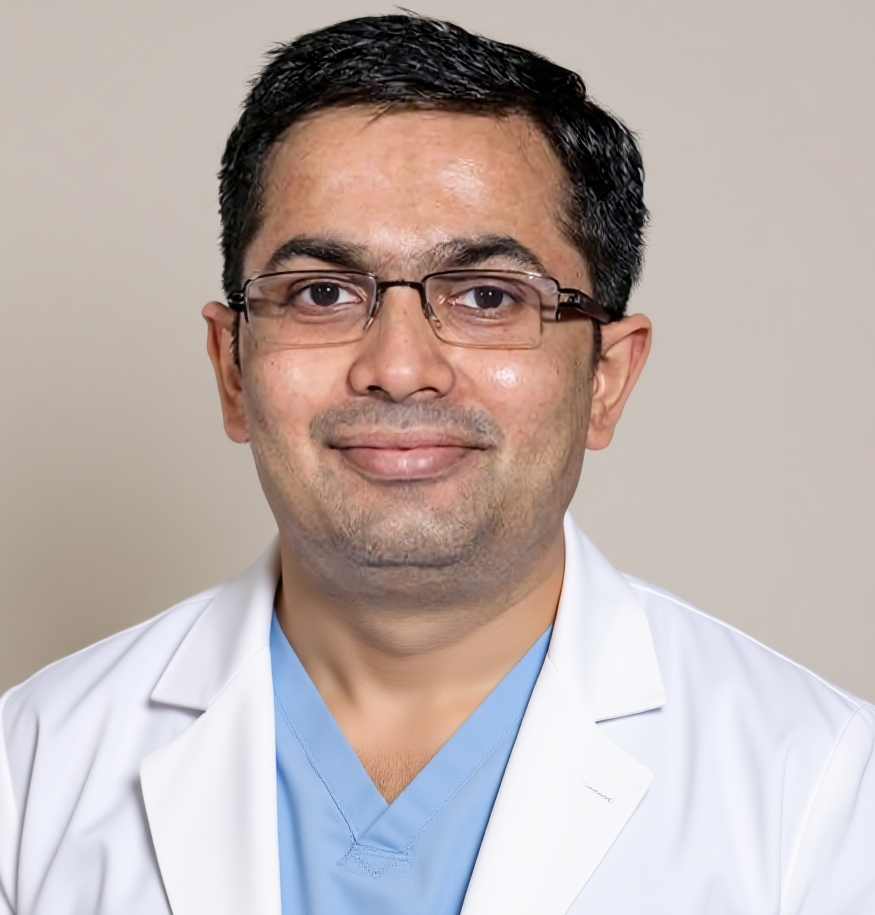
Dr Harsh Shah, gastrointestinal and cancer surgeon, Ahmedabad
Dr Harsh Shah — MS, MCh (Surgical Gastroenterology), DrNB (Surgical Gastroenterology).

Shah’s Gastro, Cancer & Robotic Surgery Centre. Trained in super-specialty surgical gastroenterology programmes, qualified twice over in the specialty, and operating on the pancreas, bile duct, stomach, food pipe and bowel as the whole of his practice rather than one line on a general surgical list.

Dr Harsh Shah
MS, MCh (Surgical Gastroenterology), DrNB (Surgical Gastroenterology)
Registered with Gujarat Medical Council, Reg. No. G-38738
Pancreas Cancer Surgeon · Apollo Hospital, Bhat, Gandhinagar · Gota OPD, Ahmedabad

Google rating 4.89 from 216 reviews at the Gota clinic, and 4.94 from 17 reviews at Apollo, Bhat.

Chemotherapy is given by a medical oncologist, and the two work from one plan. Every patient is discussed at a tumour board — surgeon, medical oncologist, radiologist and pathologist reading the same images — at diagnosis, and again after the first months of treatment, because a proportion of locally advanced tumours respond well enough to be reconsidered for surgery.

Is the label right? The first thing a surgeon checks

“Locally advanced” means the tumour has wrapped around more than half the circumference of one of the main arteries behind the pancreas, or has blocked the main vein over a length that cannot be rebuilt — with no spread beyond the pancreas and its own lymph nodes. Before anything else, Dr Harsh Shah confirms that the scan actually shows this.

The label goes wrong in two directions, and both matter. A tumour that only touches the vein, or only partly touches an artery, is borderline rather than locally advanced — and borderline disease has a planned route to an operation after chemotherapy. The commonest cause of that error is the scan itself: a routine abdominal CT cannot measure contact with the vessels, and only a thin-slice, two-phase pancreatic-protocol CT can. If that is not the scan you were given, it is repeated before anyone tells you what is possible.

The opposite error also happens. A tumour that truly encases an artery is sometimes offered an immediate operation. Removing and rebuilding the main artery is not standard practice, and an operation that leaves cancer behind carries all the risk of a major resection with none of the benefit. A surgeon who declines that operation is not giving up; he is choosing the order of treatment that keeps the chance of a later one open.

Tissue is taken before chemotherapy starts, usually by an endoscopic ultrasound needle biopsy. Chemotherapy is never started on a scan alone, and a negative biopsy does not mean there is no cancer — it can mean the needle missed.

Keeping chemotherapy on track — the surgical problems along the way

Chemotherapy for locally advanced pancreatic cancer runs for months, and the commonest reasons it stops early are jaundice, a blocked stomach outlet, pain and weight loss. Each has a surgical or procedural answer, and dealing with it promptly is part of Dr Harsh Shah’s role while there is no operation to do.

Problems during treatment, and what is done about them
ProblemWhat it usually meansWhat is done
Yellow eyes, itching, dark urineThe tumour is blocking the bile ductA short covered metal stent, placed endoscopically — plastic stents block over months of chemotherapy
Fever and shivering with jaundiceInfection in a blocked bile ductTreated the same day as an emergency; drainage first, chemotherapy resumes afterwards
Vomiting, fullness after a few mouthfulsThe tumour is narrowing the outlet of the stomachAssessed by the surgeon the same day; relieved with an endoscopic stent or a bypass operation joining the stomach to the bowel
Deep pain through to the backThe tumour is affecting the nerves behind the pancreasA coeliac plexus block alongside medicines — under-used, and often very effective
Weight loss, loose pale stoolsThe pancreas is not making enough digestive enzymesEnzyme capsules with every meal and snack, dietitian review, weight checked at every visit
New or worsening diabetesThe pancreas is producing less insulinA written plan for blood sugar, with insulin where needed

Two further points run through these months. This is among the most clot-prone of all cancers, so a calf swelling or sudden breathlessness is reported at once, and the risk of clots is discussed with you at the start. And palliative care is introduced early and in parallel — not at the end, and not instead of active treatment.

Re-staging — the operation question asked again

After the first months of chemotherapy the pancreatic-protocol CT and the CA 19-9 marker are repeated and the tumour board meets again. Surgery is reconsidered when four things line up: the scan suggests the tumour can now be removed completely, the marker is falling, you have stayed fit, and no new disease has appeared anywhere else.

A minority of locally advanced tumours reach that point. When they do, the operation is a Whipple’s for a tumour of the head or a distal pancreatectomy for one in the body or tail, often with removal and rebuilding of the main vein. Before that decision is final, a short camera look inside the abdomen may be advised, because deposits too small for any scan would change the answer.

The re-staging scan has to be read carefully. CT under-estimates the response to chemotherapy, and a tumour that looks the same size may contain more scar than cancer. A patient who is well, with a falling marker and a scan that “has not changed”, has not failed treatment. For patients whose disease is controlled but not yet removable, radiotherapy or a focused form of it may be added for local control, and the question is asked again later.

When the answer is still no

For many patients with locally advanced pancreatic cancer the answer at re-staging remains that an operation would not help — and Dr Harsh Shah says so plainly, with the reasons. Treatment then continues to control the disease and protect quality of life, and the surgical problems in the table above still have surgical answers.

The reason an artery is not simply removed and rebuilt is not timidity. Arterial resection for pancreatic cancer is confined to highly selected patients in specialist settings, its benefit is debated, and the operation’s risks are considerable. Offering it as routine would expose many patients to harm to benefit very few.

What “no operation” does not mean is “no surgeon”. The bypass for a blocked stomach, the stent decisions, the pain block and the nutrition plan are all part of the care Dr Harsh Shah continues to give, and they are the parts that most change how a family’s months feel.

Who is at the console, if an operation becomes possible

If re-staging opens the way to surgery, Dr Harsh Shah performs the operation himself at Apollo, Bhat. The approach is decided for the tumour once the re-staging scan is read, and is not promised in advance.

Dr Harsh Shah operates robotically and laparoscopically for other gastrointestinal cancers. After months of chemotherapy, with a tumour close to the main vessels and a vein that may need rebuilding, the priority is a complete removal and a secure reconstruction rather than a particular technology. Ask any surgeon who names a machine before reading your scan what the machine changes about your operation.

When a second opinion is worth taking

In locally advanced disease, a second opinion is worth taking when you were told “nothing can be done” without a pancreatic-protocol CT or a tumour board, when you were offered an immediate operation on a tumour that encases an artery, when months of chemotherapy have passed and nobody has asked the surgical question again, and when pain is uncontrolled and nobody has mentioned a coeliac plexus block.

Each of these is common, and each changes the plan. Bring every CT on a disc or drive — the first one and the latest one — not only the reports; the biopsy report; the chemotherapy record with any doses reduced or delayed; every CA 19-9 result with the bilirubin from the same date; and the name and date of any stent.

Questions to ask the team

  1. Which vessel makes my tumour locally advanced rather than borderline — the artery or the vein?
  2. Was that read on a pancreatic-protocol CT, and has the tumour board seen it?
  3. When will the operation question be asked again, and who will ask it?
  4. What will you do if I become jaundiced, start vomiting, or the pain gets worse during chemotherapy?
  5. Am I on the right dose of enzyme capsules, and who checks my weight?
  6. Has germline testing been done, and does the result change my chemotherapy?
  7. If an operation becomes possible, who performs it, and what would make you stop it once it starts?

If surgery does come, the risks are gone through in person by Dr Harsh Shah before you sign — a leak from the join between the pancreas and the bowel, a stomach slow to start emptying, bleeding including the small warning bleed that is never watched overnight, and the possibility of a second operation — with the figures that apply to you, at a discussion where questions can be asked.

What patients and families have said

★★★★★

“Met with Dr. Harsh Shah for the consultation of one of my relative. Dr. Harsh Shah is an exceptional surgical oncologist in Ahmedabad. His expertise in treating complex GI cancers like liver, pancreas, and colon cancers is truly remarkable. He explains everything clearly and gives patients full confidence in their treatment. Highly recommended for anyone looking for a skilled and compassionate cancer specialist.”

— Nagesh Patidar, Google review

★★★★★

“My patient was having tumour in abdomen. Dr Harsh Shah did an operation called whipple’s operation. Today after 7 days of operation, we are being discharged from the hospital. We are happy with the services provided by Dr Harsh Shah & Apollo Hospital.”

— piyush aanjna, Google review, Gota clinic listing

★★★★★

“We are very thankful to Dr. Harsh Shah for successfully performing the Whipple’s procedure. From the beginning, he explained everything clearly and gave us great confidence throughout the treatment. Today, we are happy to share that we received the discharge and are going home with a positive feeling. Thank you, Dr. Harsh Shah, for your expertise, care, and support. Highly recommended for GI surgery.”

— Desai Sonal, Google review

Reviews are reproduced exactly as written on Google, including the original spelling and spacing.

A patient’s own account after a Whipple’s operation by Dr Harsh Shah, for a neuroendocrine tumour of the pancreas — a different tumour from the one on this page, recorded and shared with written consent.

Your patient journey, in five steps

  1. Book your consultation. At the Gota OPD, Ahmedabad, with the CT images and reports.
  2. Tests and a treatment plan. A pancreatic-protocol CT if one has not been done, tissue, the marker, germline testing, nutrition and fitness assessment, and the tumour board. Chemotherapy is arranged with the medical oncologist.
  3. Treatment, with the surgical problems handled. Stents, pain control, enzyme capsules and nutrition kept on track; re-staging after the first months. Surgery, if it becomes possible, is at Apollo Hospital, Bhat, Gandhinagar, with Dr Harsh Shah operating.
  4. The hospital stay, when there is one. For an operation: early walking and drinking, drain fluid tested the next morning, enzyme capsules taught before you leave. For a stent or bypass: a shorter stay, with chemotherapy resuming as soon as you are well.
  5. Follow-up. Regular review of symptoms, weight, the marker and scans on a written schedule, with palliative care alongside from early on.

Cost, insurance and admission

Locally advanced pancreatic cancer is treated over months, so the cost is a series of episodes — chemotherapy cycles, procedures such as a stent or a pain block, any admission for a bypass, and an operation if one becomes possible — rather than one figure. Each admission comes with a written estimate beforehand.

Apollo Hospital, Bhat, works with the major insurers and cashless schemes, and the office handles pre-authorisation for admissions and procedures directly. Keep the policy papers, chemotherapy bills and discharge summaries in one folder from the start, and send the policy details with the reports so the paperwork runs alongside the medical planning.

Bring on admission: the latest CT on a disc or drive, the chemotherapy summary, medicines with doses, the insurance card and identification, and one family member as the point of contact.

Frequently asked questions

Can a locally advanced pancreatic cancer ever be operated on?

Sometimes. After the first months of chemotherapy a minority of tumours respond enough for the scan to suggest complete removal is possible. If the marker is falling, you have stayed fit and no new disease has appeared, the tumour board reconsiders surgery.

Why won't the surgeon remove the artery along with the tumour?

Because removing and rebuilding the main artery is not standard practice for pancreatic cancer. It is confined to highly selected patients in specialist settings, its benefit is debated and its risks are considerable, so Dr Harsh Shah does not offer it as routine.

What can be done if I start vomiting during chemotherapy?

Persistent vomiting can mean the tumour is narrowing the stomach outlet. It is assessed by the surgeon the same day and relieved, either with an endoscopic stent or with a bypass operation that joins the stomach to the bowel, so treatment can continue.

Is the back pain from pancreatic cancer treatable?

Yes, usually. Alongside medicines, a coeliac plexus block numbs the nerves behind the pancreas that carry the pain. It is under-used and often very effective.

Do I need a biopsy before chemotherapy?

Yes. Chemotherapy is never started on a scan alone. Tissue is usually taken by an endoscopic ultrasound needle biopsy, and a negative result does not rule out cancer — it may mean the needle missed.

Why do I need enzyme capsules if I am not having surgery?

Because a tumour in the pancreas often blocks the duct that carries digestive enzymes. Without the capsules food is poorly absorbed, weight falls and chemotherapy is tolerated badly. They are taken with every meal and snack.

Where Dr Harsh Shah sees and operates

Shah’s Gastro, Cancer & Robotic Surgery Centre — Gota, Ahmedabad
Consultations, review of scans, follow-up and surveillance.
Google: Dr Harsh Shah · 4.89 from 216 reviews
Directions to the Gota clinic · +91-63555-64601

Apollo Hospital — Bhat, Gandhinagar
Apollo Hospital International Limited, Plot No. 1 A, GIDC Bhat Industrial Estate, Bhat, Gandhinagar.
Google: Dr Harsh Shah – Robotic GI Surgeon · 4.94 from 17 reviews
Directions to Apollo, Bhat · WhatsApp +91-63555-64601

Families come to Ahmedabad for pancreatic cancer surgery from across Gujarat — Gandhinagar, Mehsana, Banaskantha, Nadiad, Anand, Bhavnagar, Rajkot, Jamnagar and Kutch — and from southern Rajasthan and western Madhya Pradesh.

The images decide this, so bring the images. The CT on a disc or drive, the biopsy report and any chemotherapy record can be sent ahead of your appointment, so the consultation starts with them already read. Treatment is decided at the consultation, after examination. Call +91-63555-64601 · WhatsApp the clinic

Rate this page

Get health updates from Dr Harsh Shah on WhatsApp

Swasth Parivar: twice a month, practical advice on recovery, diet and warning signs. No advertising. Stop any time.

Your number is used for these updates and for the clinic to reach you. It is never sold or passed on. To stop, reply STOP on WhatsApp.

Dr Harsh Shah - Surgical Gastroenterologist and GI Robotic Surgeon, Ahmedabad
Privacy Overview

This website uses cookies so that we can provide you with the best user experience possible. Cookie information is stored in your browser and performs functions such as recognising you when you return to our website and helping our team to understand which sections of the website you find most interesting and useful.