
Shah's Gastro, Cancer & Robotic Surgery Centre · Ahmedabad & Gandhinagar
Last updated: 12-Oct-2026
Retroperitoneal sarcoma surgeon in Ahmedabad · Gota OPD, Gota, Ahmedabad · Apollo Hospital, Bhat, Gandhinagar
A retroperitoneal sarcoma is a rare cancer in the tissues at the back of the abdomen. The first planned operation gives the strongest chance of long-term control.
Two rules come before any cut. A core biopsy is taken from the back or side first. Then one planned operation removes the tumour in one piece.
That operation often removes a kidney, part of the bowel or a muscle along with the tumour. Each organ is named and agreed before the day of surgery.
Read this if a scan has found a large mass behind the bowel and someone has mentioned an operation. It covers how that operation is planned, the findings that change it, the moments when another expert look is wise, and the questions to settle before signing. A general account of sarcoma is not the aim here.
Dr Harsh Shah sees you at the Gota OPD, takes the scans and biopsy to a sarcoma team meeting, explains the plan himself and performs the operation at Apollo Hospital, Bhat.
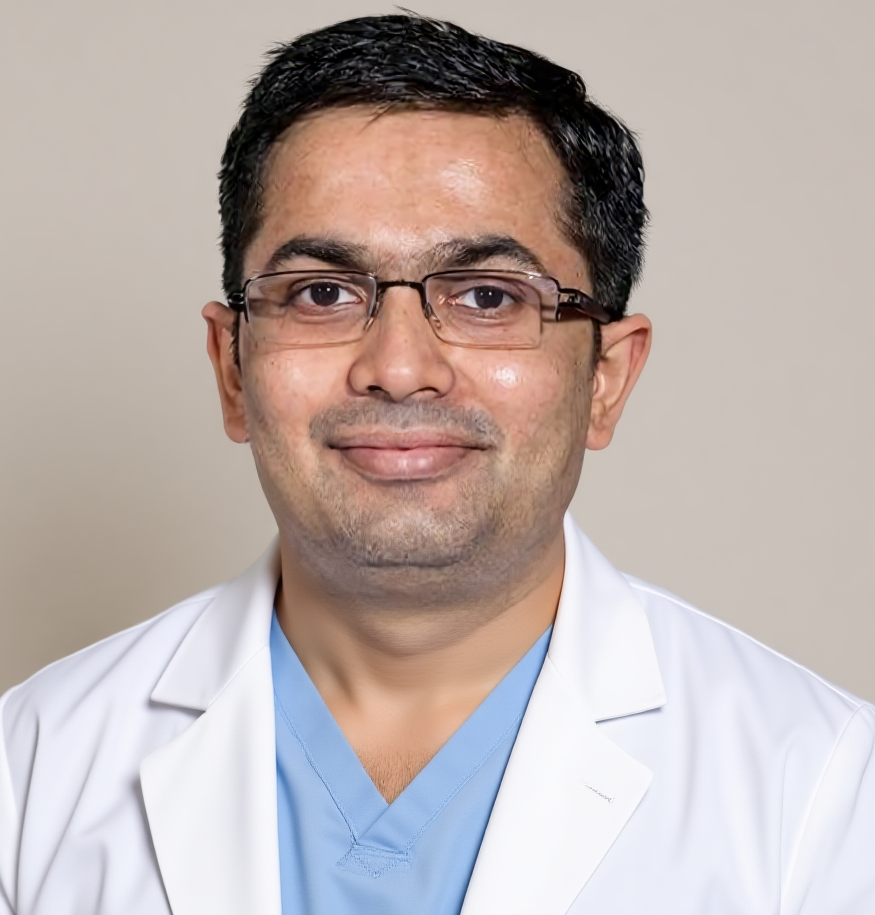
Shah’s Gastro, Cancer & Robotic Surgery Centre. He trained in super-specialty surgical gastroenterology and has 18 years of experience in abdominal cancer surgery. Operations that remove a tumour together with the bowel, pancreas, spleen or kidney are part of his work. The same surgeon sees you from the first visit to the last scan.
Dr Harsh Shah
MS, MCh (Surgical Gastroenterology), DrNB (Surgical Gastroenterology)
Registered with Gujarat Medical Council, Reg. No. G-38738
Gastro & Cancer Surgeon · Apollo Hospital, Bhat, Gandhinagar · Gota OPD, Ahmedabad
Google rating 4.89 from 216 reviews at the Gota clinic, and 4.94 from 18 reviews at Apollo, Bhat.
A mass in this space is discussed twice: once before the needle goes in, and again once the slides are read. A radiologist used to sarcoma scans and an expert sarcoma pathologist sit with the surgeon and the cancer physician for both talks. Only after the second talk is an operation offered. Dr Shah then meets you and your family, often more than once, to list each organ that may come out and why.
Never remove an undiagnosed mass at the back of the abdomen. And plan the first operation with care, because a second one is harder and less complete.
If a scan says “retroperitoneal mass” or even “lipoma”, please hold before any operation.
A CT-guided core needle biopsy, taken from the back or the side, is the standard. Several cores are taken through one guiding tube, so the track can be removed later.
| Method | Advised or not, and why |
|---|---|
| Core needle biopsy from the back or side, under CT | Advised. Several cores give enough tissue for the subtype and grade. The track stays outside the main abdominal lining, and it is removed with the tumour. |
| Needle passed through the front of the abdomen | Avoided. It can spread tumour cells into the abdominal lining. |
| Keyhole (laparoscopic) biopsy | Avoided. It opens the abdomen and risks spillage. |
| Open biopsy through a cut | Avoided. It leaves a track that is hard to trace and remove. |
| Fine needle aspiration (FNA) | Avoided. It gives too few cells to name the sarcoma type. |
Before the biopsy, some blood tests may be needed. If the mass sits near the adrenal gland, a blood test for an adrenaline-making tumour (phaeochromocytoma) is done first. A needle in that tumour can be dangerous. Where a lymph gland cancer or a germ cell tumour is possible, AFP, beta-hCG and LDH are checked. The slides are then read by an expert sarcoma pathologist, because general reports often misname the subtype.
Several other diseases grow in the same place. Some are treated with chemotherapy or tablets, and an operation would harm the patient. They are ruled out first.
| Look-alike | Clue, and the usual first treatment |
|---|---|
| Lymphoma | Many swollen glands, fevers or sweats, a raised LDH. Chemotherapy, not surgery. |
| Germ cell tumour | A younger man, a mass in the midline, raised AFP or beta-hCG. Chemotherapy first. |
| GIST | Grows from the bowel wall. A tablet treatment, and a different operation. See our GIST surgery decision page. |
| Adrenal tumour | Starts in the adrenal gland. Hormone tests come first. |
| Kidney tumour | Starts in the kidney on the scan. A kidney cancer plan. |
| Tuberculosis, or scarring behind the abdomen | Clumped glands, fevers, raised IgG4. Medicines, not this operation. |
The subtype and grade, the organs the tumour touches, the large blood vessels, the other kidney’s function and your fitness decide how much is removed.
| Finding | How it changes the plan |
|---|---|
| Subtype and grade from the biopsy | The strongest guide. It sets the goal of surgery and the follow-up. |
| Organs the tumour sticks to | Those organs come out with it in one piece. They are named and agreed in advance. |
| The main vein (IVC) or leg vessels involved | A vessel may be removed and rebuilt. The vascular surgeon plans it with us before the day. |
| Ureter wrapped by the tumour | A thin tube (stent) is placed in the ureter before the operation. |
| The kidney on the other side | Its function is measured. If one kidney may go, the other must work well. |
| Nerves, the back muscle (psoas), the spine or the pelvic wall | An MRI maps these. It tells you what nerve or muscle loss to expect. |
| Your fitness and daily activity | Fully active people suit a full removal. Less active people may get a smaller operation. Very frail people may get comfort care or medicines. |
| Spread to the lungs or liver at diagnosis | The plan changes. Medicines lead, and surgery is decided case by case. |
Some sarcomas mostly come back in the same place. Others mostly spread to the lungs or liver. That tells us where to aim the treatment and the scans.
| Subtype | What it tends to do, and what that means |
|---|---|
| Well-differentiated liposarcoma | Often returns in the same place, rarely spreads. Control at the site is the goal. |
| Dedifferentiated liposarcoma | Returns locally and sometimes spreads. Firm control at the site, and scans for spread. |
| Leiomyosarcoma | Returns locally less often, but spreads to the lungs and liver. Chest scans are essential. |
| Solitary fibrous tumour | Behaviour varies, and spread can come late. Very long follow-up. |
| Undifferentiated sarcoma and nerve-sheath sarcoma | Return and spread are both common. Every step goes through the team meeting. |
★★★★★
“Met with Dr. Harsh Shah for the consultation of one of my relative. Dr. Harsh Shah is an exceptional surgical oncologist in Ahmedabad. His expertise in treating complex GI cancers like liver, pancreas, and colon cancers is truly remarkable. He explains everything clearly and gives patients full confidence in their treatment. Highly recommended for anyone looking for a skilled and compassionate cancer specialist.”
— Nagesh Patidar, Google review
★★★★★
“My father has carcinoma of stomach ,Harsh sir did radical gastrectomy and he is recovering very nicely under Dr.Harsh's observation ,he listen each and every complain calmly and with patience and make patient very comfortable during treatment , during procedure and during stay at hospital. we are satisfied with the treatment and very confident about the fully recovery of disease as we are under treatment of Dr.Harsh & team.Thank you Dr.Harsh & his whole team and staff.”
— tina parmar, Google review
★★★★★
“(Translated by Google) Dr. Harsh Shah's personality is very nice. He always talks in a good way. He has undergone surgery for colon cancer. Without any problem. Yours faithfully.🙏 (Original) ડૉ હર્ષ શાહ નો સ્વાભાવ ખૂબ જ સરસ છે.તેઓ હમેશા સારી રીત વાત કરે છે .મોટા આંતરડા ના કેન્સર ની સર્જરી એમને કરેલ લી છે. કોઈ પ્રકાર ની તકલીફ નાથી .આપનો અભર.🙏”
— Ismailbhai Shaikh, Google review
These reviews are from Dr Harsh Shah’s Google listing at the Gota clinic, quoted exactly as written. None names a retroperitoneal sarcoma. They describe his cancer care.
The tumour is removed in one block with the organs stuck to it and a layer of normal tissue, where the anatomy allows. It is never shelled out or cut into pieces.
A sarcoma often has a thin false capsule. Tumour cells lie just outside it. Peeling the tumour out of that capsule leaves those cells behind. So the operation takes the tumour with the fat around it and the organs it touches, in one piece. The organs most often removed this way are the kidney on that side, part of the colon, the psoas muscle, the tail of the pancreas, the spleen, and the blood vessels to the ovary or testis.
These organs are not removed “just in case”. Each one is listed before surgery, and you agree to each one by name. The biopsy track is removed in the same block. The surgeon marks the specimen for the pathologist and records exactly what was removed. That record matters for every later decision.
Radiotherapy before surgery is not routine. Chemotherapy before surgery is used only for selected high-grade tumours. Both are decided at the team meeting.
We tell you plainly where the evidence is firm and where it is not. Surgery remains the main treatment.
This is an open operation through a generous cut, so there is no robotic console. Dr Harsh Shah operates himself, with vascular and urology surgeons ready when needed.
These tumours are often large and press on major vessels. Full exposure and early control of the blood vessels come first. A small cut does not serve this operation, and we do not offer keyhole or robotic removal of a retroperitoneal sarcoma. The anaesthetist uses close monitoring, careful fluid control and warming, and an epidural for pain where it suits. An intensive care bed is booked before the day, and blood is arranged in advance.
Take one before any operation on an undiagnosed mass, when a biopsy came through the front of the abdomen, or when the plan does not list the organs to be removed.
A second opinion here is not a sign of distrust. The first operation matters so much that it is worth one more expert look. We are glad to review your scans and slides, and to speak with your surgeon.
Ask what the biopsy showed, which organs may come out, how your kidneys will be checked, and how the scans will be done for years after.
This consent usually takes more than one meeting. Bring a family member to each one.
Preparation builds strength, corrects nutrition and blood count, and lines up the teams. It usually starts as soon as the plan is agreed.
Care starts in intensive care. Most patients go home between one and two weeks after this operation, once eating, walking and with stable kidney tests.
| Day | What happens |
|---|---|
| Day of surgery | Intensive care, close monitoring and pain relief. Urine is measured every hour, because one kidney changes fluid and drug choices. |
| Next day | Kidney tests, sitting out of bed and first walks. Drains are reviewed. |
| Days 2 to 3 | Fluids and diet as the bowel wakes, later if the colon was removed. Medicines that harm the kidney are avoided. |
| Days 4 to 7 | Diet built up, drains reviewed daily, stoma teaching if needed, more walking. |
| Days 7 to 14 | Home, once eating, walking alone, free of fever, with stable kidney tests. |
If a kidney was removed, you leave with a written note that you have one kidney. Avoid painkillers of the NSAID type, and mention it at every future hospital visit.
This is a major operation with real risks. The main long-term threat is the tumour coming back, which is why scans continue for many years.
General risks: bleeding that needs a transfusion, wound infection, clots in the legs or lungs, heart or chest problems, and anaesthetic risks. A stay in intensive care is planned.
Risks that depend on what is removed: a leak from a bowel join, a pancreatic leak if the tail of the pancreas is removed, and long-term kidney weakness after a kidney is removed, rarely needing dialysis. Others are injury to the ureter, a lymph fluid collection or milky fluid in the abdomen, a pus collection, and numbness or weakness of the thigh or foot drop if a nerve is removed. Leg swelling and a repeat operation are also possible. After the spleen is removed, there is a lifelong risk of serious infection, so vaccines and early treatment of fevers are needed.
Later: a hernia in the scar, and bowel blockage from adhesions. The final subtype and grade are known only after the full specimen is read, and they can change the plan. The operation carries a risk to life. Dr Harsh Shah goes through each of these in person, with the figures that apply to you, before consent.
This tumour can return late, even after ten years. Scans are frequent in the first two years and then continue every year.
| When | What is done |
|---|---|
| 2 weeks | Wound check, the full pathology result explained, kidney tests, stoma review. |
| Every 3 to 4 months, years 1 and 2 | Examination and a CT of the abdomen and pelvis. A chest CT for leiomyosarcoma and other high-grade types. |
| Every 6 months, years 3 to 5 | The same checks. |
| Every year, from year 5 onward | Scans continue. This is not a disease that is discharged at five years. |
| After kidney or spleen removal | Yearly kidney tests. Vaccines kept up, and a card for fevers. |
If the tumour comes back, a repeat operation can help, especially for well-differentiated liposarcoma. Each repeat operation is harder, though. For a fast-returning high-grade tumour, repeated operations often do not help. That choice is made at the team meeting, based on how the tumour behaves.
The cost depends on how many organs are removed, any vessel repair, and the days in intensive care. An estimate is given once the plan is fixed.
Apollo Hospital, Bhat, works with the major insurers and cashless schemes. The office handles pre-authorisation. Bring: CT reports and discs, biopsy reports and slides, blood reports, a list of medicines, the insurance card and identification. You can also call +91-63555-64601 to ask what to bring.
No. A mass at the back of the abdomen is biopsied first. Some look-alikes are treated with medicines, and a sarcoma needs a planned removal in one piece. Removing it first can spoil the strongest chance of control.
A needle from the back or side keeps the track outside the abdominal lining, and the track is removed with the tumour later. A needle through the front of the abdomen can spread cells inside it.
Only if the tumour is stuck to it. That is decided from the scans and agreed with you before surgery. The other kidney's function is checked first.
No. These tumours are large and lie on major vessels. An open operation with full exposure is the safe way to remove them in one piece.
Not routinely. Radiotherapy before surgery may be discussed for selected liposarcomas. Chemotherapy is considered for some high-grade tumours. The team meeting decides with you.
For many years. Scans are done every few months at first, then every year, because these tumours can return late.
Shah’s Gastro, Cancer & Robotic Surgery Centre — Gota, Ahmedabad
Consultations, review of scans and biopsy slides, and long-term follow-up.
Google: Dr Harsh Shah · 4.89 from 216 reviews
Directions to the Gota clinic · +91-63555-64601
Apollo Hospital, Bhat, Gandhinagar
Apollo Hospital International Limited, Plot No. 1 A, GIDC Bhat Industrial Estate, Bhat, Gandhinagar.
Google: Dr Harsh Shah – Robotic GI Surgeon · 4.94 from 18 reviews
Directions to Apollo, Bhat · WhatsApp +91-63555-64601
Patients come to Ahmedabad from across Gujarat, including Gandhinagar, Mehsana, Nadiad, Anand, Rajkot and Kutch, and from southern Rajasthan.
A scan has shown a large mass at the back of the abdomen? The CT scan on a disc, any biopsy report and slides, blood reports and earlier operation notes can be sent ahead of your appointment, so the consultation starts with them already read. Treatment is decided at the consultation, after examination. Please do not agree to an operation on an undiagnosed mass before that. Call +91-63555-64601 · Send the reports ahead on WhatsApp
Swasth Parivar: twice a month, practical advice on recovery, diet and warning signs. No advertising. Stop any time.
Your number is used for these updates and for the clinic to reach you. It is never sold or passed on. To stop, reply STOP on WhatsApp.