
Shah's Gastro, Cancer & Robotic Surgery Centre · Ahmedabad & Gandhinagar
GIST surgeon in Ahmedabad · Gota OPD, Ahmedabad · Apollo Hospital, Bhat, Gandhinagar
A gastrointestinal stromal tumour — GIST — is judged by three things the surgeon controls: that it comes out in one piece without breaking, that a clear rim of normal wall comes with it, and that as much of the stomach or bowel as possible is kept. Dr Harsh Shah makes the decisions that protect those three himself, before a date is fixed. Should the tumour be removed now, or shrunk first with imatinib tablets so that a smaller operation will do? Is a wedge of stomach wall enough, or does the position demand more? And can it be done through keyhole cuts without risking the tumour? This page explains how each is decided, when a second opinion is worth taking, and what to ask before you sign.
Dr Harsh Shah sees you at the Gota OPD, takes the consent himself, and performs the operation at Apollo Hospital, Bhat. Whenever imatinib before or after surgery is being considered, when the GIST sits at the junction with the food pipe, in the duodenum near the bile duct opening or low in the rectum, or when it has spread, the plan is made at a multidisciplinary tumour board first.
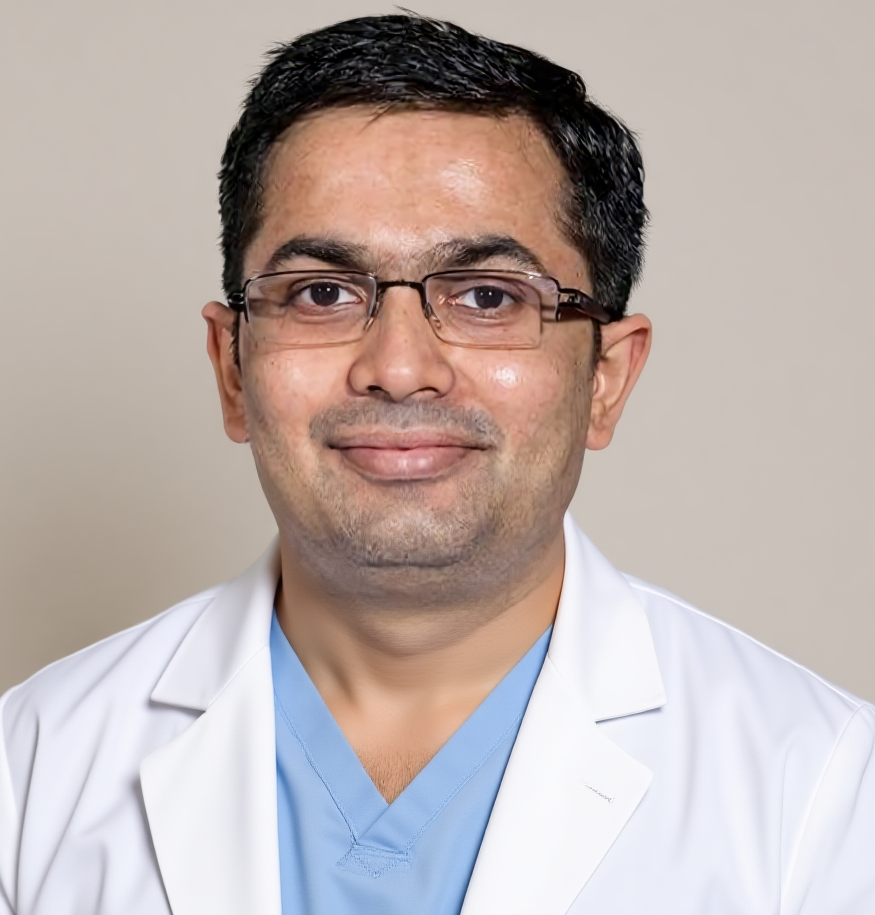
Shah’s Gastro, Cancer & Robotic Surgery Centre. Trained in super-specialty surgical gastroenterology, qualified twice over in that specialty, and with 18 years of experience in GI and cancer surgery. Operations on the stomach, small bowel, duodenum, colon, rectum, pancreas and bile duct are the whole of his practice, not one line on a general surgical list.
Dr Harsh Shah
MS, MCh (Surgical Gastroenterology), DrNB (Surgical Gastroenterology)
Registered with Gujarat Medical Council, Reg. No. G-38738
Gastro & Cancer Surgeon · Apollo Hospital, Bhat, Gandhinagar · Gota OPD, Ahmedabad
Google rating 4.89 from 216 reviews at the Gota clinic, and 4.94 from 17 reviews at Apollo, Bhat.
At the tumour board the surgeon, the medical oncologist, the radiologist and the pathologist look at the same CT, the same endoscopy and the same tissue. For a GIST the question they answer is rarely “can it be removed?” — most can — but “what is the smallest operation that removes it completely and safely, and should tablets come first?”
A GIST grows from the muscle wall, not from the lining, and it rarely spreads to lymph nodes. So the operation removes the tumour with a narrow rim of normal wall, and does not clear lymph nodes routinely. That is why a GIST of the stomach can usually be taken out with a wedge of stomach wall, leaving the rest of the stomach working.
| Where the GIST is | The usual operation | What the surgeon protects |
|---|---|---|
| Body or fundus of the stomach | Wedge resection — a piece of stomach wall around the tumour | The rest of the stomach; no rupture |
| Close to the food-pipe junction or the stomach outlet | Wedge with the closure hand-sewn so the passage does not narrow; imatinib first if the tumour is large | Swallowing, or the passage of food out of the stomach |
| Back wall of the stomach | Wedge after freeing the stomach from the bowel attachment, often with an endoscope inside to guide the cut | An exact margin without taking healthy stomach |
| Duodenum, away from the bile duct opening | Segmental or wedge removal of the duodenum | The bile and pancreatic ducts |
| Duodenum, near the bile duct opening | Imatinib first where possible, then a segment with the opening preserved; a Whipple’s operation only when that cannot be done | The ampulla and the pancreas |
| Small bowel | Removal of that segment and joining of the ends | Bowel length |
| Low rectum | Imatinib first, then a local or anterior resection; removal of the anal sphincter only if it cannot be freed | Bowel control and avoiding a permanent stoma |
A larger operation — removing most or all of the stomach — is chosen only when a wedge cannot leave a working passage. It is never chosen because the tumour is called a “cancer” and a cancer operation sounds more thorough. For GIST, more is not better; complete and intact is better.
Not always. A GIST that is clearly removable does not need a biopsy before the operation, and it must never be biopsied with a needle through the skin, because that can rupture it and seed the tumour along the track. A biopsy through an endoscope (EUS) is taken when the result will change the plan — above all, before any imatinib is started.
Imatinib before surgery is only given with tissue in hand and, ideally, a mutation test. The mutation decides whether imatinib will work at all, and at what dose: one particular change makes the tumour resistant to imatinib and needs a different drug, and another needs a higher dose. Starting tablets blind wastes months on a drug that may not act. Some tumours that look like GIST on a scan turn out to be something else — a leiomyoma, a schwannoma, a lymphoma or a stomach cancer — and the biopsy matters most where that difference would change the operation.
Most GISTs are removed straight away. Imatinib first, for six to twelve months, is advised when the tumour is so large or so placed that removing it now would cost more of an organ than necessary — at the food-pipe junction, in the duodenum near the bile duct opening, low in the rectum, or when it is borderline removable. The aim is a smaller, organ-sparing operation later.
When imatinib is given first, a CT is repeated at intervals. The operation is timed for the point of maximum shrinkage — usually when two successive scans show no further change — and not left so long that the tumour has a chance to develop resistance. On imatinib a GIST often becomes darker and more fluid-filled on CT before it becomes smaller; that change is a response, and reading it correctly is part of deciding when to operate.
The decision is made at the tumour board, with the surgeon who will operate in the room. A patient started on imatinib by one team and operated on by another is at risk of the timing being nobody’s job.
A GIST that ruptures during removal — even a small tear, or a tumour taken out in pieces — is classed as high risk from that moment, whatever its size, and the chance of it coming back rises sharply. Every step of the operation is built around keeping the capsule intact.
In practice that means the tumour itself is never grasped with instruments; it is handled through the normal wall beside it. In keyhole surgery the gas pressure is kept low over the tumour, and every specimen comes out inside a retrieval bag, never pulled through a small cut. If the tumour cannot be freed safely by keyhole surgery, the operation is converted to open — that is the right decision, not a failure. After the stomach is closed, the join is tested for leaks before the operation ends. If a biopsy was taken through the skin elsewhere, the track is removed. Whether the tumour was intact, and how it was removed, is written explicitly in the operation note, because the pathologist and the oncologist need to know.
Dr Harsh Shah performs the operation himself. For a smaller GIST of the stomach in a favourable position, laparoscopic or robotic wedge resection is the usual approach; for a large tumour, a tumour that looks fragile, or an emergency with bleeding or perforation, open surgery is chosen because it is safer for the capsule.
The approach is decided for your tumour after the scans are read and is explained at consent. Ask who will be operating on the day, whether that remains true if the date moves, and what will happen if the tumour cannot be removed in one piece by keyhole surgery.
Every risk of the operation is named at the consent discussion, and the figures that apply to you — adjusted for the tumour’s size and position, your age, your fitness and whether the operation is planned or urgent — are given there, in person. The risk of dying from the operation is stated, not implied.
General risks: bleeding needing transfusion, wound infection, clots in the leg or lung, heart problems, and a change from keyhole to open surgery. Risks specific to GIST surgery: a leak from the stomach closure; bleeding from the staple line, which can show as black stools or vomiting blood; narrowing near the food-pipe junction or the stomach outlet; a stomach that is slow to empty for a while; a tear in the tumour capsule despite every precaution, which upgrades the risk; and the need for a larger operation, decided on the table when a wedge would not leave a working stomach. Longer term: the chance of the GIST returning, which depends on its final risk category, the possibility of imatinib for three years, and a CT schedule to keep.
After surgery, a fast pulse, fever, new abdominal pain, or fresh black stools or vomited blood is reported at once and acted on the same day — never watched overnight.
When a GIST has already spread to the liver or the lining of the abdomen, imatinib, not surgery, is the main treatment. Surgery still has a place in three situations: a limited amount of disease that has responded well and can be removed completely, a single spot that grows while everything else stays controlled, and a complication such as bleeding or a blockage.
An operation for widespread disease that is growing on tablets does not help, and Dr Harsh Shah will say so plainly. Equally, a bleeding GIST is an emergency in its own right: the first steps are resuscitation and an endoscopy, and the operation that follows is planned to remove the tumour intact rather than in haste.
A second opinion is worth taking before you sign if a needle biopsy through the skin has been suggested for a tumour that looks removable, if removal of the whole stomach is proposed for a GIST that might come out with a wedge, or if a GIST at the food-pipe junction, near the bile duct opening or low in the rectum is booked for a large operation without imatinib being discussed first.
It is also worth one if imatinib has been started without a mutation test, if the pathology report after an operation does not state the mitotic count, the size and whether the tumour was intact, or if you have been told the operation is “small and simple” without any mention of how rupture will be avoided. A good second opinion reads the images and reports already done and either confirms the plan or explains exactly what would change it.
Bring the CT on a disc or drive rather than the report alone, endoscopy and EUS reports with photographs, any biopsy and mutation reports, blood tests including haemoglobin, and your current medicines.
★★★★★
“I would like to recommend Dr Swati and Dr Harsh for any gastrointestinal and uro- gynecological related issues..Both doctors are highly experienced and treat patients with utmost care.”
— Neha Jain, Google review, Shah's Cancer & Robotic Surgery Centre listing
★★★★★
“We are very thankful to Dr. Harsh Shah for treating and operating on my father for gastric (stomach) cancer. From the first consultation to the surgery and follow-up, he guided us with great care and explained everything clearly. My father is doing well now, and we are extremely grateful for the treatment and support provided by Dr. Harsh Shah and his team. He is a highly experienced and compassionate doctor. We would definitely recommend Dr. Harsh Shah to anyone looking for an experienced doctor for stomach cancer treatment. Thank you, Doctor, for everything!”
— Moh. Ahsan, Google review
★★★★★
“My father has carcinoma of stomach ,Harsh sir did radical gastrectomy and he is recovering very nicely under Dr.Harsh's observation ,he listen each and every complain calmly and with patience and make patient very comfortable during treatment , during procedure and during stay at hospital. we are satisfied with the treatment and very confident about the fully recovery of disease as we are under treatment of Dr.Harsh & team.Thank you Dr.Harsh & his whole team and staff.”
— tina parmar, Google review
Reviews are reproduced exactly as written on Google, including the original spelling and spacing. The first describes surgery for a sarcoma — the family of tumours GIST belongs to; the other two describe stomach cancer operations, a different tumour of the same organ.
A patient’s own account of recovery after stomach surgery by Dr Harsh Shah — for a stomach cancer, a different tumour from GIST — recorded and shared with written consent.
Every removed GIST is classified by four facts: its size, how fast its cells are dividing (the mitotic count, measured over a fixed area), where it arose, and whether it ruptured. Together they place it in a risk category, and that category decides whether imatinib is advised after surgery.
Dr Harsh Shah goes through the report with you in person. A high-risk GIST is usually treated with imatinib for three years after the operation; a low-risk one needs no tablets, only scans; the middle group is decided individually, partly on the mutation. Some GISTs — those with the imatinib-resistant change, and a type called SDH-deficient — are not given imatinib after surgery at all. If the margin under the microscope is close, a second operation is not automatic; it is weighed at the tumour board.
If imatinib is advised, two things matter as much as the drug itself: taking it every day without silent breaks, and getting genuine tablets, because poor-quality generics are a real problem. Follow-up CT scans run on a schedule set by the risk category, and for a high-risk GIST they continue after the tablets stop, because that is when a recurrence is most likely to show itself.
The cost of GIST surgery is not a single figure. It moves with the size and position of the tumour, whether a wedge or a larger operation is needed, keyhole or open, the room category and the length of stay. Imatinib before or after surgery is a separate, ongoing cost. A written estimate is given before admission.
Apollo Hospital, Bhat, works with the major insurers and cashless schemes, and the insurance desk handles pre-authorisation directly. Send the policy details with the reports so the paperwork runs alongside the medical planning, and ask how your policy covers long-term oral cancer tablets.
Bring on admission: imaging on a disc or drive, endoscopy and biopsy reports, previous discharge summaries, medicines with doses, the insurance card and identification, and one family member as the point of contact.
A GIST is a sarcoma — a tumour of the muscle wall of the gut — and its behaviour ranges from very low risk to high risk. The risk is decided after removal from its size, mitotic count, site and whether it ruptured. That is why it is treated as a cancer and planned carefully, even when it is small.
Usually not. Most stomach GISTs are removed with a wedge of the stomach wall, and the rest of the stomach keeps working. A larger operation is needed only when a wedge would narrow the passage, near the food-pipe junction or the stomach outlet.
Because a needle through the skin can rupture a GIST and spread tumour cells along the track, which upgrades its risk. When a biopsy is needed, it is taken through an endoscope. A clearly removable GIST often needs no biopsy before surgery at all.
Yes, for many smaller stomach GISTs in a favourable position. The condition is that the tumour comes out intact inside a bag. Large or fragile tumours, and emergencies, are safer with open surgery.
That depends on the risk category from the pathology report. High-risk GISTs usually get imatinib for three years; low-risk ones need only scans; the middle group is decided individually. Some mutation types are not given imatinib at all.
Yes, particularly if total removal of the stomach, a biopsy through the skin, or a large operation without imatinib first has been proposed for a tumour at a difficult site. Bring the images, not only the reports.
Shah’s Gastro, Cancer & Robotic Surgery Centre — Gota, Ahmedabad
Consultations, review of scans, follow-up and surveillance.
Google: Dr Harsh Shah · 4.89 from 216 reviews
Directions to the Gota clinic · +91-63555-64601
Apollo Hospital — Bhat, Gandhinagar
Apollo Hospital International Limited, Plot No. 1 A, GIDC Bhat Industrial Estate, Bhat, Gandhinagar.
Google: Dr Harsh Shah – Robotic GI Surgeon · 4.94 from 17 reviews
Directions to Apollo, Bhat · WhatsApp +91-63555-64601
Families come to Ahmedabad for GIST surgery from across Gujarat — Gandhinagar, Mehsana, Himmatnagar, Palanpur, Nadiad, Anand, Rajkot, Bhavnagar and Kutch — and from southern Rajasthan and western Madhya Pradesh.
Bring the CT, the endoscopy or EUS report, and any biopsy result to the first visit. The images and reports can be sent ahead of your appointment, so the consultation starts with them already read. Treatment is decided at the consultation, after examination. Call +91-63555-64601 · WhatsApp the clinic
Swasth Parivar: twice a month, practical advice on recovery, diet and warning signs. No advertising. Stop any time.
Your number is used for these updates and for the clinic to reach you. It is never sold or passed on. To stop, reply STOP on WhatsApp.