
Shah's Gastro, Cancer & Robotic Surgery Centre · Ahmedabad & Gandhinagar
Colon cancer surgeon in Ahmedabad · Gota OPD, Gota, Ahmedabad · Apollo Hospital, Bhat, Gandhinagar
Last updated: 13-Oct-2026
A biopsy that shows colon cancer starts a plan, not an operation. Five checks come first. Together they decide which operation you need, and when.
Many families ask for the earliest possible date at the first visit. That wish is natural. But a date fixed before these checks can lead to the wrong operation, or to a second tumour being missed. This page covers what is settled first. It shows how the tumour’s position picks the operation, who makes the call, and what to ask before you sign. For an overview of colon cancer care, see Dr Harsh Shah’s colon cancer treatment page.
The whole colon, a CT scan, a CEA blood test, the MMR test and your fitness are checked first. Any one of them can change the operation.
| Check | Why it matters |
|---|---|
| A colonoscopy that reaches the very start of the colon. | A second tumour can sit elsewhere in the colon. The whole bowel must be seen. A small tumour is marked with ink, so the surgeon can find it during the operation. |
| A CT scan of the chest, abdomen and pelvis. | It shows whether the cancer has reached the liver, the lungs or the lymph nodes. |
| A CEA blood test. | It gives a starting value. The same test is used to follow you after treatment. |
| An MMR or MSI test on the biopsy. | It is done on every colon cancer. It screens for an inherited cause and guides chemotherapy later. |
| Fitness, blood count and nutrition. | They are scored and corrected before surgery. They can change the timing and the route. |
Sometimes a blocked tumour stops the scope from passing. Then the rest of the colon is checked another way. A CT colonography is one choice. A full colonoscopy within three to six months after the operation is the other. This step is never dropped. A PET scan is not part of routine staging. An MRI of the liver is used only to explain a doubtful spot. Gene tests on the tumour, such as RAS and BRAF, are needed only if the cancer has spread.
Dr Harsh Shah examines you, takes your scans to the tumour board, explains the plan to your family and performs the operation himself at Apollo Hospital, Bhat.
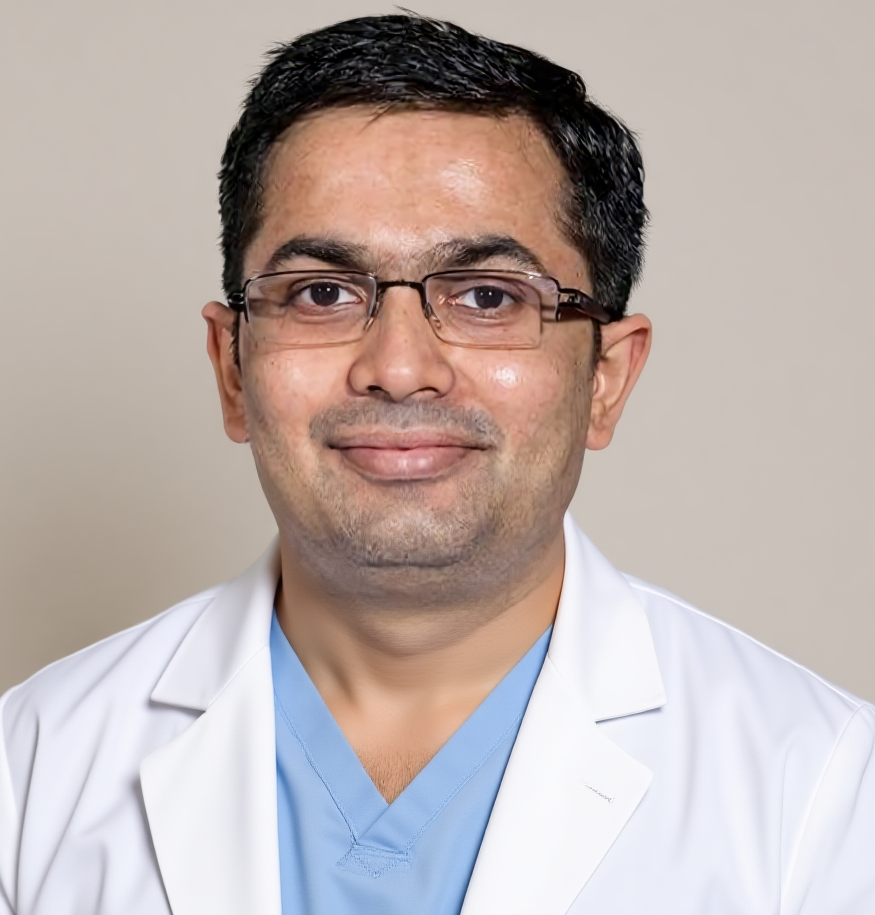
Shah’s Gastro, Cancer & Robotic Surgery Centre. He trained in super-specialty surgical gastroenterology and holds two higher degrees in that field. He has 18 years of experience in GI and cancer surgery. Colon cancer operations are part of his regular work. You see the same surgeon from the first visit to the last follow-up.
Dr Harsh Shah
MS, MCh (Surgical Gastroenterology), DrNB (Surgical Gastroenterology)
Registered with Gujarat Medical Council, Reg. No. G-38738
Colon Cancer Surgeon · Apollo Hospital, Bhat, Gandhinagar · Gota OPD, Ahmedabad
Google rating 4.89 from 216 reviews at the Gota clinic, and 4.94 from 18 reviews at Apollo, Bhat.
Once staging is complete, your case goes to the tumour board. A surgeon, a cancer physician, a radiologist and a pathologist review the same scans and slides. The board must see some cases before anything is fixed. These include spots in the liver or lungs, a tumour grown into another organ, a deficient MMR result, and any case where the need for chemotherapy is unclear. A curative plan made outside the board is not accepted. Dr Shah then sits with you and the family. He explains the plan, the reasons for it, and the other choices that were weighed.
A cancer in the last part of the bowel, close to the back passage, follows rectal cancer rules. Those need different scans and often treatment before surgery.
The colon runs from the start of the large bowel, near the appendix, to where it meets the rectum. A tumour near that junction needs care. The colonoscopy report should say how far up it sits, and the surgeon checks this himself. If the tumour counts as rectal, an MRI of the pelvis is added, and radiotherapy or chemotherapy may come before surgery. Dr Shah’s page on the operative plan for rectal cancer explains that path. Everything below is about the colon.
The colon is removed in sections, each with its own blood supply. The tumour’s position picks the section, the artery that is tied, and the page to read next.
| Where the tumour is | The operation | Read more |
|---|---|---|
| Caecum or ascending colon. | Right hemicolectomy. The ileocolic and right colic vessels are tied. | Right hemicolectomy. |
| Hepatic flexure, or the first part of the transverse colon. | Extended right hemicolectomy. The middle colic vessel is also tied. | Transverse colon cancer. |
| The far end of the transverse colon, or the splenic flexure. | Extended right or extended left hemicolectomy, chosen case by case. | Transverse colon cancer. |
| Descending colon. | Left hemicolectomy. The left colic vessel is tied. | Left colon cancer. |
| Sigmoid colon. | Sigmoid colectomy, also called anterior resection. The inferior mesenteric artery is tied, high or low. | Sigmoid colon cancer. |
Each linked page goes deep into one operation. This page stays with what all of them share. If several relatives have had bowel cancer, or the MMR test is abnormal, read the page on hereditary bowel and stomach cancer as well. An inherited cause can change how much bowel is removed.
Whatever section is removed, the same cancer rules apply. They make the operation complete, and the pathology report later shows whether each one was met.
A blocked bowel, a burst bowel, spread to the liver or lungs, a tumour fixed to another organ, or low fitness each change the operation offered.
| Finding | What usually happens |
|---|---|
| Blocked bowel on the right side. | The tumour is removed, and the bowel is usually joined at the same operation. |
| Blocked bowel on the left side, in a fit patient. | The tumour is removed. The bowel is joined, sometimes with a temporary stoma above it. If you are unstable or the abdomen is soiled, the end is brought out as a stoma instead. This is called Hartmann’s procedure. |
| Blocked bowel on the left side, when you are unfit or the cancer has spread. | A metal stent opens the bowel through a scope. It can be a bridge to a planned operation, or the treatment itself. It avoids an emergency stoma. |
| A burst bowel. | Emergency removal, a wash-out of the abdomen and usually a stoma. |
| Spots in the liver or lungs. | The tumour board decides if they can be removed, and in what order. |
| A tumour fixed to the bladder, womb, small bowel or abdominal wall. | That part is removed with the bowel in one piece, often as an open operation. |
| Low fitness on the activity score. | A milder plan is discussed. For some, supportive care is the kinder choice. |
In India, many colon cancers first show up as a blocked or burst bowel. The planned path above does not fit those patients, and the risks are higher. Two warning signs bring the consultant surgeon the same day. One is a hugely swollen or tender bowel above a blockage. The other is heavy bleeding from the tumour. If either happens, call +91-63555-64601 and go to the hospital at once.
If the cancer has already spread, medicine often comes first. Surgery is offered later only when the tumour board sees a real chance to remove everything.
For spread disease, the tumour’s genes guide the medicines. Tests such as RAS and BRAF are done, along with the MMR result. A tumour with a deficient MMR result is usually treated first with immunotherapy. A few liver or lung spots may be removable, either at once or after chemotherapy shrinks them. That choice belongs to the tumour board, not to one doctor. Every patient with spread disease also meets the palliative care and nutrition team early. This is extra support, not a sign that treatment has stopped.
Keyhole surgery is the standard route for colon cancer. Robotic surgery is an accepted choice in experienced hands. Open surgery is chosen when it is safer.
Keyhole surgery gives the same cancer results as open surgery, with a quicker recovery. Large trials have shown this. A robotic operation follows the same cancer rules. Open surgery is the right call for a bulky tumour, an operation that takes another organ, or an abdomen scarred by earlier surgery. Sometimes a keyhole operation is changed to open midway. That keeps the operation complete and safe. It is not a failure, and you agree to it beforehand. Dr Harsh Shah performs the operation himself. Ask who will be operating on the day, and whether that holds if the date moves.
Preparation starts at the first visit. Blood count, sugar, nutrition and habits are corrected, so your body meets the operation in better shape.
| What is done | Why |
|---|---|
| Anaemia is corrected, with iron through a drip if tablets will not work in time. | A better blood count makes the operation safer. |
| Sugar is controlled. Smoking and alcohol stop at least four weeks before. | Both lower the risk of infection and lung problems. |
| A dietitian sees you if you have lost weight, have low albumin or are eating little. | Well-fed patients heal better. Special nutrition drinks may be given. |
| A short food and exercise programme, if you are underweight or limited in daily activity. | It is offered where it helps, not to everyone. |
| A bowel-cleaning drink plus antibiotic tablets the day before. | Together they lower infection and leak risk. The drink alone does not. |
| A sugary drink the evening before and on the morning of surgery. | It shortens fasting. It is skipped if the bowel is blocked. |
| The stoma nurse marks a site on your abdomen, if a stoma is possible. | A bag, if needed, then sits where you can see and manage it. |
Most patients sit out of bed on the day of surgery and eat on the first day. After an uncomplicated keyhole operation, home is usually on day four or five.
| Day | What happens |
|---|---|
| Day of surgery. | Sit out of bed for two hours. Sip clear fluids. Chew gum to wake the bowel. |
| Next day. | Normal food as you can manage. Walk four times. The urine tube comes out. |
| Second day. | Full meals. Pain tablets instead of drips. Passing wind is expected. |
| Third day. | The bowels usually open. The team checks whether you are ready for home. |
| Fourth or fifth day. | Home, once you eat well, walk alone, have no fever and your pain is controlled with tablets. |
There is no routine tube through the nose, and usually no drain. If you have a stoma, you or a family member must be able to change the bag before you leave. One rule protects every patient. In the first week, a fast pulse, a fever, new pain, or a patient who was improving and then slips back is treated as a leak until proved otherwise. A scan is done, and the consultant surgeon is told at once. It is never watched overnight.
The final stage comes from the removed bowel, not from the scan. It decides whether chemotherapy is advised, which drugs are used, and for how long.
| Final result | What usually follows |
|---|---|
| Stage I. | Surgery alone, then regular checks. |
| Stage II with no high-risk feature. | Regular checks. Any gain from chemotherapy is small. |
| Stage II with a deficient MMR result. | Regular checks. Single-drug chemotherapy is not given, as it does not help. |
| Stage II with a high-risk feature. | Chemotherapy is discussed, and the decision is shared with you. |
| Stage III, lower risk. | Three months of CAPOX chemotherapy. |
| Stage III, higher risk. | Six months of chemotherapy, usually FOLFOX or CAPOX. |
The report must state four things: the number of nodes examined, the margins, the MMR result and any high-risk features. If chemotherapy is advised, it should start within six to eight weeks of the operation. The benefit falls after that. Where the test is available, a DPYD blood test is done first, because a rare enzyme gap makes standard doses dangerous. The first visit after discharge, at about two weeks, is where the report is read with you.
Every risk is named at the consent meeting. Your own figures depend on your age, your fitness and whether the operation is planned or urgent.
General risks include bleeding that needs a transfusion, a wound infection, clots in the legs or lungs, heart or breathing problems, a problem with the anaesthetic, and a change from keyhole to open surgery. Risks of the operation include a leak from the join, a bowel slow to wake up, injury to the ureter that carries urine from the kidney, a milky lymph leak after a right-sided operation, a pus collection, a narrowed join, and a temporary or permanent stoma. Later, a hernia can form in the scar, or adhesions can block the bowel. The risk of dying is stated plainly, and it is higher after emergency surgery. The cancer can return even after complete removal. That is why checks and colonoscopy continue for life. Dr Shah goes through four of these in person: a leak, a stoma, the risk of dying, and the fact that the final stage is known only after the report.
A second opinion helps most before the first operation. Take one if a key check was skipped, or if a stoma or a refusal was never explained.
| What you notice | Why it matters |
|---|---|
| The colonoscopy stopped short, and no one plans to finish it. | A second tumour can be missed. |
| The CT did not include the chest. | Spread to the lungs changes the plan. |
| The biopsy was not tested for MMR. | It affects inherited risk, chemotherapy and immunotherapy. |
| Liver spots were called hopeless without a tumour board review. | Some can be removed. |
| A tumour fixed to another organ is to be “freed”. | It should come out in one piece with that organ. |
| You were stable, yet only an emergency stoma was offered. | A stent or a join may have been possible. |
| No one could name the section or artery to be removed. | The plan may not follow the tumour’s site. |
A second opinion that agrees with your plan is not wasted. You go into theatre with no question left open. Bring the colonoscopy report and photos, the biopsy report, the CT on a disc, the CEA result and your list of medicines.
★★★★★
“(Translated by Google) Dr. Harsh Shah's personality is very nice. He always talks in a good way. He has undergone surgery for colon cancer. Without any problem. Yours faithfully.🙏 (Original) ડૉ હર્ષ શાહ નો સ્વાભાવ ખૂબ જ સરસ છે.તેઓ હમેશા સારી રીત વાત કરે છે .મોટા આંતરડા ના કેન્સર ની સર્જરી એમને કરેલ લી છે. કોઈ પ્રકાર ની તકલીફ નાથી .આપનો અભર.🙏”
— Ismailbhai Shaikh, Google review
★★★★★
“Met with Dr. Harsh Shah for the consultation of one of my relative. Dr. Harsh Shah is an exceptional surgical oncologist in Ahmedabad. His expertise in treating complex GI cancers like liver, pancreas, and colon cancers is truly remarkable. He explains everything clearly and gives patients full confidence in their treatment. Highly recommended for anyone looking for a skilled and compassionate cancer specialist.”
— Nagesh Patidar, Google review
★★★★★
“My father has carcinoma of stomach ,Harsh sir did radical gastrectomy and he is recovering very nicely under Dr.Harsh's observation ,he listen each and every complain calmly and with patience and make patient very comfortable during treatment , during procedure and during stay at hospital. we are satisfied with the treatment and very confident about the fully recovery of disease as we are under treatment of Dr.Harsh & team.Thank you Dr.Harsh & his whole team and staff.”
— tina parmar, Google review
Reviews are reproduced exactly as written on Google, including the original spelling. The first describes colon cancer surgery by Dr Harsh Shah. The other two speak about his cancer care more widely.
A patient describes recovery after keyhole colon cancer surgery by Dr Harsh Shah. Recorded and shared with consent.
The cost depends on the route, whether surgery is planned or urgent, the days in hospital and any stoma care. A written estimate is given before admission.
Apollo Hospital, Bhat, works with the major insurers and cashless schemes. The insurance desk handles pre-authorisation. If a stay runs longer, an extension is requested at the time. On admission, bring your scans on a disc or drive, all reports, your medicines with doses, the insurance card and an identity proof. Bring one family member who can learn stoma care if it is needed.
Not usually. The whole colon, a CT scan, CEA and the MMR test come first, and the tumour board reviews them. A date fixed before that can mean the wrong operation.
It screens for an inherited cause, which can change how much bowel is removed. It also guides chemotherapy and immunotherapy later.
Most planned colon operations end with a join and no stoma. A stoma becomes more likely with a blocked or burst bowel, or an unsafe join. You are told and consented in advance.
Keyhole surgery is the standard and gives the same cancer results as open surgery. Robotic surgery is an accepted choice in experienced hands. The cancer rules stay the same either way.
The rest of the colon is checked another way, by CT colonography or a colonoscopy within three to six months after surgery. It is never skipped.
It depends on the final pathology report. Spread to lymph nodes, or certain high-risk features, usually means chemotherapy is advised. It should start within six to eight weeks.
Shah’s Gastro, Cancer & Robotic Surgery Centre — Gota, Ahmedabad
Consultations, review of scans, follow-up and surveillance.
Google: Dr Harsh Shah · 4.89 from 216 reviews
Directions to the Gota clinic · +91-63555-64601
Apollo Hospital — Bhat, Gandhinagar
Apollo Hospital International Limited, Plot No. 1 A, GIDC Bhat Industrial Estate, Bhat, Gandhinagar.
Google: Dr Harsh Shah – Robotic GI Surgeon · 4.94 from 18 reviews
Directions to Apollo, Bhat · WhatsApp +91-63555-64601
Families come to Ahmedabad for colon cancer surgery from across Gujarat, including Gandhinagar, Mehsana, Banaskantha, Nadiad, Anand, Bhavnagar, Rajkot, Jamnagar and Kutch, and from southern Rajasthan and western Madhya Pradesh.
Holding a colonoscopy or biopsy report that says cancer? The colonoscopy and biopsy reports, any CT scan on a disc and recent blood tests can be sent ahead of your appointment, so the consultation starts with them already read. The plan is decided at the consultation, after examination. Call +91-63555-64601 · Send the reports ahead on WhatsApp
Swasth Parivar: twice a month, practical advice on recovery, diet and warning signs. No advertising. Stop any time.
Your number is used for these updates and for the clinic to reach you. It is never sold or passed on. To stop, reply STOP on WhatsApp.