Shah's Gastro, Cancer & Robotic Surgery Centre · Ahmedabad & Gandhinagar
Esophageal cancer surgeon in Ahmedabad · Gota OPD, Ahmedabad · Apollo Hospital, Bhat, Gandhinagar
Removing the food pipe is one of the largest operations in cancer surgery, and for most patients it is not the first treatment. Before any date is fixed, Dr Harsh Shah answers three questions with the tumour board: can this cancer be removed completely, should treatment come before the operation, and can this person’s heart, lungs and nutrition carry them through it. The order of treatment depends on the type of cancer, and some patients are better served without an operation at all.
The surgeon who examines you at the Gota OPD and explains the plan is the surgeon who performs the esophagectomy at Apollo, Bhat. Every non-metastatic esophageal cancer is discussed by the tumour board — surgeon, medical oncologist, radiation oncologist, radiologist and pathologist — before any treatment starts, and Dr Harsh Shah brings the surgical view to that table himself.
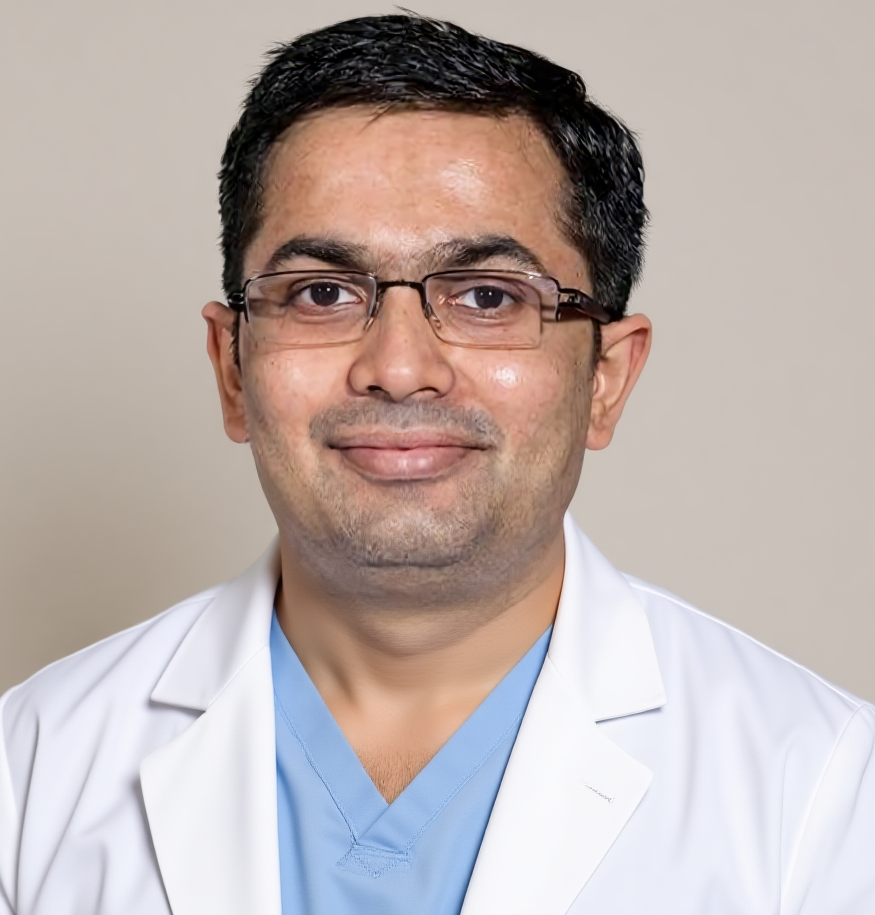
Shah’s Gastro, Cancer & Robotic Surgery Centre. Trained in super-specialty surgical gastroenterology programmes, qualified twice over in the specialty, with 18 years of experience in GI and cancer surgery. Operations on the food pipe, stomach, pancreas, liver and bowel are the whole of the practice, not one line on a general surgical list.
Dr Harsh Shah
MS, MCh (Surgical Gastroenterology), DrNB (Surgical Gastroenterology)
Registered with Gujarat Medical Council, Reg. No. G-38738
Food Pipe Cancer Surgeon · Apollo Hospital, Bhat, Gandhinagar · Gota OPD, Ahmedabad
Google rating 4.89 from 216 reviews at the Gota clinic, and 4.94 from 17 reviews at Apollo, Bhat.
Families usually arrive with one question: “When can the operation be done?” It is the right instinct and the wrong first question. For esophageal cancer, the operation done at the wrong time — before treatment that should have come first, or in a body not ready for it — can do more harm than good. The questions below come first, and their answers set the date.
Can the cancer be removed completely? Should chemotherapy or chemoradiation come first? Can the patient’s body take the operation? A yes to the first and third, and a clear answer to the second, makes a candidate for esophagectomy. A no to any of them changes the plan, not the ambition.
Can it be removed completely? This is answered by staging, not by how the tumour looks on one scan. An endoscopy with several biopsies maps exactly where the tumour starts and ends. A CT of the chest, abdomen and pelvis and a PET-CT look for spread that would make the operation pointless. An endoscopic ultrasound is added where it changes the decision — for instance, in telling a very early tumour from one that has gone deeper. For tumours in the upper and middle food pipe, a bronchoscopy checks the windpipe, and for squamous cancer an ENT examination looks for a second cancer in the throat. For tumours at the junction with the stomach, a staging laparoscopy may come first.
Should treatment come first? That depends on the cancer’s type and depth, and is set out in the next sections.
Can the body take it? Fitness is measured, not guessed. An ECG and echocardiogram check the heart; lung function tests, including how well the lungs transfer oxygen, are required before any operation that enters the chest. Daily activity level is recorded at every visit. Age alone does not rule anyone in or out; the tests do.
The earliest cancers, confined to the inner lining, are usually removed through the endoscope without any operation. Small cancers that have gone slightly deeper, or that show unfavourable features under the microscope after an endoscopic removal, need an esophagectomy straight away, without chemotherapy first.
This is the decision most often missed in both directions. A very early cancer sent for a major operation has been over-treated, because an endoscopic resection could have removed it with the food pipe kept. And a cancer removed endoscopically that turns out deeper than expected, with spread into small vessels or a poorly formed pattern, or with cancer at the cut edge, is under-treated if it is simply watched. That patient is a candidate for surgery, and the decision is made by the tumour board on the pathology report, not by the endoscopist alone.
For a locally advanced squamous cell cancer, chemoradiation is given first and the operation follows some weeks after it finishes. For a locally advanced adenocarcinoma, a course of chemotherapy is given before the operation and completed after it. The biopsy report decides which path you are on.
| Type and extent | Before the operation | The operation and after |
|---|---|---|
| Earliest cancer, inner lining only | Endoscopic resection, usually no operation | Endoscopic surveillance |
| Early cancer, slightly deeper or with unfavourable features | Nothing — surgery first | Esophagectomy with removal of lymph nodes |
| Locally advanced squamous cell cancer | Chemoradiation | Esophagectomy some weeks after; immunotherapy afterwards if cancer remains in the specimen |
| Locally advanced adenocarcinoma, including the junction with the stomach | Chemotherapy (perioperative course) | Esophagectomy, then the rest of the chemotherapy course |
| Squamous cancer in the neck, cancer grown into a vital structure, or a patient unfit for surgery | Definitive chemoradiation as the main treatment | Close surveillance, with surgery kept in reserve |
| Cancer that has spread to distant organs | Chemotherapy with immunotherapy, chosen by biomarkers | No esophagectomy; relief of swallowing if needed |
During the weeks of treatment before surgery, swallowing can get worse before it gets better. If eating becomes nearly impossible, Dr Harsh Shah prefers a feeding tube into the small bowel over a stent in the food pipe, because a stent can complicate the operation that is planned. Nutrition is never allowed to be the reason treatment stops.
An esophagectomy is not advised when the cancer has spread to distant organs, when it has grown into a structure that cannot be removed, when a squamous cancer sits high in the neck, or when the heart and lungs cannot safely carry the operation. Saying so plainly is part of the surgeon’s job.
For these patients, chemoradiation or chemotherapy with immunotherapy becomes the main treatment, and swallowing is protected with a stent or radiotherapy where needed. This is not giving up. For squamous cancer in particular, definitive chemoradiation is a recognised treatment in its own right, and some patients have no visible cancer left at the end of it.
That last group raises a decision of its own: operate anyway, or watch closely and operate only if the cancer returns. Watching with endoscopies and scans, and keeping surgery in reserve, is an emerging approach rather than the standard; it is offered only after tumour board discussion, and only where a salvage esophagectomy can be done if it is needed. Dr Harsh Shah sets out both choices and what each one asks of the patient.
The weeks before an esophagectomy are used to make you stronger for it. Stopping smoking and alcohol well ahead, walking every day, breathing exercises with a spirometer, building protein, and correcting anaemia all reduce the lung problems that are the commonest trouble after this operation.
A dietitian sees anyone who has lost a noticeable amount of weight, is eating much less than needed, or has low protein in the blood, and prehabilitation starts in the OPD rather than on admission. A dental check removes any hidden source of infection. These steps are not optional extras; they decide how a patient comes through the first week.
The operation removes the cancerous part of the food pipe with its lymph nodes and rebuilds the passage, usually by shaping the stomach into a tube and drawing it up. Where the join is made — in the chest or in the neck — depends on where the tumour sits.
For a tumour in the lower food pipe, or at the junction with the stomach, the join is usually made in the chest (an Ivor Lewis esophagectomy). For a tumour in the middle or upper food pipe, or when the upper margin is a concern, the join is made in the neck (a McKeown esophagectomy). Cancers centred at the junction itself have their own decision between an esophagectomy and a gastrectomy, set out on Dr Harsh Shah’s junction cancer page.
Where the tumour and the tissues allow, Dr Harsh Shah performs the operation by robotic or other minimally invasive surgery, which has been shown to reduce lung complications compared with a fully open operation. A bulky tumour, or tissues stiffened by chemoradiation, may need open surgery; that judgement is made on the scans and, at times, during the operation itself, and it is explained before you consent. A feeding tube into the small bowel is placed at the operation when it is likely to be needed.
Esophagectomy carries real risks, including the risk of death, and Dr Harsh Shah names each of them at the consent discussion with figures adjusted to your age, fitness and prior treatment. Risk rises after chemoradiation, with poor lung function, and with other illnesses.
Risks of the operation: a leak at the join; chest infection and other lung problems; an irregular heartbeat; a hoarse or weak voice from strain on the nerve to the voice box, which usually recovers; a milky lymph leak into the chest; poor blood supply to the new food pipe, which may need another operation; bleeding, wound infection and clots. Longer term: narrowing at the join that may need repeated stretching through an endoscope, acid or bile coming back up, and feeling faint or unwell after a large meal.
One warning is worth knowing in advance. In the first week, a fast heart rate or a new irregular heartbeat is treated as a possible leak until proven otherwise — investigated the same day, never watched overnight.
The pathology report on the removed food pipe shapes the next step. If chemoradiation was given first and cancer is still present in the specimen, immunotherapy is offered for about a year. If none is left, follow-up alone is enough. After perioperative chemotherapy, the remaining cycles are completed.
Life afterwards changes in predictable ways: small, frequent meals for life, sleeping with the head raised, and care with large or sugary meals. Follow-up runs for many years, with visits and scans more frequent in the early years, because that is when any return is most likely to be found. Dr Harsh Shah reviews the pathology with you himself, and the referral for immunotherapy, where it applies, is made at the first follow-up visit.
Take a second opinion before agreeing to an esophagectomy if the plan was not discussed by a tumour board, if surgery straight away is advised for a locally advanced cancer, if a very early cancer is being sent for a major operation without an endoscopic option being considered, if no PET-CT or lung function test has been done, or if no one has told you which type of cancer you have.
Bring the endoscopy report and photographs, the biopsy report naming the cancer type, the CT and PET-CT images on a disc or drive, any treatment summary from chemotherapy or radiation, your lung and heart test results, and a list of medicines.
Dr Harsh Shah performs the esophagectomy himself, at the robotic console or the operating table, and he is the surgeon you see at follow-up. The approach is chosen for your tumour after the scans are read and is explained at consent; no approach is offered because it sounds more advanced.
A patient describes the operation and recovery after a robotic esophagectomy by Dr Harsh Shah for esophageal cancer, recorded and shared with written consent.
Dr Harsh Shah explains, step by step, how a robotic esophagectomy is performed.
The cost of esophagectomy is not a single figure. It moves with the operation and approach, the treatment given before it, the room category, the length of stay and any time in intensive care. A written estimate is given before admission and its contents are explained.
Apollo Hospital, Bhat, works with the major insurers and cashless schemes, and the office handles pre-authorisation directly; if the stay runs longer than estimated, an enhancement request is raised at the time rather than at discharge. Immunotherapy after surgery carries its own cost, and access programmes are discussed openly when it is advised.
Bring on admission: imaging on a disc or drive, previous discharge summaries and treatment records, medicines with doses, the insurance card and identification, and one family member as the point of contact.
★★★★★
“Met with Dr. Harsh Shah for the consultation of one of my relative. Dr. Harsh Shah is an exceptional surgical oncologist in Ahmedabad. His expertise in treating complex GI cancers like liver, pancreas, and colon cancers is truly remarkable. He explains everything clearly and gives patients full confidence in their treatment. Highly recommended for anyone looking for a skilled and compassionate cancer specialist. — Nagesh Patidar, Google review, Gota clinic listing”
★★★★★
“Dr. Harsh Shah is an excellent doctor who handled our case with great diligence and care. He listens attentively and addresses every concern with utmost patience. He's very humble and answers all of your questions in detail which is very assuring. I would highly recommend Dr. Harsh Shah for consultation and treatment. — Srinath Vasudevan, Google review, Gota clinic listing”
★★★★★
“Dr. Harsh and his team at Apollo Gandhinagar bring excellence to execution and a patient centric approach. They proactively plan in detail and stretch the last mile surprising with meticulous planning and follow up. My robotic surgery was well explained and outcomes and recovery were even better than explained in advance. Much obliged. MK — Coffe Muske, Google review, Gota clinic listing”
Real Google reviews from Dr Harsh Shah’s listings, reproduced exactly as written.
No. The earliest cancers, limited to the inner lining, are usually removed through the endoscope. Cancers that have spread to distant organs are treated with chemotherapy and immunotherapy. Some squamous cancers, especially high in the neck, are treated with chemoradiation as the main treatment.
For locally advanced cancers, treatment before surgery shrinks the tumour and treats cancer cells that scans cannot see, which makes a complete removal more likely. Squamous cell cancers usually receive chemoradiation first; adenocarcinomas usually receive a chemotherapy course before and after the operation.
Usually some weeks after chemoradiation finishes, once the body has recovered and a repeat assessment has confirmed the cancer can still be removed. The exact timing is set by the tumour board for each patient.
Age alone does not decide it. Heart tests, lung function tests and how active you are day to day decide whether the operation is safe. A fit older person may be a good candidate; a younger person with weak lungs may not.
Most people return to eating by mouth, but in smaller, more frequent meals for life, with the head raised when sleeping. Some need the join stretched through an endoscope if swallowing becomes difficult later.
Both remove the cancerous food pipe and rebuild the passage with the stomach. In an Ivor Lewis operation the join is in the chest, suited to lower tumours. In a McKeown operation the join is in the neck, suited to middle and upper tumours.
Shah’s Gastro, Cancer & Robotic Surgery Centre — Gota, Ahmedabad
Consultations, review of scans, follow-up and surveillance.
Google: Dr Harsh Shah · 4.89 from 216 reviews
Directions to the Gota clinic · +91-63555-64601
Apollo Hospital — Bhat, Gandhinagar
Apollo Hospital International Limited, Plot No. 1 A, GIDC Bhat Industrial Estate, Bhat, Gandhinagar.
Google: Dr Harsh Shah – Robotic GI Surgeon · 4.94 from 17 reviews
Directions to Apollo, Bhat · WhatsApp +91-63555-64601
Families come to Ahmedabad for esophageal cancer surgery from across Gujarat — Gandhinagar, Mehsana, Banaskantha, Nadiad, Anand, Bhavnagar, Rajkot, Jamnagar and Kutch — and from southern Rajasthan and western Madhya Pradesh.
Send the endoscopy, biopsy and scan reports before you travel. The endoscopy photographs, biopsy report, CT or PET-CT images and any treatment summary can be sent ahead of your appointment, so the consultation starts with them already read. Treatment is decided at the consultation, after examination. Call +91-63555-64601 · WhatsApp the clinic
Swasth Parivar: twice a month, practical advice on recovery, diet and warning signs. No advertising. Stop any time.
Your number is used for these updates and for the clinic to reach you. It is never sold or passed on. To stop, reply STOP on WhatsApp.