
Shah's Gastro, Cancer & Robotic Surgery Centre · Ahmedabad & Gandhinagar
Intrahepatic cholangiocarcinoma surgeon in Ahmedabad · Gota OPD, Gota, Ahmedabad · Apollo Hospital, Bhat, Gandhinagar
Last updated: 16-Oct-2026
A bile duct cancer that grows inside the liver follows its own rules. Three questions come first: is it one tumour, will enough liver remain, and has it spread?
Many families hear “liver cancer” and assume one plan fits all. It does not. A cancer of the small bile ducts inside the liver is called intrahepatic cholangiocarcinoma. It is staged and treated apart from HCC, the commonest liver cancer. This page is written by the surgeon who would operate. It explains how the decision is made, what can change it, when a second opinion helps, and what to ask before you sign the consent form. For the wider picture of bile duct cancers, see Dr Harsh Shah’s page on biliary tract cancer surgery by tumour site.
HCC and intrahepatic bile duct cancer both sit in the liver. But they are confirmed differently, staged differently, and the operation for bile duct cancer always includes the lymph nodes.
| Point | HCC | Intrahepatic bile duct cancer |
|---|---|---|
| Usual setting. | Often a scarred, cirrhotic liver. | Often a liver mass found by chance on a scan. |
| What the scan shows. | A typical pattern that can confirm HCC without a biopsy. | The liver surface may be pulled in over the mass. The mass fills with contrast slowly, on the later pictures. |
| Lymph nodes. | Not removed as a routine. | Removed in every operation. They give the stage. |
| Staging system. | Its own. | Its own, separate from the other bile duct cancers. |
| Treatment after surgery. | Follows the HCC plan. | Capecitabine tablets are usually advised. |
A tumour with features of both is called combined HCC and cholangiocarcinoma. It follows the HCC rules. If your report says HCC, read Dr Shah’s page on how the liver operation for HCC is decided instead. The rest of this page is about bile duct cancer inside the liver.
A biopsy is not needed before removing a mass that is clearly removable on scans. It is needed before chemotherapy. A negative brushing never rules the cancer out.
| Your situation | Biopsy? |
|---|---|
| One mass, clearly removable on scans, and you are fit. | Not needed before the operation. The removed liver gives the full answer. |
| Chemotherapy or immunotherapy is planned first. | Yes. Tissue is needed before any medicine is started. |
| The cancer has spread or cannot be removed. | Yes. The tissue is also sent for a gene test. |
| An earlier brushing or biopsy came back negative. | A negative result does not mean there is no cancer. It must not delay the plan. |
Families often ask for a biopsy “to be sure” before agreeing to surgery. The wish is fair. But when the scans already show a removable tumour, the operation itself is the most complete test. Waiting for a biopsy can lose weeks. Dr Shah explains which group you fall into at the first visit.
A contrast CT of the chest, abdomen and pelvis, an MRI with MRCP, and blood tests come first. Large or multiple tumours also need a staging laparoscopy.
Dr Harsh Shah examines you, presents your scans at the tumour board, explains the plan to your family, and performs the liver operation himself at Apollo Hospital, Bhat.
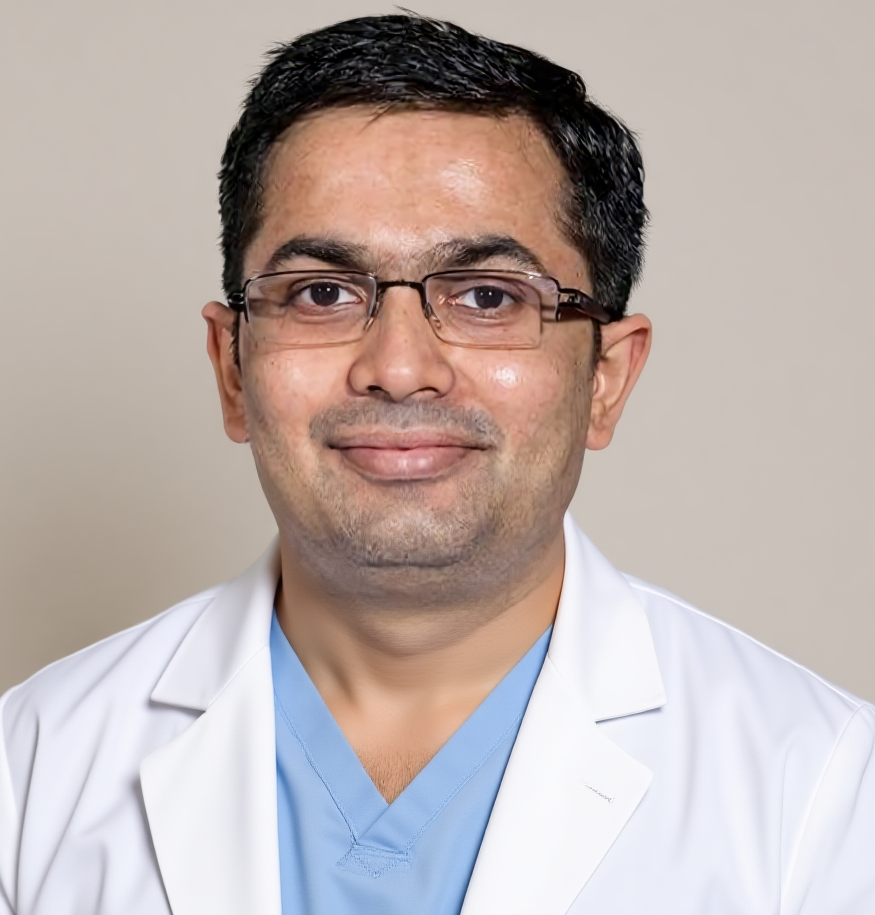
Shah’s Gastro, Cancer & Robotic Surgery Centre. He trained in super-specialty surgical gastroenterology and holds two higher degrees in that field. He has 18 years of experience in GI and cancer surgery. Liver resections are part of his regular work. You see the same surgeon from the first visit to the last follow-up.
Dr Harsh Shah
MS, MCh (Surgical Gastroenterology), DrNB (Surgical Gastroenterology)
Registered with Gujarat Medical Council, Reg. No. G-38738
Liver Cancer Surgeon · Apollo Hospital, Bhat, Gandhinagar · Gota OPD, Ahmedabad
Google rating 4.89 from 216 reviews at the Gota clinic, and 4.94 from 18 reviews at Apollo, Bhat.
Every bile duct cancer is discussed at the tumour board before treatment starts. A surgeon, a cancer physician, a radiologist and a pathologist look at the same scans. Some cases need the board again later. These include a remnant that must be grown first, and any case where the gene test result arrives. Dr Shah then sits with you and the family. He explains the plan, the reasons, and the other paths that were weighed. On the day of surgery, he is the operating surgeon. If any part is done with keyhole or robotic tools, he is the surgeon at the console.
One tumour, enough healthy liver left behind, and no spread outside the liver: when all three hold, an operation can be planned with an aim to remove the cancer completely.
| Question | Removable when | Not removable when |
|---|---|---|
| How many tumours? | A single tumour. | Several tumours spread through both halves of the liver. |
| Will enough liver remain? | The remaining liver is large and healthy enough. | Too little liver would be left, even after growing it. |
| Has it spread? | No spread outside the liver. | Spread to the lungs, bones, or the lining of the abdomen. |
| Are you fit? | You are active and able to look after yourself. | You are in bed for much of the day. |
The answer is rarely clear from one scan alone. It comes from the CT, the MRI, the liver volume and your fitness, read together. Sometimes the answer is “not yet”. That happens when the tumour is removable but the liver that would remain is too small. Then the next section applies.
The tumour is removed with a clear margin of healthy liver, along the liver’s own segments. The liver left behind must be large enough to work for the whole body.
The liver is made of segments, each with its own blood supply and bile duct. The operation follows these lines. It is called an anatomical liver resection. The aim is a clear margin, with no cancer at the cut edge. How much must stay depends on the health of the liver. A healthy liver can manage with a smaller remnant. More must stay if you have had chemotherapy. More again is needed if the liver is cirrhotic. When the remnant would be too small, it can be grown first. This is done by blocking the blood flow to the side that will be removed. It is called portal vein embolisation. The remaining side then grows over some weeks. During every liver operation, an ultrasound probe is used on the liver itself. It finds small tumours the scan missed. It also guides the line of the cut.
| Factor | How it changes the plan |
|---|---|
| Tumour size and position. | Decides which segments, or which half of the liver, must go. |
| Health of the remaining liver. | A cirrhotic or treated liver needs a larger remnant. |
| Measured liver volume. | If too small, the remnant is grown first by portal vein embolisation. |
| Findings on the liver ultrasound in theatre. | A new small tumour can change the cut, or the plan. |
The lymph nodes at the root of the liver are removed in every operation for this cancer. Their result sets the stage and guides the treatment after surgery.
These nodes lie along the bile duct, the hepatic artery and the portal vein, near where they enter the liver. Cancer cells can reach them early, and a scan cannot always tell. So they are removed as a routine, not only when they look large. Enough nodes must be taken for a reliable stage. The pathologist counts and checks each one. A report that lists no nodes, or very few, is a reason to ask questions. Node removal is one clear difference from an HCC operation. It is also a point worth checking in any plan you are given.
Several tumours, a small remnant, spread found at laparoscopy, jaundice with infection, or low fitness each change the plan. Some change the timing, others the whole approach.
| Finding | What usually happens |
|---|---|
| Several tumours in both halves of the liver. | Resection is not the right treatment. Medicines become the main plan. |
| The remnant would be too small. | Portal vein embolisation first. The scan is repeated before surgery. |
| A large tumour or several tumours. | A staging laparoscopy first. If spread is found, the large operation is not done. |
| Jaundice or bile infection. | The bile is drained first. CA 19-9 is checked again after. |
| Spread found when the abdomen is opened. | The operation may be stopped. You are told this risk at consent. |
| Low fitness. | A gentler plan is discussed. For some, comfort care is the kinder choice. |
If the cancer cannot be removed, the first treatment is chemotherapy with immunotherapy. A gene test on the tumour can open further medicines later.
The usual first treatment is cisplatin and gemcitabine with durvalumab or pembrolizumab. If immunotherapy cannot be used, the two chemotherapy drugs are given alone. Intrahepatic bile duct cancer often carries gene changes. FGFR2 and IDH1 are the two that matter most here. Each has its own tablet, used in the second line. Others, such as HER2, BRAF and NTRK, also have matched drugs. So the gene test is sent early, before it is needed. Its cost and availability are discussed openly at the start. Every patient also meets the palliative care and nutrition team early. This is extra support for itching, infection, pain and weight. It is not a sign that treatment has stopped.
The route is chosen for your tumour’s size and position, after the scans are read. It never changes the cancer rules: a clear margin and full lymph node removal.
Liver surgery can be open, keyhole or robotic. A keyhole route suits some tumours better than others. The tumour’s position, its size, the vessels around it and any earlier surgery all matter. A large resection with node clearance is often done open. Dr Shah tells you the planned route before consent, and why. A keyhole operation is sometimes changed to open midway. That keeps the operation complete and safe. It is not a failure, and you agree to it beforehand. Ask who will be operating on the day, and whether that holds if the date moves.
Preparation starts at the first visit. Nutrition, blood count, sugar, clotting and habits are corrected, so your body meets a liver operation in better shape.
| What is done | Why |
|---|---|
| A dietitian checks your weight and food intake. Extra nutrition is given if needed. | Well-fed patients heal better. |
| A short exercise and breathing programme. | It prepares the body for a long operation. |
| Anaemia, sugar and clotting are corrected. Vitamin K is given if jaundice affects clotting. | It makes the operation safer. |
| Smoking and alcohol stop at least four weeks before. | Both raise the risk of infection and lung problems. |
| A sugary drink the evening before and on the morning of surgery. | It shortens fasting. |
| Blood-thinning injections continue for four weeks after surgery. | They protect against clots in the legs and lungs. |
You sit out of bed on the day of surgery and eat on the next day. Blood tests on the fifth day show how well the remaining liver is working.
| Day | What happens |
|---|---|
| Day of surgery. | The breathing tube comes out. You sit out of bed and sip clear fluids. Baseline liver tests are taken. |
| Next day. | Food as you can manage. Walk three times. The urine tube comes out. The drain is checked for bile. |
| Second day. | Full meals. Walk four times. Pain tablets replace drips. |
| Third to fifth day. | Bilirubin and clotting on day five show whether the liver is coping. The drain comes out if it shows no bile. |
| Fifth to tenth day. | Home after an uncomplicated operation. A larger resection may need longer. |
Before you go home, you must be eating, walking alone, free of fever for a day, and comfortable on tablets. Your liver tests must be improving. One rule protects every patient. A rising bilirubin and clotting after the third day, bile in the drain, fever with shivering, a fast pulse, new confusion or little urine is reported at once. The consultant surgeon is told the same day. It is never watched overnight.
The final stage comes from the removed liver and nodes, not from the scan. It confirms the margin and decides the treatment that follows the operation.
| Step | What usually happens |
|---|---|
| Visit at about two weeks. | The wound is checked. The report, the margin and the nodes are explained. |
| Treatment after surgery. | Capecitabine tablets for six months. They start within two to three months of the operation. |
| Positive margin or positive nodes. | Radiotherapy with chemotherapy may be added. The tumour board decides. |
| First two years. | A visit every three months, with CA 19-9 and liver tests. A CT scan every three to six months. |
| Years three to five. | A visit every six months. A CT scan every six months. |
Every risk is named at the consent meeting. Your own figures depend on how much liver is removed, the health of the liver left, and your fitness.
General risks include bleeding that needs a transfusion, a wound infection, clots in the legs or lungs, heart or breathing problems, and a problem with the anaesthetic. Risks of the operation include the remaining liver struggling to cope, which is the most serious one, a bile leak from the cut surface of the liver, a pus collection inside the abdomen, bleeding after surgery, a clot in a liver vessel, fluid in the abdomen or near the lungs, and a second operation. Later, a hernia can form in the scar. The risk of dying is stated plainly for the operation actually planned. The operation may be stopped if spread is found. The cancer can return even after complete removal. That is why follow-up continues. Dr Shah goes through four of these in person: liver failure after surgery, the risk of dying, the chance the operation is stopped, and the treatment that follows.
A second opinion helps most before the first operation. Take one if a key test was skipped, the nodes were left out, or you were told it is inoperable without reasons.
| What you notice | Why it matters |
|---|---|
| You were told it is HCC, but the report or scan suggests a bile duct cancer. | The two need different operations and different treatment after. |
| The plan does not include removing the lymph nodes. | Node removal is routine for this cancer. |
| No liver volume was measured before a large resection. | Too small a remnant is the main danger. |
| You were called inoperable only because the remnant is small. | Portal vein embolisation can sometimes grow it. |
| A large tumour is to be removed without a staging laparoscopy. | Hidden spread may be missed. |
| Medicines were started without a biopsy or gene test. | Tissue is needed first, and gene changes open other drugs. |
| Surgery is planned for several tumours in both halves of the liver. | Resection does not help this pattern. |
A second opinion that agrees with your plan is not wasted. You go into theatre with no question left open. Bring the CT and MRI on a disc, all reports, any biopsy slides, the CA 19-9 result and your list of medicines.
★★★★★
“Dr harsh operated my sister for liver cancer .we came for follow up .Now she is good. Thank u so much sir”
— Natu Vadalia, Google review
★★★★★
“Met with Dr. Harsh Shah for the consultation of one of my relative. Dr. Harsh Shah is an exceptional surgical oncologist in Ahmedabad. His expertise in treating complex GI cancers like liver, pancreas, and colon cancers is truly remarkable. He explains everything clearly and gives patients full confidence in their treatment. Highly recommended for anyone looking for a skilled and compassionate cancer specialist.”
— Nagesh Patidar, Google review
★★★★★
“Dr harsh sir is a good doctor for Liver, Gastro & Cancer Surgeon in Ahmedabad thanks sir.”
— Milan Pareek, Google review
Reviews are reproduced exactly as written on Google, including the original spelling. No Google review yet names a bile duct cancer inside the liver. The first describes liver cancer surgery by Dr Harsh Shah. The other two speak about his liver and cancer care more widely.
The cost depends on how much liver is removed, the days in hospital, and whether embolisation or a laparoscopy is needed first. A written estimate is given before admission.
Apollo Hospital, Bhat, works with the major insurers and cashless facilities. The insurance desk handles pre-authorisation. If a stay runs longer, an extension is requested at the time. The gene test and targeted medicines can cost more, so that is discussed early. On admission, bring your scans on a disc or drive, all reports, your medicines with doses, the insurance card and an identity proof. Bring one family member who can stay and help with care at home.
It is a cancer inside the liver, but it starts in the small bile ducts, not in the liver cells. HCC starts in the liver cells. The two are staged and treated differently.
Not if the mass is clearly removable on scans. A biopsy is needed before chemotherapy or immunotherapy. A negative brushing or biopsy does not rule the cancer out.
Cancer cells can reach the nodes at the root of the liver without changing how they look on a scan. Their result sets the stage and guides the treatment after surgery.
The remaining side can often be grown first by portal vein embolisation. The scan is repeated after some weeks. Surgery is planned once the remnant is large enough.
Several tumours spread through both halves of the liver are not treated by resection. Chemotherapy with immunotherapy is the usual plan, guided later by a gene test on the tumour.
Usually yes. Capecitabine tablets for six months are the standard after removal. They start within two to three months of the operation.
Shah’s Gastro, Cancer & Robotic Surgery Centre — Gota, Ahmedabad
Consultations, review of scans, follow-up and surveillance.
Google: Dr Harsh Shah · 4.89 from 216 reviews
Directions to the Gota clinic · +91-63555-64601
Apollo Hospital — Bhat, Gandhinagar
Apollo Hospital International Limited, Plot No. 1 A, GIDC Bhat Industrial Estate, Bhat, Gandhinagar.
Google: Dr Harsh Shah – Robotic GI Surgeon · 4.94 from 18 reviews
Directions to Apollo, Bhat · WhatsApp +91-63555-64601
Families come to Ahmedabad for liver and bile duct cancer surgery from across Gujarat, including Gandhinagar, Mehsana, Banaskantha, Nadiad, Anand, Bhavnagar, Rajkot, Jamnagar and Kutch, and from southern Rajasthan and western Madhya Pradesh.
Has a scan shown a liver mass that does not look like HCC? The CT or MRI on a disc, its report, any biopsy report and recent blood tests can be sent ahead of your appointment, so the consultation starts with them already read. The plan is decided at the consultation, after examination. Call +91-63555-64601 · Send the reports ahead on WhatsApp
Swasth Parivar: twice a month, practical advice on recovery, diet and warning signs. No advertising. Stop any time.
Your number is used for these updates and for the clinic to reach you. It is never sold or passed on. To stop, reply STOP on WhatsApp.