
Shah's Gastro, Cancer & Robotic Surgery Centre · Ahmedabad & Gandhinagar
Biliary tract cancer surgeon in Ahmedabad · Gota OPD, Ahmedabad · Apollo Hospital, Bhat, Gandhinagar
Last updated: 11 October 2026.
“Bile duct cancer” is not one operation. It can sit in the gallbladder, where the ducts leave the liver, inside the liver, or low in the duct near the pancreas. These are four different operations. Each is staged on its own system. The first thing Dr Harsh Shah settles is exactly where the tumour sits. He also checks how far it runs along the ducts. That decides which operation is possible. The tumour board then decides whether it can be removed at all. It looks at both the anatomy and how well the remaining liver will work.
Dr Harsh Shah sees you at the Gota OPD. He takes every biliary cancer to the tumour board. He performs the resection himself at Apollo Hospital, Bhat. The surgeon who explains which operation your tumour’s site calls for is the surgeon who carries it out.
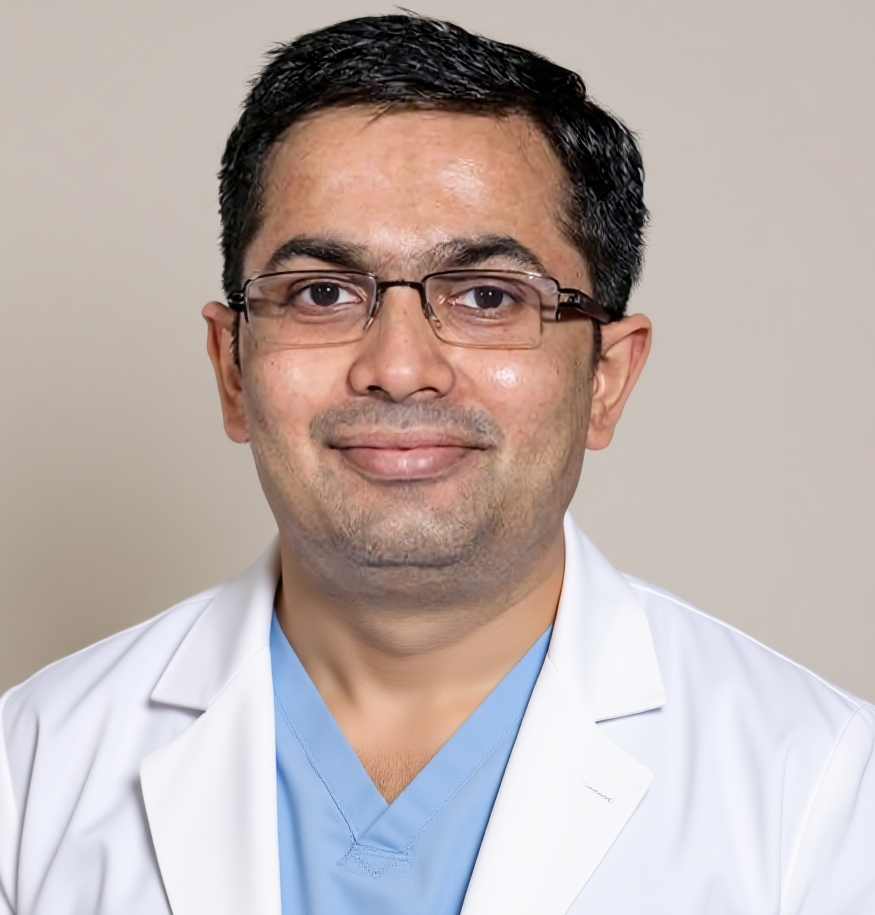
Shah’s Gastro, Cancer & Robotic Surgery Centre. Dr Harsh Shah trained in super-specialty surgical gastroenterology programmes. He is qualified twice over in the specialty. He has 18 years of experience in GI and cancer surgery. This includes liver resection, bile duct reconstruction and the Whipple operation. The same surgeon sees you from the first consultation to the follow-up visits.
Dr Harsh Shah
MS, MCh (Surgical Gastroenterology), DrNB (Surgical Gastroenterology)
Registered with Gujarat Medical Council, Reg. No. G-38738
Gastro & Cancer Surgeon · Apollo Hospital, Bhat, Gandhinagar · Gota OPD, Ahmedabad
Google rating 4.89 from 216 reviews at the Gota clinic, and 4.94 from 18 reviews at Apollo, Bhat.
This page is the starting point for every cancer of the gallbladder and bile ducts on this site. It explains how the site of the tumour is pinned down. It explains who decides that it can be removed. It sets out what is common to all four operations. Then it sends you to the page written for your own situation. Gallbladder cancer is far more common in India than Western guidelines assume. This is true especially in women and in the Gangetic belt. So the level of suspicion here has to be higher.
Find the row that matches what your reports say. Each row names the operation that site usually calls for. It links to the page that explains it in full.
| Where the cancer sits | The usual operation, when it can be removed | Read next |
|---|---|---|
| Gallbladder, suspected on scans before any operation. | Radical cholecystectomy. This removes the gallbladder with a wedge of the liver bed and the lymph nodes around the bile duct. It follows a staging laparoscopy. | Gallbladder cancer treatment. |
| Gallbladder, found in the report after a routine gallbladder removal. | Re-staging, then a radical re-resection unless the cancer was confined to the innermost layer. | Re-staging and re-resection after cholecystectomy. |
| Where the ducts leave the liver (perihilar, or Klatskin tumour). | Extended liver resection with the caudate lobe, the bile duct and its nodes. A new bile drainage joint to the bowel is made. | Perihilar cancer, on this page. |
| Inside the liver (intrahepatic). | Anatomical liver resection with clearance of the nodes at the liver’s root. | Intrahepatic cancer, on this page. |
| Low in the duct, near the pancreas (distal). | Pancreatoduodenectomy, the Whipple operation. | Distal bile duct cancer surgery. |
Cancer of the ampulla is a different disease. The ampulla is the opening of the bile duct into the bowel. Its cancer has a better outlook and is not covered here. Benign narrowings of the bile duct are not covered either.
Resectability is decided by the tumour board, not by one opinion. It has two halves. The first is whether the cancer can be taken out with clear margins. The second is whether the liver that remains will be enough to keep you well. Every biliary cancer is discussed there before treatment.
| Site | Can usually be removed when | Usually cannot when |
|---|---|---|
| Gallbladder. | The tumour has gone beyond the innermost layer but has not spread distantly. The liver bed and nodes can be cleared in one piece. | Spread to distant organs or the abdominal lining. Extensive wrapping of major vessels, or nodes far from the liver. |
| Intrahepatic. | A single tumour, with enough liver left behind and no distant spread. | Several tumours in both halves of the liver, distant spread, or too little liver left. |
| Perihilar. | The length of duct involved can be removed. The remaining liver is adequate and drained. Any vessel can be rebuilt. | Involvement of the smaller ducts on both sides, or of vessels on both sides. Shrinkage of one side with vessel involvement on the other. Distant spread. |
| Distal. | A Whipple operation can remove it. | As for a cancer of the head of the pancreas. |
Fitness counts as much as anatomy. A patient who is fully active can be considered for a major liver resection. One who is limited in daily activity may be better served by milder treatment. One who is mostly in bed is offered drainage for jaundice and supportive care rather than surgery. Fitness is judged on function, not on age alone.
Two scans do most of the work. One is a multiphase CT of the chest, abdomen and pelvis. The other is a MRI with MRCP. The MRCP shows the level and length of bile duct involvement. That is what decides the operation for a tumour at the hilum.
When jaundice comes from a tumour at the hilum, the stent or drain goes into the part of the liver that will remain after the operation.
Draining the side that will be removed adds infection risk and gives nothing back. Drainage through the endoscope is preferred. A drain through the skin is used when the endoscopic route fails or the anatomy demands it. The bilirubin is brought down to a safe level before a major liver resection. Infection of the bile after a stent is called cholangitis. It is the commonest reason a removable tumour becomes unremovable. So it is treated as an emergency. That means antibiotics, proper drainage the same day, and no stent placed where it cannot drain. If you already have a stent and develop fever with shivering, contact the team that day.
A cancer where the bile ducts leave the liver carries the highest risk of the four operations. The type of duct involvement is mapped on MRCP. It decides which half of the liver is removed. The operation is planned only once the remaining side has been drained. If needed, that side is also grown first.
Frozen sections of the duct margins are checked during the operation. A clear margin and complete node clearance decide the long-term result. A few carefully selected patients have a tumour that cannot be removed. For them, a referral to a specialist transplant programme is discussed.
A cholangiocarcinoma inside the liver is removed by an anatomical liver resection with a clear margin. The lymph nodes at the root of the liver are removed with it. The nodes are taken in every case. They show the stage and guide treatment after surgery.
How much liver can safely be removed depends on how healthy the remaining liver is. More must be left after chemotherapy. More again must be left in a cirrhotic liver. Where the remnant would be too small, portal vein embolisation is done first. Intra-operative ultrasound is used in every liver resection. It finds small tumours and helps plan the cut. Several tumours spread through both halves of the liver are not treated by resection. Chemotherapy-based treatment is the plan instead.
These two have their own pages on this site. The points below are the ones that most often change a plan. You can check them against your own reports before you read further.
| Situation | What decides the plan |
|---|---|
| Gallbladder cancer suspected before surgery. | A routine keyhole gallbladder removal is not done. A staging laparoscopy and a planned radical operation follow. Care is taken not to perforate the gallbladder. A retrieval bag is always used. |
| Cancer found only in the innermost layer, fully removed. | The original gallbladder removal is enough. No second operation is needed. |
| Cancer deeper than that layer. | A radical re-resection of the liver bed and nodes, after a repeat CT. This is usually one to two months after the first operation. |
| Cystic duct margin involved. | The bile duct is removed as well. Otherwise it is not removed routinely. The old port sites are no longer excised routinely. |
| Lower bile duct cancer. | A Whipple operation. The pancreas here is often soft with a small duct. This raises the risk of a pancreatic leak. |
★★★★★
“We are very thankful to Dr. Harsh Shah for successfully performing the Whipple’s procedure. From the beginning, he explained everything clearly and gave us great confidence throughout the treatment. Today, we are happy to share that we received the discharge and are going home with a positive feeling. Thank you, Dr. Harsh Shah, for your expertise, care, and support. Highly recommended for GI surgery.”
— Desai Sonal, Google review
★★★★★
“My patient was having tumour in abdomen. Dr Harsh Shah did an operation called whipple’s operation. Today after 7 days of operation, we are being discharged from the hospital. We are happy with the services provided by Dr Harsh Shah & Apollo Hospital.”
— piyush aanjna, Google review
★★★★★
“Met with Dr. Harsh Shah for the consultation of one of my relative. Dr. Harsh Shah is an exceptional surgical oncologist in Ahmedabad. His expertise in treating complex GI cancers like liver, pancreas, and colon cancers is truly remarkable. He explains everything clearly and gives patients full confidence in their treatment. Highly recommended for anyone looking for a skilled and compassionate cancer specialist.”
— Nagesh Patidar, Google review
Reviews are reproduced exactly as written on Google. No Google review yet names a gallbladder or bile duct cancer. The first two describe the Whipple operation. This is the operation for a lower bile duct cancer. The third describes Dr Harsh Shah’s cancer care more generally.
If the cancer cannot be removed, has spread, or returns, chemotherapy is combined with immunotherapy. This is now the first treatment, rather than chemotherapy alone. Molecular profiling of the tumour, sent early, decides the options after that.
Recovery follows a written daily plan. You sit out of bed on the day of surgery. You eat and walk from the next day, and liver tests are done daily. Discharge after an uncomplicated resection usually comes within about five to ten days. It is later after an extended liver resection or a Whipple.
The bilirubin and INR around the fifth day show whether the remaining liver is coping. If both are rising, that is treated as liver failure. The operating surgeon and the liver specialist are involved at once. Drains are removed when they show no bile. Before you go home, a family member is trained in drain care if a drain remains. The referral for chemotherapy after surgery is also made. Capecitabine tablets for six months are the standard after removal of any biliary cancer. They are started within about two to three months. Radiation with chemotherapy is added selectively, for example when a margin or nodes are involved. This is done only after a tumour board decision.
Some signs are never watched overnight. These are rising jaundice with a rising INR after the third day, bile in the drain, fever or shivering, or a fast pulse. New confusion, very little urine or a tense, swollen abdomen are the same. Each can mean a bile leak, liver strain or infection.
After a new bile drainage joint has been made, infection of the bile ducts can return at any time in life. You are taught to come in with fever and jaundice rather than wait at home. After a Whipple, any bleeding is treated as an emergency warning bleed. This holds even for a small bleed that stops.
The risk depends on which operation you need. The operation for a hilar tumour carries more risk than the others. Dr Harsh Shah gives you the figures for the operation actually planned, at the consent discussion. They are adjusted to your liver and general health.
Around the operation: bleeding needing transfusion, wound infection, and clots in the legs or lungs. Heart or breathing problems can occur. The remaining liver can fail. This is the main threat to life after an extended liver resection. Bile can leak from the new joint or the cut liver surface. Other risks are a collection of pus, bile infection and bleeding after the operation. A clot can form in the portal vein or hepatic artery. Fluid can gather in the abdomen or around the lung. A return to theatre may be needed. The operation may be stopped if spread is found at laparoscopy or on opening. There is a risk of dying, stated for the operation planned. Later on: the bile joint can narrow, with repeated infections. A hernia can form at the wound. After a Whipple, poor digestion and diabetes can follow. The final stage and margin are known only from the pathology report. The cancer can return even after complete removal. That is why follow-up is lifelong.
The first visit is about two weeks after the operation. It goes through the pathology report and the margins. It checks the wound and any drain, and confirms the plan for capecitabine.
| Period | What is checked |
|---|---|
| First two years. | Every three months: symptoms, especially any bile infection, weight, fitness, CA 19-9 and liver tests. A CT scan every three to six months. |
| Years three to five. | Every six months, with six-monthly scans. MRI with MRCP is used when a narrowing of the joint has to be told apart from a return of cancer. |
| Molecular profile. | Confirmed as done at or before any recurrence, not after the second treatment has failed. |
| For life. | Fever with jaundice means coming in the same day. |
A second opinion is worth taking if a gallbladder cancer was found after a routine gallbladder removal. This applies if you were advised only to wait and watch. A radical re-resection is often not offered after an operation done elsewhere.
It is also worth taking in other cases. One is a stent placed in the side of the liver that is to be removed, or none placed in the side that stays. Another is a negative brushing taken to mean there is no cancer. Another is a hilar tumour being operated on without MRCP or a liver volume measurement. Others are a routine keyhole gallbladder removal planned for a gallbladder that already looks like cancer, or no molecular profiling sent in advanced disease. The last is when no one has told you who will operate. A second opinion that agrees with your plan still lets you go ahead with confidence.
Dr Harsh Shah performs the staging laparoscopy and the resection himself. The approach for your operation is stated before consent. Any decision during surgery is his. That includes stopping because of spread, sending a frozen section, or removing more duct or vein. He explains afterwards what was done and why.
Dr Harsh Shah explains gallbladder cancer, which is far more common in India than in the West. Your own operation is decided only after your scans and the tumour board.
The cost depends on which of the four operations you need. It also depends on the days in hospital and in intensive care. Any drainage or embolisation before surgery adds to it, as does the treatment after it. A written estimate is given before admission and explained line by line.
Apollo Hospital, Bhat, works with the major insurers and cashless schemes. The office handles pre-authorisation directly. If a stay runs longer, an enhancement request is raised at the time. Molecular profiling and targeted medicines carry their own costs. These are discussed openly in advance. Bring these on admission: imaging on a disc or drive, reports and stent details, and medicines with doses. Also bring the insurance card and identification, and one family member who will learn drain care.
Each site needs a different operation. The gallbladder needs a radical gallbladder operation. A hilar tumour needs an extended liver resection. A tumour inside the liver needs a liver resection. A tumour low in the duct needs a Whipple operation. Each is also staged on its own system.
Not if the mass is clearly removable on scans. A biopsy is needed before chemotherapy. A negative brushing taken at ERCP does not rule cancer out, so it should not delay a plan.
Often yes. The stent must drain the part of the liver that will remain, and there must be no ongoing bile infection. Fever with shivering after a stent needs attention the same day. Infection can make a removable tumour unremovable.
At the hilum, the cancer runs along ducts that sit inside the liver. So a clear margin needs part of the liver, always including the caudate lobe. Inside the liver, the tumour itself lies in liver tissue.
Usually yes. Capecitabine tablets for six months are the standard after removal of any biliary cancer. They are started within about two to three months of the operation.
A repeat CT comes first. Then a decision is made on a second, radical operation, unless the cancer was confined to the innermost layer. The page on re-resection after cholecystectomy explains this in full.
Shah’s Gastro, Cancer & Robotic Surgery Centre — Gota, Ahmedabad
Consultations, review of scans, follow-up and surveillance.
Google: Dr Harsh Shah · 4.89 from 216 reviews
Directions to the Gota clinic · +91-63555-64601
Apollo Hospital — Bhat, Gandhinagar
Apollo Hospital International Limited, Plot No. 1 A, GIDC Bhat Industrial Estate, Bhat, Gandhinagar.
Google: Dr Harsh Shah – Robotic GI Surgeon · 4.94 from 18 reviews
Directions to Apollo, Bhat · WhatsApp +91-63555-64601
Families come to Ahmedabad for gallbladder and bile duct cancer surgery from across Gujarat. They come from Gandhinagar, Mehsana, Banaskantha, Nadiad, Anand, Bhavnagar, Rajkot, Jamnagar and Kutch. Others come from southern Rajasthan and western Madhya Pradesh.
Told you have a cancer of the gallbladder or bile duct, or that a stent has been placed for jaundice? You can send your reports ahead of your appointment. Send the MRCP and CT images on a disc, CA 19-9 and liver test results, and the ERCP or stent report. Add any biopsy or brushing report, and the histology of a gallbladder already removed. The consultation then starts with them already read. Treatment is decided at the consultation, after examination. Call +91-63555-64601 · Send the reports ahead on WhatsApp
Swasth Parivar: twice a month, practical advice on recovery, diet and warning signs. No advertising. Stop any time.
Your number is used for these updates and for the clinic to reach you. It is never sold or passed on. To stop, reply STOP on WhatsApp.
