Dr. Jivraj Mehta Hospital · Vasna, Ahmedabad
Tapping Book on WhatsApp will likely open the WhatsApp app on your phone.
Mid oesophageal cancer surgeon in Ahmedabad · Dr. Jivraj Mehta Hospital, Vasna, Ahmedabad
Expect three wounds — on the chest, the abdomen and the neck — because a middle-third tumour is usually removed by a McKeown esophagectomy, with the stomach drawn up to replace the food pipe and joined to it in the neck. The name of the operation is only the start. Dr Harsh Shah also decides the route for the chest and abdomen, the extent of lymph node clearance, how the upper margin is checked and how the blood supply of the stomach tube is confirmed, and he tells you each decision, with its reason, before you sign.
Dr Harsh Shah sees you at Dr. Jivraj Mehta Hospital, Vasna, takes your case to the tumour board, and operates himself at Dr. Jivraj Mehta Hospital, Vasna, Ahmedabad. The person who explains each operative choice to you is the person who makes it in the theatre, including any change of plan during the operation.
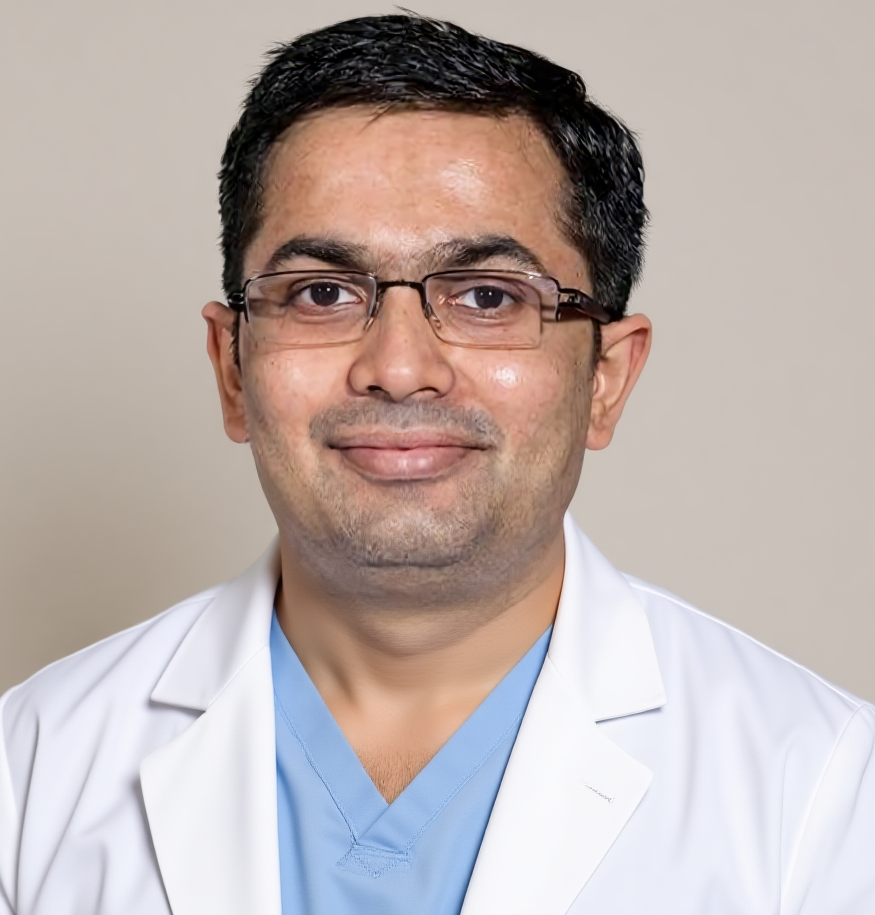
Dr Harsh Shah. Trained in super-specialty surgical gastroenterology programmes, qualified twice over in the specialty, with 18 years of experience in GI and cancer surgery. The practice performs esophagectomy by keyhole and open routes, with the same surgeon from the first consultation to the follow-up visits.
Dr Harsh Shah
MS, MCh (Surgical Gastroenterology), DrNB (Surgical Gastroenterology)
Registered with Gujarat Medical Council, Reg. No. G-38738
Food Pipe Cancer Surgeon · Dr. Jivraj Mehta Hospital, Vasna, Ahmedabad
Google rating 4.94 from 18 reviews at Dr. Jivraj Mehta Hospital, Vasna, Ahmedabad.
Families usually reach this point with one question: the oncologist and the scans say an operation, so what exactly happens on the operating table, and what is still open? What follows answers that for a tumour in the middle third — the disease itself, and whether treatment comes before surgery, are covered on other pages linked at the end.
The middle third of the food pipe lies in the chest, behind the windpipe and the heart. To remove enough healthy food pipe above a tumour here, the cut has to be made high, so the new join is placed in the neck rather than inside the chest. That is the three-stage, or McKeown, esophagectomy.
For a tumour low in the food pipe or at the junction with the stomach, the join can usually be made inside the chest, in a two-stage operation. For the middle third, the concern is the upper margin. Cancer cells can track along the wall of the food pipe beyond what the eye or the scope can see, so the line of removal must sit well above the tumour. A join in the neck allows that, and it gives the surgeon room to remove the food pipe almost completely.
Most mid-third cancers that need an operation receive treatment first. For a squamous cancer the operation usually follows chemoradiation by six to eight weeks; for an adenocarcinoma, chemotherapy is given before and after the operation, which comes four to six weeks after the last cycle before it.
The gap lets the body recover from treatment and lets the tumour respond. Before a date is fixed, the scans are repeated to confirm the cancer can still be removed completely, and the heart and lungs are checked again. The tumour board’s written plan names the treatment before surgery, the expected date of surgery and the reason for both. Which treatment comes first is decided by the tumour type and stage; the page on who is a candidate for esophagectomy, and after which treatment explains that order.
Chemoradiation changes the tissues around the food pipe, which is why the surgeon who will operate should see you before treatment begins, not only after it ends.
Six findings can change an operative plan for a mid-third cancer before the patient reaches the theatre. Each is checked during the workup and again after treatment before surgery, and each is discussed at the tumour board.
★★★★★
“Met with Dr. Harsh Shah for the consultation of one of my relative. Dr. Harsh Shah is an exceptional surgical oncologist in Ahmedabad. His expertise in treating complex GI cancers like liver, pancreas, and colon cancers is truly remarkable. He explains everything clearly and gives patients full confidence in their treatment. Highly recommended for anyone looking for a skilled and compassionate cancer specialist.”
— Nagesh Patidar, Google review
★★★★★
“We are very thankful to Dr. Harsh Shah for treating and operating on my father for gastric (stomach) cancer. From the first consultation to the surgery and follow-up, he guided us with great care and explained everything clearly. My father is doing well now, and we are extremely grateful for the treatment and support provided by Dr. Harsh Shah and his team. He is a highly experienced and compassionate doctor. We would definitely recommend Dr. Harsh Shah to anyone looking for an experienced doctor for stomach cancer treatment. Thank you, Doctor, for everything!”
— Moh. Ahsan, Google review
★★★★★
— Jyotsnaben Kotwal, Google review
Reviews are reproduced exactly as written on Google. None of them describes an operation on the food pipe — no Google review yet names it — so these three describe Dr Harsh Shah’s cancer care more generally.
Preparation starts in the OPD, not on the day of admission. Stopping smoking and alcohol, daily walking, breathing exercises and good nutrition protect the lungs and the join, and they are part of the operative plan rather than general advice.
Recovery follows a written daily plan. Patients sit out of bed on the evening of surgery, walk from the first day, are fed through the small-bowel tube while the neck join heals, and begin sips by mouth only once the join is checked.
| Day | What happens |
|---|---|
| Day of surgery | Breathing tube out in the theatre or soon after; head of the bed raised; sitting out of bed in the evening; chest physiotherapy and the spirometer begin; pain relief with as little morphine-type medicine as possible |
| Day one | Walking two or three times; a slow trickle of feed through the small-bowel tube; oxygen reduced; the urine catheter planned for removal |
| Days two and three | Feeds increased to the target; walking four times a day; drip fluids reduced; the nose tube removed when its output is low |
| Days four and five | A first trial of water by mouth, with a contrast swallow study if there is any concern about the neck join; then sips and liquids |
| Days six to eight | Soft food introduced step by step; the chest drain removed when it meets its criteria; the discharge check |
You go home when you have had no fever for a day, are taking liquids or soft food or are settled on tube feeds, are walking on your own, have pain controlled with tablets, and have an acceptable chest X-ray. A family member is trained to care for the feeding tube before you leave.
A heart rate that stays fast, a new irregular heartbeat, a rising need for oxygen, a change in what the chest drain brings out, air under the skin, or redness of the neck wound is treated as a possible leak at the join until proven otherwise, and investigated that day.
These signs are not watched overnight. The response is to stop food by mouth, start fluids, and arrange a CT scan with contrast swallowed and, if needed, an endoscopy, with the operating surgeon informed straight away. A collection at a neck join can often be drained by opening the neck wound at the bedside. Milky fluid in the chest drain once feeds start suggests a lymph leak and is managed with a special diet or by resting the gut.
An esophagectomy is a major operation with real risks. Dr Harsh Shah names each one at the consent discussion, with figures adjusted to your age, your heart and lung function and the treatment you have already had. Risks rise after chemoradiation and with poor lung function.
During and soon after the operation: a leak at the neck join; chest infection and other lung problems; an irregular heartbeat; a hoarse voice from strain on the nerve to the voice box, which usually recovers; a milky lymph leak into the chest; poor blood supply to the stomach tube, which may need another operation; bleeding needing transfusion, wound infection, and clots in the legs or lungs; a change from keyhole to open surgery; and the risk of dying. Over the longer term: narrowing at the join that may need stretching through the endoscope, sometimes more than once; acid or bile coming back up; feeling faint or unwell after a large or sweet meal; and small, frequent meals for life, with the head of the bed raised at night.
The first visit, about two weeks after the operation, goes through the pathology report. It decides whether anything more is needed: follow-up alone if no cancer is left, immunotherapy for about a year if some remains after chemoradiation, or the remaining chemotherapy cycles for an adenocarcinoma.
The report records the margins, the number of nodes removed and whether any held cancer, and how much of the tumour responded to treatment before surgery. Where immunotherapy is advised, it is offered to every eligible patient, the cost is discussed openly, and access programmes are explored. After that, follow-up visits continue every three months for the first two years, then every six months to five years, checking swallowing, weight and strength, with CT scans of the chest and abdomen every six months for two years and then yearly to five years. An endoscopy is done whenever swallowing becomes difficult again.
A second opinion is worth taking if you were offered a join inside the chest for a mid-third tumour without being told why the margin allows it, if no bronchoscopy was done, if the plan was not made by a tumour board, or if no one has told you who will operate.
It is also worth taking if your heart and lungs were never tested before the operation was offered, if a stent is planned before surgery, if you have not been told whether the route will be keyhole or open and what would change it, or if a squamous cancer is being sent straight to an operation without treatment before it. A second opinion that agrees with your plan is not wasted: it lets you go into the operation without a question left open.
The cost of an esophagectomy depends on the route, the length of stay, any time in intensive care and the treatment given before and after it. A written estimate is given before admission and explained line by line.
Dr. Jivraj Mehta Hospital, Vasna, Ahmedabad, works with the major insurers and cashless schemes, and the office handles pre-authorisation directly; if a stay runs longer, an enhancement request is raised at the time. Immunotherapy after surgery carries its own cost, and access programmes are discussed openly. Bring on admission: imaging on a disc or drive, treatment summaries, medicines with doses, the insurance card and identification, and one family member who will learn to care for the feeding tube.
Because the new join is made in the neck. For a mid-third tumour, the food pipe has to be removed well above the cancer, and a neck join allows that. A leak at a neck join is also easier to manage than one inside the chest.
A bulky tumour, or tissues scarred by chemoradiation, may need an open operation, and the route can change during the operation if that is safer.
Not routinely. Nodes in the chest and upper abdomen are cleared in every case. A third field in the neck is added when scans show nodes in the neck or upper chest in a squamous cancer.
Your stomach, shaped into a narrow tube and drawn up to the neck. If the stomach cannot be used, a segment of colon is the reserve choice.
You are fed through a small tube into the bowel from the first day. Sips of water usually start around the fourth or fifth day, once the neck join is checked, and soft food follows over the next few days.
Yes, if anything in the plan is unclear: where the join will be, the route, whether the airway was checked, or who will operate. A second opinion that agrees with the plan still helps you go ahead with confidence.
Dr. Jivraj Mehta Hospital, Vasna, Ahmedabad
Dr. Jivraj Mehta Hospital, Dr Jivraj Mehta Marg, Vasna, Ahmedabad 380007.
Google: Dr Harsh Shah · 4.94 from 18 reviews
Directions to Dr. Jivraj Mehta Hospital, Vasna · WhatsApp +91-63555-64601
Families come to Ahmedabad for oesophageal cancer surgery from across Gujarat — Gandhinagar, Mehsana, Banaskantha, Nadiad, Anand, Bhavnagar, Rajkot, Jamnagar and Kutch — and from southern Rajasthan and western Madhya Pradesh.
Told you need an operation for a cancer in the middle of the food pipe? The endoscopy report with its measurements from the teeth, the biopsy report, CT and PET-CT images, the bronchoscopy report and any chemotherapy or radiation summary can be sent ahead of your appointment, so the consultation starts with them already read. Treatment is decided at the consultation, after examination. Call +91-63555-64601 · Bring the reports to the visit
Tapping Book on WhatsApp will likely open the WhatsApp app on your phone.
Swasth Parivar: every week, practical advice on recovery, diet and warning signs. No advertising. Stop any time.
Your number is used for these updates and for the clinic to reach you. It is never sold or passed on. To stop, reply STOP on WhatsApp.