
Shah's Gastro, Cancer & Robotic Surgery Centre · Ahmedabad & Gandhinagar
Linitis plastica surgeon in Ahmedabad · Gota OPD, Gota, Ahmedabad · Apollo Hospital, Bhat, Gandhinagar
Last updated: 17-Oct-2026
Linitis plastica is a stomach cancer that spreads inside the wall. The surgeon’s first job is to prove it, then check the abdominal lining before any operation.
Most stomach cancers grow as a lump or an ulcer that the scope can see and the biopsy can reach. Linitis plastica behaves differently. It creeps through the layers of the stomach wall and makes the whole stomach stiff and narrow. The surface can look almost normal. That is why families often arrive with a puzzle. The scan shows a thick stomach, eating has become hard, and yet a report says no cancer was found. This page does not explain stomach cancer in general. It explains how Dr Harsh Shah reaches a firm answer in this form of it, why a look inside the abdomen comes before any plan to remove the stomach, when surgery is the wrong answer, and what to ask before you sign. For stomach cancer as a whole, see the stomach cancer treatment page.
The cancer cells sit deep in the wall, under a lining that may look healthy. A small number of shallow biopsies can miss them completely.
A clear biopsy is good news in most stomach problems. In a stomach that is thick, stiff and slow to stretch, it is not yet an answer. The standard is at least six biopsies, taken from the abnormal area and the edge of any ulcer. When the scope and the scan still point one way and the report points the other, the biopsies are repeated. An endoscopic ultrasound is added when its result would change the plan. It shows how deep the thickening goes and which layers it involves. A CT of the chest, abdomen and pelvis, taken in two phases after contrast, looks for spread and for fluid in the abdomen. A PET scan is not a routine test for stomach cancer. A doubtful answer is not left to wait. Each repeat is planned within days, because time spent unsure is time taken from treatment.
| What raises the question | What helps settle it |
|---|---|
| A stomach that looks thick on CT. | Endoscopy with at least six biopsies from the abnormal area. |
| A stomach that does not stretch with air during endoscopy. | Repeat biopsies when the first set is clear but the picture is not. |
| Feeling full after a few bites, weight loss, or vomiting. | Endoscopic ultrasound, when its result would change the plan. |
| Low blood count from slow blood loss. | CT of the chest, abdomen and pelvis in two phases. |
| Fluid in the abdomen on a scan. | Staging laparoscopy with washings, once cancer is confirmed and an operation is being considered. |
Every case is discussed at a tumour board before treatment. Dr Harsh Shah examines you, explains the plan and performs the operation himself.
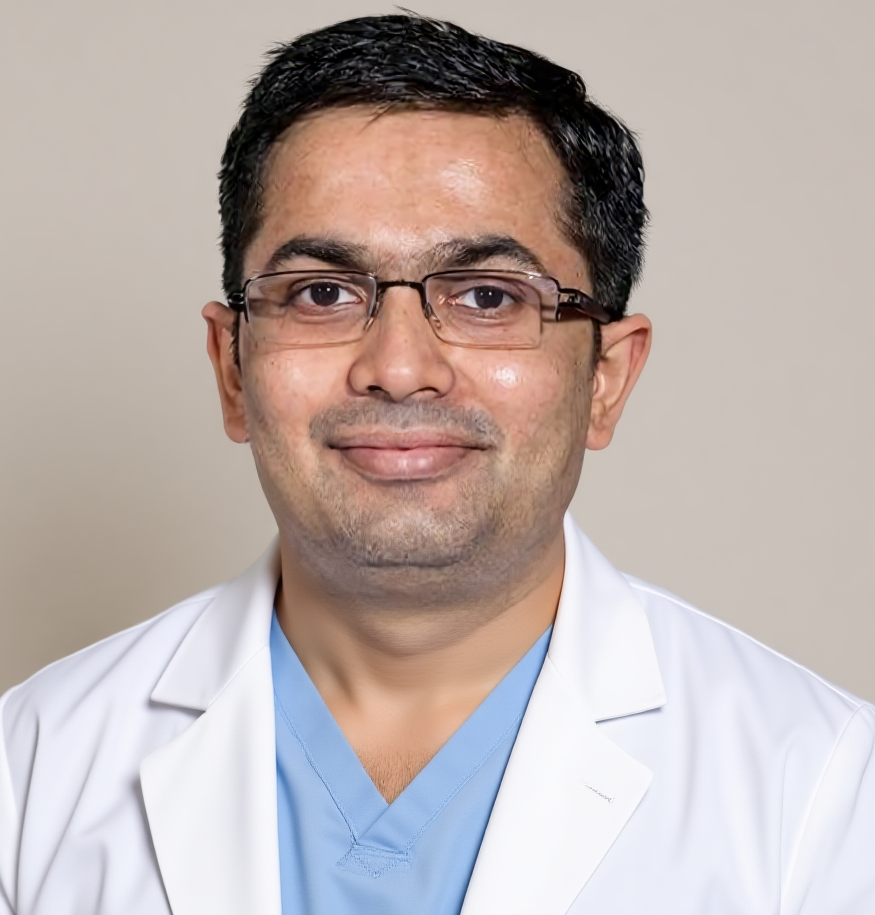
Shah’s Gastro, Cancer & Robotic Surgery Centre. He trained in super-specialty surgical gastroenterology and holds two higher degrees in that field. He has 18 years of experience in GI and cancer surgery, including the stomach and the food pipe. You see the same surgeon from the first visit to the last follow-up.
Dr Harsh Shah
MS, MCh (Surgical Gastroenterology), DrNB (Surgical Gastroenterology)
Registered with Gujarat Medical Council, Reg. No. G-38738
Gastro & Cancer Surgeon · Apollo Hospital, Bhat, Gandhinagar · Gota OPD, Ahmedabad
Google rating 4.89 from 216 reviews at the Gota clinic, and 4.94 from 18 reviews at Apollo, Bhat.
No plan for an operation is made by one doctor alone here. The board sees every stomach cancer that has not spread, every case with positive washings, and every case where an operation after chemotherapy is being weighed. A surgeon, a cancer physician, a radiologist and a pathologist look at the same scans and slides. Dr Shah then sits with you and the family and explains the choice in plain words. On the question of the route, the honest answer is simple. Keyhole and robotic surgery suit tumours in the lower stomach. Linitis plastica usually needs the whole stomach removed, and for that the open route is often chosen, on the surgeon’s judgement for your case. Ask who will be at the operating table or the console on the day, and whether that holds if the date moves.
A staging laparoscopy with washings checks the abdominal lining for spread that no scan can show. It is done before the stomach is removed, not during.
This step matters more in linitis plastica than in most stomach cancers. The way the disease spreads inside the wall means it can reach the lining early, long before a scan shows anything. A clean look inside lets the larger plan go ahead with confidence. A positive one spares you an operation that would not help. Dr Shah’s page on deciding whether a gastric cancer operation will help explains the general method. This page applies it to the diffuse form.
Clear lining and clear washings keep surgery on the table. Cancer cells in the washings are treated as spread, even when nothing can be seen.
| What is found | What usually follows |
|---|---|
| No spots, and the washings are clear. | Chemotherapy first, then a total gastrectomy, if you are fit. |
| No spots, but cancer cells in the washings. | Treated as cancer that has spread. Medicine leads, not an operation. |
| Spots on the lining, confirmed on biopsy. | Treated as spread. Medicine leads, with care for symptoms. |
| Spread to the liver or elsewhere on the scans. | Medicine leads. Removing the stomach is not the treatment that helps. |
| A borderline or unclear finding. | The board reviews it before any plan is fixed. |
For a fit patient with no spread, chemotherapy usually comes first. The operation follows a few weeks after the last cycle, and more chemotherapy follows recovery.
The usual plan is four cycles of a four-drug combination called FLOT, given every two weeks. The operation is planned four to six weeks after the last cycle. Four more cycles follow once you have recovered. If you are not fit enough for four drugs, a two-drug plan is used instead. Your fitness is scored at every visit, because it decides how strong a treatment you can safely take. Eating is often the hardest part of this disease, since a stiff stomach holds very little. A dietitian sees anyone with marked weight loss, a very low body weight, a low blood protein, or a poor intake for more than a week. If food cannot pass, a feeding tube into the small bowel is the preferred bridge when an operation is planned. A stent is the other choice. Good nutrition is planned so that chemotherapy is not stopped halfway.
Linitis plastica spreads along the wall well beyond what the eye can see. So the whole stomach is removed, with wider margins and a check on the cut ends.
In a cancer of the lower stomach, part of the stomach can often be kept. In the diffuse form, that is rarely safe. The cancer runs along the wall under a normal-looking surface, so a cut that looks clear can still pass through cancer. The standard for this form is a total gastrectomy. The margins are taken wider than for an ordinary lump-forming cancer. If there is any doubt at the cut ends, a frozen section is done. The pathologist checks the edge under the microscope while you are still asleep. The lymph nodes around the stomach are removed in a D2 dissection. The spleen and the tail of the pancreas are not removed routinely. They come out only when the cancer itself demands it. How the food pipe is joined to the small bowel after the stomach is gone is set out on the total gastrectomy page. How a proximal margin is judged is on the gastric body cancer margin page.
Most decisions are made before the operation. A few are made with you asleep, and each one has a rule agreed in advance.
| Finding | What is done |
|---|---|
| The frozen section shows cancer at a cut end. | More is removed at that end, where it is safe to do so. |
| The cancer is stuck to a nearby organ. | That part is removed with the stomach only when the cancer itself demands it. |
| The final report shows cancer at the edge. | Chemoradiation is discussed. It is not routine after a clean D2 operation. |
| The lymph node removal was less than a D2. | Chemoradiation is discussed at the board. |
If the washings or the lining show spread, or you are too unwell for major surgery, removing the stomach does not help. Other treatment does.
This is the hardest conversation in linitis plastica, and the most important one. A total gastrectomy is a large operation with a long recovery. When the cancer has already reached the lining, the operation does not change the course of the disease. The weeks spent recovering are weeks away from treatment that can help. So for spread, chemotherapy leads. Before it starts, the biopsy is tested for markers called HER2, PD-L1, MSI and, where available, Claudin-18.2. Those results guide which drugs are added. An early referral to the palliative care team and a dietitian is part of the plan, not a sign of giving up. If fitness is low, a gentler plan is used. If you are very unwell, a supportive care plan is discussed openly. A blocked stomach outlet, bleeding or a tear in the stomach is seen by the consultant surgeon the same day.
| Situation | What is usually advised instead |
|---|---|
| Cancer cells in the washings. | Chemotherapy chosen by the marker results, with care for symptoms. |
| Spots on the lining, or spread to the liver. | The same marker-guided treatment, with early palliative care. |
| Fit for treatment, but not for four drugs. | A two-drug plan. |
| Too unwell for chemotherapy or surgery. | An open discussion of supportive care. |
| Food cannot pass, during treatment. | A feeding tube into the small bowel, or a stent. |
A total gastrectomy carries real risks, including a leak from the join and a risk to life. Your own figures are given at consent, in person.
General risks include bleeding that needs a transfusion, wound infection, clots in the legs or lungs, a heart problem, and a problem with the anaesthetic. A keyhole start may need to become open. Risks of this operation are a leak from the join, a leak from the closed end of the duodenum, which can threaten life, slow emptying, weakness and dizziness after meals called dumping, bile coming back up, and an internal hernia years later. In the long run, vitamin B12 and iron run low without supplements, and meals must be small and frequent for life. The risk of dying is real, and it is discussed openly. Risks rise with age, other illness, high body weight, earlier surgery and chemotherapy before the operation. Dr Shah talks through four things himself. They are the leak, the duodenal stump, the risk to life, and the fact that small meals become a permanent pattern.
Recovery follows a planned path. You sit out of bed on the first evening and move through liquids to soft food over several days.
| When | What happens |
|---|---|
| Day of the operation. | Sitting out of bed for two hours, small sips of water, and pain relief with as little morphine as possible. |
| Day 1. | A liquid diet, walking three times, and the urine tube removed. Feeding through the bowel tube starts slowly, if one was placed. |
| Days 2 and 3. | Soft food builds up. The drip is reduced. Pain relief moves to tablets. |
| Days 4 to 6. | A full soft diet. The drain comes out, if there was one. Discharge is checked. |
| Going home. | No fever for a day, soft food kept down, walking alone, and pain controlled on tablets. The family is taught tube care, if needed. |
Some signs stop this path at once. A fast pulse that stays high, new or worse belly pain, fever, or a change in the drain fluid is treated as a leak until proven otherwise. The consultant surgeon is told straight away, and a scan is done. These signs are never watched overnight.
Follow-up is close for two years and continues to five. Vitamin B12 injections are lifelong after the whole stomach is removed.
| When | What is done |
|---|---|
| Two weeks after surgery. | Wound check, the final report explained, chemotherapy referral and a dietitian visit. |
| Every 3 months for 2 years. | Symptoms, weight, fitness score, blood count and tumour markers. |
| Every 6 months up to 5 years. | The same checks, with scans on schedule. |
| Scans. | CT every 6 months for 2 years, then once a year. |
| For life. | Vitamin B12 injections every 3 months, iron as the blood count needs, and a bone density check considered each year. |
A second opinion helps most before the stomach is removed. Take one if a key step is missing, or if the plan seems out of step with the disease.
| What you notice | Why it matters |
|---|---|
| The stomach looks thick and stiff, the biopsy is clear, and you are told to wait. | Repeat biopsies or an endoscopic ultrasound may settle it. |
| An operation is booked with no staging laparoscopy or washings. | Spread to the lining is common in this form, and scans miss it. |
| A part-stomach operation is advised for linitis plastica. | The diffuse form usually needs the whole stomach removed. |
| No plan to check the cut ends during surgery. | Cancer at the edge is found too late on the final report. |
| Surgery is still planned after cancer cells were found in the washings. | Positive washings are treated as spread. |
| The case has not been seen by a tumour board. | Every plan to remove the cancer should be. |
| Chemotherapy for spread starts before the marker results are back. | The markers decide which drugs help. |
| You are told nothing can be done, with no fitness or marker review. | Treatment that helps may still be possible. |
A second opinion that agrees with your plan is not wasted. You go into treatment with no question left open. Bring every endoscopy and biopsy report, the slides or blocks if you can get them, the CT on a disc, the laparoscopy report if one was done, recent blood tests and a list of your medicines.
★★★★★
“My father has carcinoma of stomach ,Harsh sir did radical gastrectomy and he is recovering very nicely under Dr.Harsh's observation ,he listen each and every complain calmly and with patience and make patient very comfortable during treatment , during procedure and during stay at hospital. we are satisfied with the treatment and very confident about the fully recovery of disease as we are under treatment of Dr.Harsh & team.Thank you Dr.Harsh & his whole team and staff.”
— tina parmar, Google review
★★★★★
“Met with Dr. Harsh Shah for the consultation of one of my relative. Dr. Harsh Shah is an exceptional surgical oncologist in Ahmedabad. His expertise in treating complex GI cancers like liver, pancreas, and colon cancers is truly remarkable. He explains everything clearly and gives patients full confidence in their treatment. Highly recommended for anyone looking for a skilled and compassionate cancer specialist.”
— Nagesh Patidar, Google review
★★★★★
“Dr harsh sir is a good doctor for Liver, Gastro & Cancer Surgeon in Ahmedabad thanks sir.”
— Milan Pareek, Google review
Reviews are reproduced exactly as written on Google. The first describes a radical gastrectomy for stomach cancer by Dr Harsh Shah. The other two speak about his cancer care in general. None states the type of stomach cancer, so none is presented as a linitis plastica case.
A patient speaks about recovery after stomach cancer surgery by Dr Harsh Shah. Recorded and shared with consent. It is not presented as a linitis plastica case. Every patient’s plan and recovery are different.
The cost depends on the tests, the chemotherapy, the operation and the days in hospital. A written estimate is given before admission.
Apollo Hospital, Bhat, works with the major insurers and cashless facilities. The insurance desk handles pre-authorisation. The staging laparoscopy is a separate short admission, and its cost is shared in advance. Some newer marker-guided drugs are hard to obtain in India, so this is raised early. On admission, bring all scans on a disc or drive, all reports, your medicines with doses, the insurance card and an identity proof. If you have questions about your report before booking, call +91-63555-64601.
It is a form of stomach cancer that spreads inside the stomach wall instead of forming a lump. The stomach becomes thick, stiff and unable to stretch.
Yes, in this form it can. The cancer sits deep in the wall. If the scope and the scan still suggest it, the biopsies are repeated, and an endoscopic ultrasound may be added.
It checks the lining of the abdomen and takes washings. Spread there is common in this form, and scans often miss it. It decides whether an operation can help.
Usually not. The cancer runs along the wall beyond what can be seen, so the whole stomach is removed with wider margins.
Keyhole and robotic surgery suit lower stomach tumours. Removing the whole stomach for linitis plastica is often done open, chosen on the surgeon's judgement for your case.
That is treated as spread, even if nothing is visible. Chemotherapy guided by marker tests leads, and removing the stomach is not advised.
Shah’s Gastro, Cancer & Robotic Surgery Centre — Gota, Ahmedabad
Consultations, review of reports and scans, follow-up and surveillance.
Google: Dr Harsh Shah · 4.89 · 216 reviews
Directions to the Gota clinic · +91-63555-64601
Apollo Hospital — Bhat, Gandhinagar
Apollo Hospital International Limited, Plot No. 1 A, GIDC Bhat Industrial Estate, Bhat, Gandhinagar.
Operations, endoscopic procedures and hospital stay.
Google: Dr Harsh Shah – Robotic GI Surgeon · 4.94 · 18 reviews
Directions to Apollo, Bhat · WhatsApp +91-63555-64601
Families come to Ahmedabad from across Gujarat, including Gandhinagar, Mehsana, Banaskantha, Nadiad, Anand, Bhavnagar, Rajkot, Jamnagar and Kutch, and from southern Rajasthan and western Madhya Pradesh.
Told your stomach wall is thick, with no clear answer yet? The endoscopy and biopsy reports, the CT scan on a disc and recent blood tests can be sent ahead of your appointment, so the consultation starts with them already read. The plan is decided at the consultation, after examination. Call +91-63555-64601 · Send the reports ahead on WhatsApp
Swasth Parivar: twice a month, practical advice on recovery, diet and warning signs. No advertising. Stop any time.
Your number is used for these updates and for the clinic to reach you. It is never sold or passed on. To stop, reply STOP on WhatsApp.