

Dr. Jivraj Mehta Hospital · Vasna, Ahmedabad
Small bowel cancer surgeon in Ahmedabad · Dr. Jivraj Mehta Hospital, Vasna, Ahmedabad
Last updated: 24-Oct-2026
The small bowel is long and hidden, so its tumours are usually found after months of vague symptoms. The type of tumour decides the treatment, so it must be named before anything is cut.
Often the first sign is a blocked bowel, a low blood count that no scope explains, or a slow loss of weight. By then a family may have visited several clinics. If you are reading this with a scan report in hand, the sections below show what a careful team does, one step at a time. How the operation is done is described separately under small bowel resection for a tumour.
Dr Harsh Shah is a surgical gastroenterologist with two higher degrees in that field. He has 18 years of experience in GI and cancer surgery.
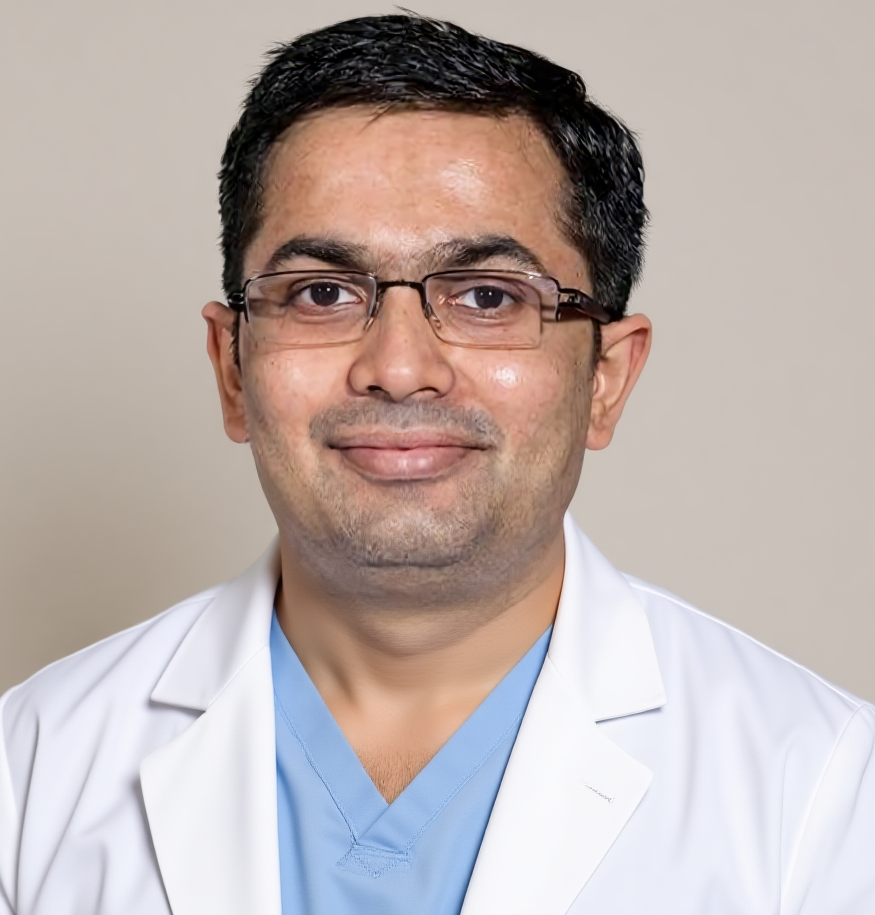
Dr Harsh Shah. He trained at Maulana Azad Medical College and GB Pant Hospital in Delhi. His work is cancer and major surgery of the food pipe, stomach, liver, pancreas, gallbladder and bowel. He operates by the open and 3D HD laparoscopic routes. You see the same surgeon from the first visit to the last follow-up.
Dr Harsh Shah
MS, MCh (Surgical Gastroenterology), DrNB (Surgical Gastroenterology)
Registered with Gujarat Medical Council, Reg. No. G-38738
Gastro, Cancer & Laparoscopic Surgeon · Dr. Jivraj Mehta Hospital, Vasna, Ahmedabad
Google rating 4.94 from 18 reviews at Dr. Jivraj Mehta Hospital, Vasna, Ahmedabad.
Surgery of the small bowel sits between his bowel, pancreas and tumour work, so the whole abdomen is familiar ground. He sees patients at Dr. Jivraj Mehta Hospital, Vasna in Ahmedabad and operates at Dr. Jivraj Mehta Hospital, Vasna, Ahmedabad. What you can check, before you decide, is the method. The rest of this page sets it out.
Four main kinds of tumour arise in the small bowel. Each one is treated differently, so the biopsy report is the first fact to settle.
| Type | What it is | Usual first step |
|---|---|---|
| Adenocarcinoma. | A cancer of the bowel lining, often in the duodenum or jejunum. | Removal of the bowel segment with its lymph nodes, then chemotherapy if the report calls for it. |
| Neuroendocrine tumour. | A slow-growing tumour, often in the ileum, that can spread to nodes and liver. | Removal of the segment and the nodes in its mesentery. |
| Gastrointestinal stromal tumour (GIST). | A tumour of the bowel wall muscle that seldom spreads to nodes. | Removal with clear margins, and a tablet treatment for some. |
| Lymphoma. | A cancer of the immune cells in the bowel wall. | Drug treatment, with surgery kept for blockage or a hole. |
A growth in the first part, next to the pancreas, is handled as a duodenal or ampullary tumour. The pages on GIST surgery, gut lymphoma and neuroendocrine tumours explain each type in full.
Small bowel tumours give few early signs. Anaemia with no clear cause, colicky belly pain or repeated vomiting should prompt a scan of the small bowel.
Long-standing Crohn’s disease, coeliac disease and certain inherited conditions raise the chance of a small bowel cancer. If you have one of them and new symptoms, say so at the first visit.
No single test shows the whole small bowel. A careful work-up combines a scan, a look from inside and a biopsy, and the order is chosen to avoid harm.
A blocked bowel is an emergency, and the aim is then to make it safe first. The full work-up follows once the patient is stable, and the final report decides whether more treatment is needed.
A plan for a small bowel tumour is not made by one doctor alone. The reports go to the tumour board, and the plan is written down before the operation.
A drug may come before the operation for lymphoma, and after it for some GISTs and adenocarcinomas. That is why the board sees the case first.
The usual operation removes the diseased bowel with a wide margin and the fan of fat and lymph nodes that serves it. The two bowel ends are then joined.
For an early, well-placed tumour, the operation may be done by keyhole methods. A large, blocked or stuck tumour is better removed through an open incision. The route is chosen for your tumour, not for the instrument.
The weeks before a bowel operation are used to make you stronger. Correcting anaemia and building up nutrition lowers the risk of a leak.
Small bowel surgery is a major operation with real risks, including a leak from the join. Your own risks are discussed at consent, in person.
A fast pulse, fever, new belly pain or a change in the drain fluid after surgery is treated as a leak until proven otherwise. The consultant surgeon is told at once, and a scan is done the same day.
Most patients sit out of bed on the day of surgery and move from sips to soft food as the bowel wakes up. Follow-up is planned for years.
| When | What happens |
|---|---|
| Day of the operation. | Sitting out of bed, small sips of water, and pain relief with little morphine. |
| The next few days. | Liquids, then soft food as the bowel starts working. Walking several times a day. |
| Going home. | No fever, food kept down, stools passing, walking alone and pain controlled on tablets. |
| Two weeks after. | The final report is explained. Further treatment is planned if needed. |
| First two years. | Visits with blood tests and scans on a schedule set by the tumour type. |
| Later years. | Checks space out, but a neuroendocrine tumour or a GIST is watched for longer. |
The same surgeon sees you at each visit, so new symptoms are looked at early. Vitamin B12 is checked yearly when the last part of the small bowel has been removed.
A second opinion is most useful before the operation. Take one if the type of tumour is not clear, or if the plan was made in an emergency.
| What you notice | Why it matters |
|---|---|
| An emergency operation removed a growth, and the report is unclear. | The type of tumour decides whether more treatment is needed. |
| The biopsy says “tumour” with no type. | A GIST, a neuroendocrine tumour, a lymphoma and a cancer need different care. |
| Surgery is advised for a suspected lymphoma with no drug plan. | Lymphoma is usually treated with drugs first. |
| No tumour board has seen your case. | Every plan to remove a cancer should be seen by one. |
| You are told nothing can be done. | Treatment that helps may still be possible. |
A second opinion that agrees with your plan is not wasted. You start treatment with no question left open. Bring every report, the scans on a disc, the biopsy slides if you can get them, and a list of your medicines.
★★★★★
“Met with Dr. Harsh Shah for the consultation of one of my relative. Dr. Harsh Shah is an exceptional surgical oncologist in Ahmedabad. His expertise in treating complex GI cancers like liver, pancreas, and colon cancers is truly remarkable. He explains everything clearly and gives patients full confidence in their treatment. Highly recommended for anyone looking for a skilled and compassionate cancer specialist.”
— Nagesh Patidar, Google review
★★★★★
“We are very thankful to Dr. Harsh Shah for successfully performing the Whipple’s procedure. From the beginning, he explained everything clearly and gave us great confidence throughout the treatment. Today, we are happy to share that we received the discharge and are going home with a positive feeling. Thank you, Dr. Harsh Shah, for your expertise, care, and support. Highly recommended for GI surgery.”
— Desai Sonal, Google review
★★★★★
“Dr. Harsh is very polite and humble and will listen to you and guide you.”
— Ratan Sharma, Google review
Reviews are reproduced exactly as written on Google. They speak about Dr Harsh Shah’s care in complex GI surgery, and do not name small bowel cancer.
The cost depends on the tests, the operation and the days in hospital. A written estimate is given before admission.
Dr. Jivraj Mehta Hospital, Vasna, Ahmedabad, works with the major insurers and offers cashless admission. The insurance desk handles pre-authorisation. On admission, bring all scans on a disc, all reports, your medicines with doses, the insurance card and an identity proof. For questions before booking, call +91-63555-64601.
Yes. He examines you, explains the plan and performs the operation himself at Dr. Jivraj Mehta Hospital, Vasna, Ahmedabad. He also sees you at every follow-up visit.
The small bowel is long and lies deep in the belly. Early tumours cause few signs, and the usual scopes cannot reach most of it. Anaemia, colicky pain or a blockage often lead to the scan that finds it.
Usually yes, because the type decides the treatment. A lymphoma is treated mainly with drugs. When the bowel is blocked and cannot wait, the removed tumour is examined after the operation.
Not usually. In most planned operations the two bowel ends are joined at once. A stoma is kept for emergency operations or when the join is not safe.
For a small, mobile tumour, yes. A large, blocked or stuck tumour is safer through an open incision. The route is chosen for your tumour.
Consultations are at Dr. Jivraj Mehta Hospital, Vasna in Ahmedabad. Operations are at Dr. Jivraj Mehta Hospital, Vasna, Ahmedabad.
Dr. Jivraj Mehta Hospital, Vasna, Ahmedabad
Dr. Jivraj Mehta Hospital, Dr Jivraj Mehta Marg, Vasna, Ahmedabad 380007.
Operations, endoscopic procedures and hospital stay.
Google: Dr Harsh Shah · 4.94 · 18 reviews
Directions to Dr. Jivraj Mehta Hospital, Vasna · WhatsApp +91-63555-64601
Families come to Ahmedabad from across Gujarat, including Gandhinagar, Mehsana, Banaskantha, Nadiad, Anand, Bhavnagar, Rajkot, Jamnagar and Kutch, and from southern Rajasthan and western Madhya Pradesh.
Reports in hand and not sure what they mean? Share the CT or MR enterography, any scope or capsule report, the biopsy, an operation note if you had one, and the latest blood count. Dr Shah goes through them ahead of the visit. Nothing is decided until he has examined you. Call +91-63555-64601 · Send the reports on WhatsApp
Swasth Parivar: every week, practical advice on recovery, diet and warning signs. No advertising. Stop any time.
Your number is used for these updates and for the clinic to reach you. It is never sold or passed on. To stop, reply STOP on WhatsApp.