

Dr. Jivraj Mehta Hospital · Vasna, Ahmedabad
Tapping Book on WhatsApp will likely open the WhatsApp app on your phone.
Pancreatic cancer surgeon in Ahmedabad · Dr. Jivraj Mehta Hospital, Vasna, Ahmedabad
Last updated: 24-Oct-2026
The first question after a pancreatic cancer scan is whether the tumour can be removed. The answer depends on how the tumour sits against the blood vessels, and a surgeon who does this operation should read the scan.
Many families hear “pancreatic cancer” and “nothing can be done” in the same visit. That is not always true. Some tumours can be removed straight away, some can be made removable with drug treatment first, and some are treated without an operation. This page shows how those groups are told apart, and how Dr Shah plans each one.
Dr Harsh Shah is a surgical gastroenterologist with two higher degrees in that field. He has 18 years of experience in GI and cancer surgery.
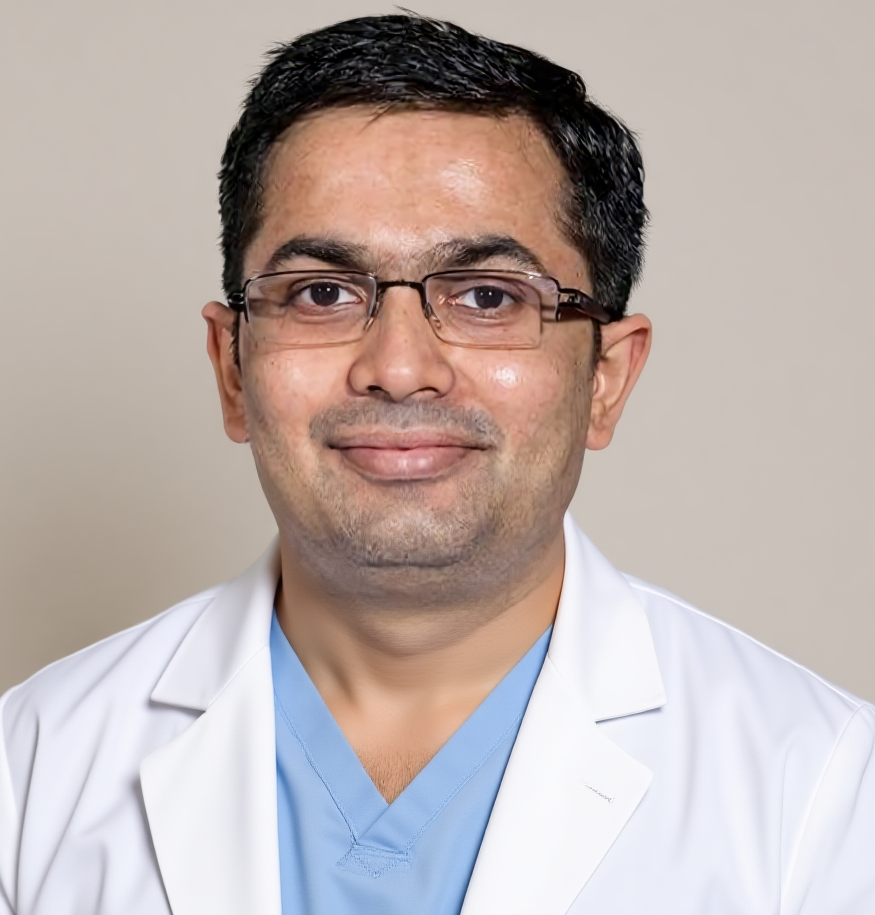
Dr Harsh Shah. He trained at Maulana Azad Medical College and GB Pant Hospital in Delhi. His work is cancer and major surgery of the food pipe, stomach, liver, pancreas, gallbladder and bowel. He operates by the open and 3D HD laparoscopic routes. You see the same surgeon from the first visit to the last follow-up.
Dr Harsh Shah
MS, MCh (Surgical Gastroenterology), DrNB (Surgical Gastroenterology)
Registered with Gujarat Medical Council, Reg. No. G-38738
Gastro, Cancer & Laparoscopic Surgeon · Dr. Jivraj Mehta Hospital, Vasna, Ahmedabad
Google rating 4.94 from 18 reviews at Dr. Jivraj Mehta Hospital, Vasna, Ahmedabad.
The pancreas, the bile duct and the liver sit close together, and operations on them are part of his daily surgical work. He sees patients at Dr. Jivraj Mehta Hospital, Vasna in Ahmedabad and operates at Dr. Jivraj Mehta Hospital, Vasna, Ahmedabad. You cannot judge a surgeon from a web page, so what follows is the method. Check it against any other advice you receive.
A tumour in the head of the pancreas often shows up as yellow eyes. A tumour in the body or tail usually shows up later, as back pain and weight loss.
None of these means cancer on its own. Together, and when new, they call for a pancreas-protocol scan rather than a routine ultrasound.
Surgeons sort a pancreatic cancer into four groups by its contact with the main blood vessels. The group decides whether the operation comes first, comes later, or is not the main treatment.
| Group | What the scan shows | Usual plan |
|---|---|---|
| Resectable. | The tumour does not touch the main vessels. | Operation first, then drug treatment. Some centres give drugs first. |
| Borderline resectable. | The tumour touches a vessel in a limited way. | Drug treatment first, then a fresh scan, then the operation if it has worked. |
| Locally advanced. | The tumour wraps around a major artery. | Drug treatment, sometimes radiation, and a careful search for a chance to operate. |
| Spread to other organs. | Deposits are seen in the liver or the belly lining. | Drug treatment and comfort care. Surgery is rarely the main step. |
The pages on borderline resectable and locally advanced pancreatic cancer explain those two groups in full.
A pancreas-protocol CT, taken in several phases, is the key test. It shows the tumour, the vessels and the liver, and it should be read by someone who operates on the pancreas.
A scan taken after a plastic stent has been placed, or one taken with a thick slice, can mislead. If your scan was done that way, a repeat is often worth the effort.
Yellow eyes do not always need a stent. A stent can delay surgery and raise the chance of infection, so it is placed only when there is a reason.
If the operation can be done within a week or two and the patient is well, it is often done without a stent. A stent is placed if the jaundice is very deep, if there is a fever, if kidney function is falling, or if drug treatment must come first. When it is needed, a metal stent is usually chosen over a plastic one.
A pancreatic cancer plan is made by a team, not by one doctor. The scan is read in the tumour board, and the order of treatment is written down.
The operation depends on where the tumour is. A tumour in the head needs a Whipple operation. A tumour in the body or tail needs a distal pancreatectomy.
| Operation | Used for | What is removed |
|---|---|---|
| Whipple operation. | Tumour in the head of the pancreas. | The head of the pancreas, the duodenum, the lower bile duct and often part of the stomach. The remaining organs are joined back. |
| Distal pancreatectomy. | Tumour in the body or tail. | The body and tail of the pancreas, usually with the spleen. |
| Total pancreatectomy. | Tumour spread through the whole gland. | The whole pancreas. Diabetes and enzyme tablets are lifelong afterwards. |
| Vein reconstruction. | Tumour stuck to the portal or mesenteric vein. | The affected stretch of vein, which is repaired or replaced. |
The Whipple operation and the distal pancreatectomy have their own pages. The goal is the same in each: remove the tumour whole, with clear margins and the lymph nodes around it.
The route follows the tumour. A small tumour in the tail often suits keyhole surgery. A large head tumour or one near a vein is safer through an open incision.
Dr Shah operates by both routes, so the choice is not limited by what one surgeon can do. A longer cut that gets the tumour out with clear margins is a better choice than a short cut that leaves disease behind.
The weeks before a pancreas operation are used to make you stronger. Nutrition and fitness lower the risk of a complication.
Pancreatic surgery is among the larger operations in the abdomen, and its risks are real. Your own risks are discussed at consent, in person.
A fever, a fast pulse, new belly pain or a change in drain fluid after surgery is treated as a leak until proven otherwise. The consultant is told at once and a scan is done the same day.
Most patients sit out of bed on the day after surgery and go home in about a week or two. Drug treatment, if planned, starts once the wound has healed.
| When | What happens |
|---|---|
| First days. | Sitting out of bed, walking, sips of water, and a drain by the wound. |
| Next few days. | Liquids, then soft food. Drain fluid is tested for a leak. |
| Going home. | No fever, food kept down, drain out, walking alone and pain controlled on tablets. |
| Two weeks after. | The final report is explained. Drug treatment is planned. |
| Following months. | Drug treatment if advised, with blood tests and scans on a schedule. |
| Later years. | Regular visits for scans, the marker, sugar and nutrition. |
Enzyme capsules, sugar control and a dietitian are part of follow-up, not an extra.
A second opinion is most useful before treatment starts. Take one if you were told the tumour cannot be removed, or if surgery was advised without a clear scan.
| What you notice | Why it matters |
|---|---|
| You are told it cannot be operated, but no surgeon has read the scan. | A surgeon who does this operation is the right person to judge vessel contact. |
| The scan is a routine CT, not a pancreas-protocol study. | The vessels may not be seen clearly. |
| Surgery is advised with no biopsy and no board review. | The type of lesion and the order of treatment may be wrong. |
| A stent was placed at once, though surgery was possible. | It may delay the operation. |
| You are offered an operation but no drug plan. | Drug treatment is part of the usual care. |
A second opinion that agrees with your plan is not wasted. Bring every scan on a disc, all reports, the biopsy slides if you can get them, and a list of your medicines.
★★★★★
“Met with Dr. Harsh Shah for the consultation of one of my relative. Dr. Harsh Shah is an exceptional surgical oncologist in Ahmedabad. His expertise in treating complex GI cancers like liver, pancreas, and colon cancers is truly remarkable. He explains everything clearly and gives patients full confidence in their treatment. Highly recommended for anyone looking for a skilled and compassionate cancer specialist.”
— Nagesh Patidar, Google review
★★★★★
“We are very thankful to Dr. Harsh Shah for successfully performing the Whipple’s procedure. From the beginning, he explained everything clearly and gave us great confidence throughout the treatment. Today, we are happy to share that we received the discharge and are going home with a positive feeling. Thank you, Dr. Harsh Shah, for your expertise, care, and support. Highly recommended for GI surgery.”
— Desai Sonal, Google review
★★★★★
“Dr. Harsh is very polite and humble and will listen to you and guide you.”
— Ratan Sharma, Google review
Reviews are reproduced exactly as written on Google. They speak about Dr Harsh Shah’s care in complex GI surgery, and do not name pancreatic cancer.
The cost depends on the tests, the operation and the days in hospital. A written estimate is given before admission.
Dr. Jivraj Mehta Hospital, Vasna, Ahmedabad, works with the major insurers and offers cashless admission. The insurance desk handles pre-authorisation. On admission, bring all scans on a disc, all reports, your medicines with doses, the insurance card and an identity proof. For questions before booking, call +91-63555-64601.
Yes. He examines you, explains the plan and performs the operation himself at Dr. Jivraj Mehta Hospital, Vasna, Ahmedabad. He also sees you at every follow-up visit.
Sometimes. It depends on how the tumour sits against the main blood vessels. Some tumours are removed first, some after drug treatment, and some are treated without an operation. A pancreas-protocol scan read by a pancreatic surgeon decides the group.
Not always. A clear, removable tumour may go straight to operation. A biopsy is needed before drug treatment, and when the diagnosis is uncertain.
Often not. If surgery can be done soon and you are well, it is done without a stent. A stent is placed for deep jaundice, fever, falling kidney function, or when drug treatment must come first.
For selected tumours, yes, especially in the body and tail. A large head tumour or one near a vein is safer through an open incision. The route is chosen for your tumour.
Consultation is at Dr. Jivraj Mehta Hospital, Vasna, Ahmedabad. Operations are at Dr. Jivraj Mehta Hospital, Vasna, Ahmedabad.
Dr. Jivraj Mehta Hospital, Vasna, Ahmedabad
Dr. Jivraj Mehta Hospital, Dr Jivraj Mehta Marg, Vasna, Ahmedabad 380007.
Operations, endoscopic procedures and hospital stay.
Google: Dr Harsh Shah · 4.94 · 18 reviews
Directions to Dr. Jivraj Mehta Hospital, Vasna · WhatsApp +91-63555-64601
Families come to Ahmedabad from across Gujarat, including Gandhinagar, Mehsana, Banaskantha, Nadiad, Anand, Bhavnagar, Rajkot, Jamnagar and Kutch, and from southern Rajasthan and western Madhya Pradesh.
Have a pancreas scan and a doubt about the advice? Send the CT or MRI, the endoscopic ultrasound or biopsy report, the CA 19-9 result and the latest blood tests. Dr Shah reads them before the visit. No plan is made until he has examined you. Call +91-63555-64601 · Bring the reports to the visit
Tapping Book on WhatsApp will likely open the WhatsApp app on your phone.
Swasth Parivar: every week, practical advice on recovery, diet and warning signs. No advertising. Stop any time.
Your number is used for these updates and for the clinic to reach you. It is never sold or passed on. To stop, reply STOP on WhatsApp.